

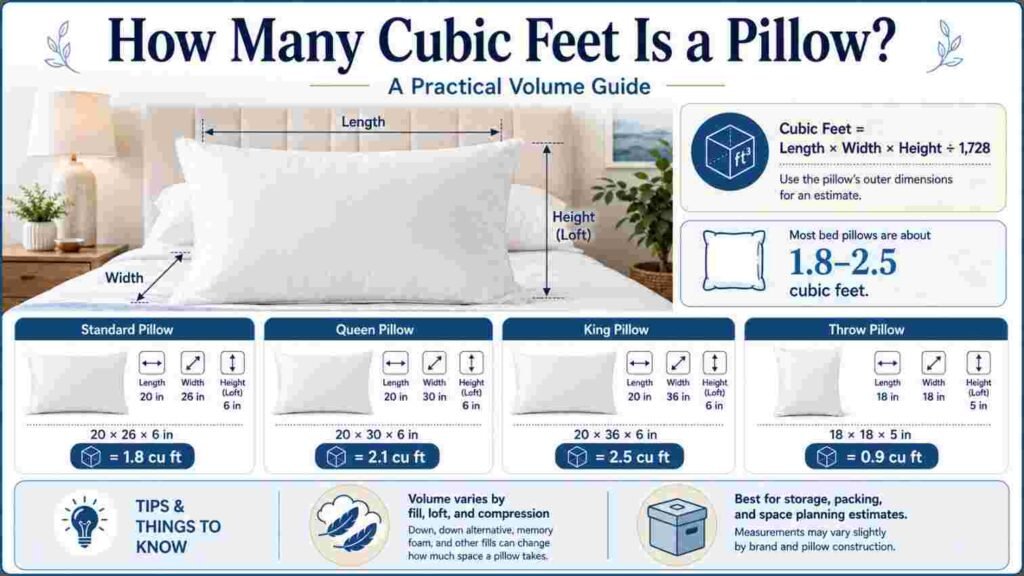
A pillow that looks compact on a bed can occupy more space than expected in a moving box. A typical standard bed pillow measuring about 20 by 26 inches and roughly 6 inches thick works out to about 1.8 cubic feet before compression. That makes the question How Many Cubic Feet Is a Pillow? useful for moving, storage, packing, and estimating container space.
The catch is that a pillow is not a rigid box. Its occupied volume changes with loft, filling, shape, and compression, so cubic-foot estimates are practical planning numbers rather than exact physical measurements.
The Short Answer: Most Bed Pillows Use About 1.8 to 2.5 Cubic Feet
Common U.S. pillow lengths are fairly standardized. Sleep Foundation lists standard pillows at 20 by 26 inches, queen pillows at 20 by 30 inches, king pillows at 20 by 36 inches, and body pillows around 20 by 54 inches. Thickness varies much more. Sleep Foundation pillow-size guide
Using a 6-inch loft as an estimating assumption:
| Pillow type | Example dimensions | Cubic inches | Approx. cubic feet |
| Small throw pillow | 16 × 16 × 5 in. | 1,280 | 0.74 ft³ |
| Standard bed pillow | 20 × 26 × 6 in. | 3,120 | 1.81 ft³ |
| Queen pillow | 20 × 30 × 6 in. | 3,600 | 2.08 ft³ |
| King pillow | 20 × 36 × 6 in. | 4,320 | 2.50 ft³ |
| Body pillow | 20 × 54 × 6 in. | 6,480 | 3.75 ft³ |
These numbers describe the pillow’s rectangular “bounding box.” A rounded down pillow, shredded-foam pillow, or soft polyester pillow will not fill every corner of that box.
Why the Math Is Simple but the Real Volume Is Not
Volume equals length × width × height. If the measurements are in inches, divide the result by 1,728 because one cubic foot contains 1,728 cubic inches.
The National Institute of Standards and Technology’s official conversion tables place one cubic foot at about 0.02831685 cubic meter, which is approximately 28.3 liters. Go through NIST volume conversion tables
For a standard pillow:
20 × 26 × 6 = 3,120 cubic inches
3,120 ÷ 1,728 = 1.81 cubic feet
The height measurement is the uncertain part. A pillow may be 7 inches high at its center and considerably thinner near its edges. Pressing a ruler into soft filling can also change the measurement while you are taking it.
Loft Changes the Answer Quickly

A 20-by-26-inch pillow at 4 inches thick is about 1.20 cubic feet. Increase the loft to 8 inches and the estimate rises to about 2.41 cubic feet.
That means two pillows designed for the same standard pillowcase can require very different amounts of closet, moving-box, or vehicle space.
A Better Way to Measure Your Own Pillow
If you need a useful number for moving, shipping, or closet planning, measure the actual pillow rather than relying exclusively on its labeled size.
- Lay the pillow flat and allow it to expand naturally.
- Measure length and width at the widest points without squeezing it.
- Measure loft at the center with a ruler held beside the pillow.
- Multiply length × width × loft, then divide the result by 1,728.
- If the pillow will be compressed, measure its packed height and calculate a second volume.
This two-number method is more useful than relying on one estimate. The full-loft figure reflects loose storage space, while the compressed figure is closer to what matters inside a moving carton, vacuum bag, storage tote, or packed vehicle.
Why Pillow Volume Also Tells You Something About Comfort

Pillow height affects more than cubic-foot calculations. It also changes how the head and neck are supported.
UCLA Ergonomics’s sleeping-posture guidance recommends maintaining proper alignment during sleep. Its guidance notes that side sleepers need support between the ear and bed, while back sleepers may benefit from appropriate neck support.
Research indexed by the U.S. National Library of Medicine provides additional context. One biomechanics study involving 10 healthy adults examined pillow heights ranging from 110 to 170 millimeters. Researchers found that changes in pillow height affected cranio-cervical pressure and cervical-spine alignment.
The study was small, so it should not be interpreted as proving that one particular height works for everyone. Instead, it reinforces a useful point: pillow loft is a functional characteristic, not simply a packing measurement.
Cleveland Clinic similarly recommends choosing a pillow that keeps the neck closer to a neutral position rather than bending it excessively forward or sideways.
A larger-volume pillow is therefore not automatically a better pillow. Appropriate loft depends on factors such as body size, sleeping position, mattress firmness, pillow construction, and how much the filling compresses under body weight.
Where Cubic Feet Matters Most
For moving, two standard pillows represent roughly 3.6 cubic feet before compression. Four king pillows approach 10 cubic feet using the 6-inch-loft estimate, enough to noticeably affect carton planning.
For storage, pillows can be surprisingly space inefficient because much of their apparent bulk comes from air held between fibers, foam pieces, feathers, or other filling materials. Compression can reduce occupied space significantly, although some specialty foam pillows may not be suitable for prolonged heavy compression.
Shipping creates another distinction. Pillow volume is not necessarily the same as billable package volume. Shipping companies typically work from the outside dimensions of the packed carton. A pillow calculated at roughly 2 cubic feet may therefore occupy a box with significantly greater external volume.
When planning a larger household move, mattresses can take up considerably more room than pillows. A king mattress volume guide can help you estimate the space needed for bulky bedding and compare it with smaller items such as pillows.
Comparing Pillow Space With Other Household Items
Pillows are relatively flexible, but comparing their volume with larger household items can make storage and moving estimates easier. For example, a queen mattress volume guide can help you understand how much space a larger, rigid household item may require compared with several pillows.
Mistakes That Lead to Bad Estimates
The biggest mistake is treating a soft pillow exactly like a rigid rectangular solid. Another is assuming that every standard-size pillow has the same thickness.
Fill material matters too. Memory foam, latex, feathers, down, microfiber, polyester fiber, and shredded foam all respond differently to pressure.
Decorative pillows create another potential source of confusion. A 20-inch square throw pillow might have smaller length and width measurements than a bed pillow but could be heavily overstuffed, increasing its actual space requirement.
That is why How Many Cubic Feet Is a Pillow? has no universal single answer. For a defensible estimate, state the length and width, show the assumed loft, and specify whether the measurement represents the pillow at full expansion or under compression.
Frequently Asked Questions
1. How many cubic feet is a standard pillow?
A 20-by-26-inch standard pillow with about 6 inches of loft is approximately 1.81 cubic feet before compression.
2. How many pillows fit in a 10-cubic-foot space?
By simple volume, about five standard 1.8-cubic-foot pillows fit. Actual packing capacity depends on compression, container shape, pillow loft, and unused space.
3. Does vacuum sealing change a pillow’s cubic feet?
Yes. Vacuum compression can substantially reduce occupied volume, particularly with soft fiber-filled pillows. The reduction depends on the filling and how much compression the pillow safely tolerates.
4. How Many Cubic Feet Is a Pillow if it is king size?
A 20-by-36-inch king pillow with an assumed 6-inch loft has a rectangular-box volume of approximately 2.5 cubic feet before compression.
Final Takeaway
A pillow is soft, but the most useful volume estimate starts with rigid-box math. Standard pillows are about 1.8 cubic feet at a 6-inch loft, queen pillows about 2.1 cubic feet, and kings about 2.5 cubic feet. From there, adjust for the variable that changes the answer most: compression.
Measure the pillow once at full loft and again in its packed condition if moving or storage space matters. That comparison produces a number you can actually plan around without pretending every pillow maintains a perfect rectangular shape. For practical calculations, dimensions plus compression tell the real story.

Ryan Mitchell
Ryan Mitchell holds a degree in Civil Engineering and spent over a decade working in construction project estimation, where accurate volume and material calculations were part of his daily work — from concrete pours to landscaping material orders. He founded this site to bring that same precision to everyday calculations, helping DIYers, contractors, and students get fast, accurate cubic footage results without the guesswork. Ryan reviews every calculator and formula on this site for accuracy and writes guides based on real-world measurement scenarios he's encountered on job sites.


