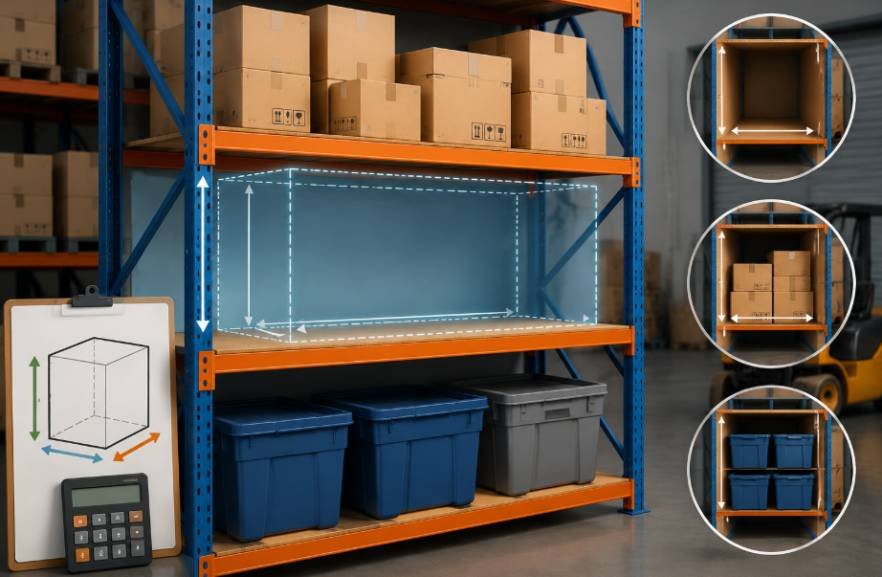
When I plan storage, I find that measuring only a shelf’s width creates a misleading picture of its capacity. A shelf may look spacious from the aisle but provide far less usable room once its depth, vertical clearance, beams, and uprights are considered.
So, How Many Cubic Feet Is a Warehouse Shelf? A typical industrial shelf level offers approximately 6 to 30 cubic feet, while a complete four-level unit may provide around 25 to 120 cubic feet. The exact answer depends on its internal dimensions and configuration.
What Is the Average Cubic Capacity of a Warehouse Shelf?
Warehouse shelving is not manufactured in one universal size. Compact shelves used for parts, tools, and small cartons may provide less than 10 cubic feet per level. Standard industrial shelves frequently hold between 10 and 20 cubic feet per level, while wider or deeper heavy-duty shelves can exceed 30 cubic feet.
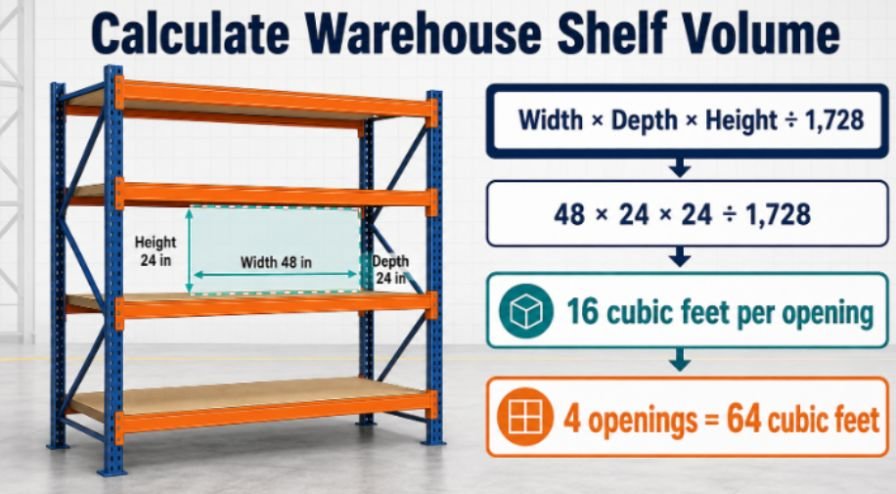
A common shelf opening measuring 48 inches wide, 24 inches deep, and 24 inches high provides 16 cubic feet. If a shelving unit has four identical openings, its gross storage capacity is approximately 64 cubic feet. Although the phrase gross storage capacity in JV dams usually relates to water-storage infrastructure, the underlying principle is similar: it describes the total volume available before practical limitations are considered.
These figures represent volume rather than guaranteed packing capacity. Uprights, beams, braces, decking, dividers, containers, and gaps between products can reduce the amount of space that inventory actually occupies.
How to Calculate Warehouse Shelf Volume
Cubic footage measures three-dimensional space. Therefore, the calculation requires width, depth, and usable height.
Formula for Measurements in Feet
When all three measurements are already in feet, use:
Width × Depth × Height = cubic feet
For example, a shelf opening that is 4 feet wide, 2 feet deep, and 2 feet high has a volume of:
4 × 2 × 2 = 16 cubic feet
Formula for Measurements in Inches
Warehouse shelves are commonly advertised in inches. Multiply the three measurements and divide the result by 1,728, because one cubic foot contains 1,728 cubic inches.
Width × Depth × Height ÷ 1,728 = cubic feet
A shelf measuring 72 inches wide, 24 inches deep, and 30 inches high provides:
72 × 24 × 30 = 51,840 cubic inches
51,840 ÷ 1,728 = 30 cubic feet
This calculation can be repeated for every storage level.
How to Measure a Shelf Correctly
Accurate results depend on measuring the usable opening rather than relying entirely on the shelving unit’s advertised exterior size.
Measure the clear width between the uprights, not the unit’s total outside width. Next, measure the usable depth from the front loading edge to the rear obstruction. Finally, measure the vertical distance from the shelf surface to the underside of the shelf or beam above it.
Exterior measurements are helpful when determining how much floor space the unit occupies. Interior measurements are more useful when deciding how much inventory can fit on it.
Shelf thickness also matters. A five-level unit that is 10 feet tall does not necessarily provide five openings that are each 2 feet high. Unlike five level inverter topologies, which describe multilevel electrical converter designs, warehouse shelving depends on physical clearances. Beams, decking, base plates, and top clearances consume part of the unit’s height.
Typical Warehouse Shelf Capacity by Size
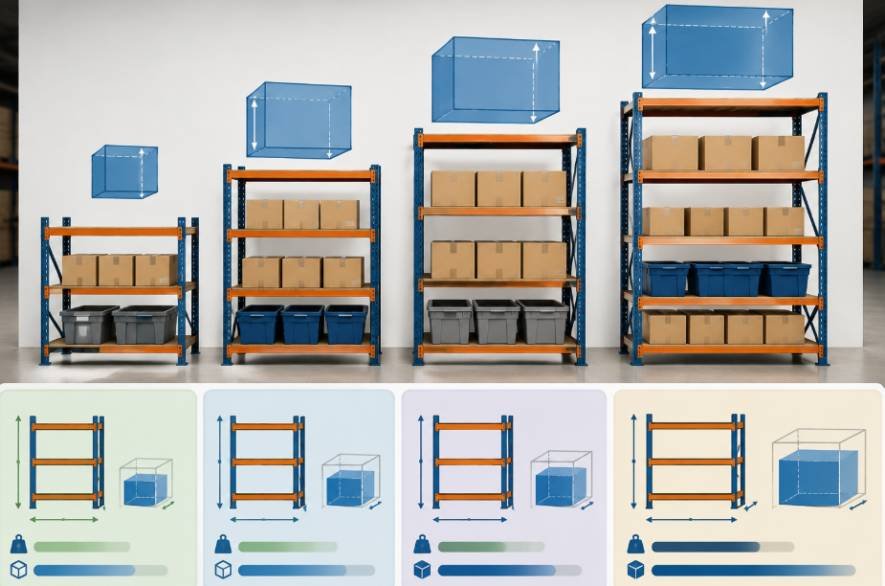
A small shelving opening measuring 36 by 18 by 18 inches provides approximately 6.75 cubic feet. Four identical openings provide about 27 cubic feet.
A standard 48-by-24-by-24-inch opening provides 16 cubic feet. Four openings provide 64 cubic feet.
A wider 60-by-24-by-24-inch shelf offers 20 cubic feet per opening. Four levels offer 80 cubic feet.
A large 72-by-24-by-30-inch opening provides 30 cubic feet. Four matching levels offer 120 cubic feet.
These examples are reference points rather than standard ratings. Manufacturers offer many combinations of widths, depths, heights, shelf counts, and adjustable beam positions.
Calculating an Entire Shelving Unit
If every opening has identical dimensions, multiply the capacity of one opening by the number of usable openings.
Capacity per opening × number of openings = total shelving capacity
However, the number of shelves and the number of storage openings may not always be identical. The floor or base level may support inventory, and the top shelf may provide open storage above it. Count only the spaces that will actually hold products.
When openings have different heights, calculate each section separately and add the answers together. This method is more accurate than multiplying the outside width, depth, and total height of the structure.
Gross Volume Versus Practical Storage Capacity
Gross cubic footage assumes the opening can be filled like a perfect rectangular box. Real warehouse inventory rarely uses every inch.
Cartons may leave gaps because their dimensions do not divide evenly into the shelf dimensions. Rounded containers, irregular equipment, loose materials, product dividers, and required picking space reduce packing efficiency. Labels and GS1 barcodes may also need to remain visible.
For practical planning, calculate how many cartons fit across the width, how many fit along the depth, and how many can be stacked within the opening. Multiply those quantities to estimate the number of units per shelf. This carton-based method is usually more reliable than comparing total volume alone.
The same gross versus usable gap shows up in office storage furniture as well my filing cabinet size guide walks through why drawer dividers and hanging-file rails shrink real capacity below the calculated exterior volume.
Cubic Feet and Weight Capacity Are Different
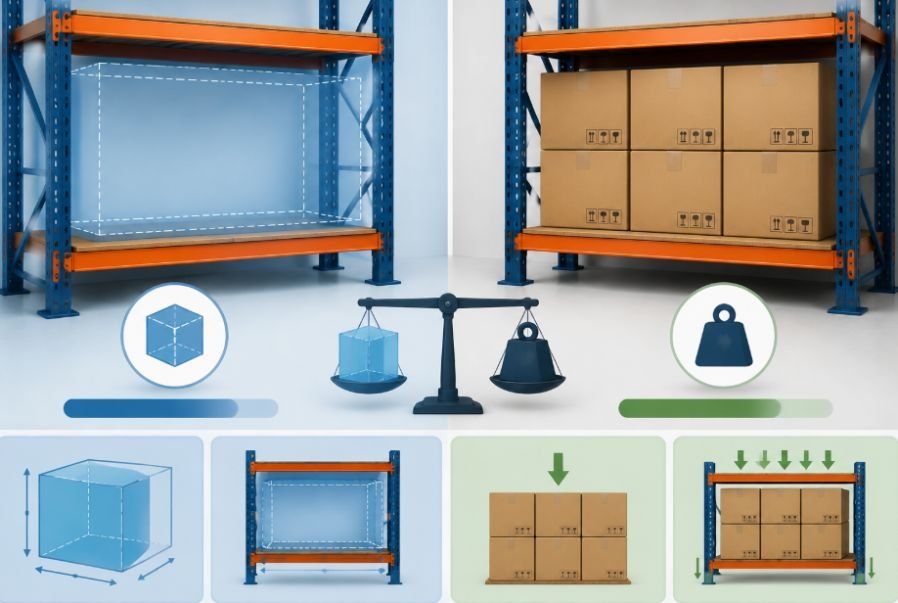
Cubic capacity describes space, while load capacity describes weight. A shelf might have enough room for 20 cubic feet of products but still be unable to support their combined weight.
Dense materials such as metal parts, liquids, hardware, paper, and stone can reach the shelf’s weight limit before filling its available volume. Lightweight goods may fill the entire opening while remaining well below that limit. Therefore, a cubic feet calculation for warehouse shelf capacity should always be considered alongside the shelf’s rated weight limit.
The same volume-versus-load distinction applies to shipping platforms too I cover it in my pallet size guide, where cubic footage and weight capacity are calculated separately for freight planning.
Always follow the manufacturer’s capacity plaque or technical specifications. Place heavier goods on lower or middle levels when appropriate, distribute loads evenly, and never assume that a visually empty area can safely accept additional weight. Damaged uprights, beams, connectors, or decking should be inspected before the unit is loaded.
Does the Shelving Type Affect Usable Space?
Yes. Steel shelving commonly provides open, adjustable levels for cartons and individual products. Pallet racks create larger openings designed around pallet dimensions and handling equipment. Cantilever racks store long materials such as timber, pipes, and panels, so rectangular cubic-foot calculations may not accurately describe their practical capacity.
Carton-flow shelving uses inclined tracks that occupy some of the opening. Bin shelving divides the available space into smaller compartments. Each system can occupy a similar exterior area while offering a very different usable storage cube.
Frequently Asked Questions
1. How many cubic feet does a four-level shelf hold?
A four-level shelving unit may provide approximately 25 to 120 cubic feet, depending on the width, depth, and clear height of each opening. A unit with four 48-by-24-by-24-inch openings provides about 64 cubic feet.
2. How Many Cubic Feet Is a Warehouse Shelf?
A typical warehouse shelf level provides approximately 6 to 30 cubic feet. Compact parts shelves may offer less, while wide industrial levels can exceed this range.
3. Should I measure inside or outside dimensions?
Use internal clear dimensions to estimate what can fit on the shelf. Use exterior dimensions when calculating the floor and building space occupied by the entire unit.
4. Can cubic feet determine how many boxes will fit?
Cubic feet provides an initial estimate, but carton dimensions offer a more practical answer. Divide the usable width, depth, and height by the corresponding box dimensions, round each result down, and multiply the three quantities.
Final Thoughts
I treat cubic footage as a planning tool rather than a promise that every inch will hold inventory. Measuring the clear internal width, depth, and height produces a much more useful result than relying on exterior dimensions.
I also compare the calculated volume with carton sizes, shelf configuration, access requirements, and the manufacturer’s weight rating. With those checks completed, I can estimate shelf capacity more accurately and avoid wasting valuable vertical storage space.

Ryan Mitchell
Ryan Mitchell holds a degree in Civil Engineering and spent over a decade working in construction project estimation, where accurate volume and material calculations were part of his daily work — from concrete pours to landscaping material orders. He founded this site to bring that same precision to everyday calculations, helping DIYers, contractors, and students get fast, accurate cubic footage results without the guesswork. Ryan reviews every calculator and formula on this site for accuracy and writes guides based on real-world measurement scenarios he's encountered on job sites.