

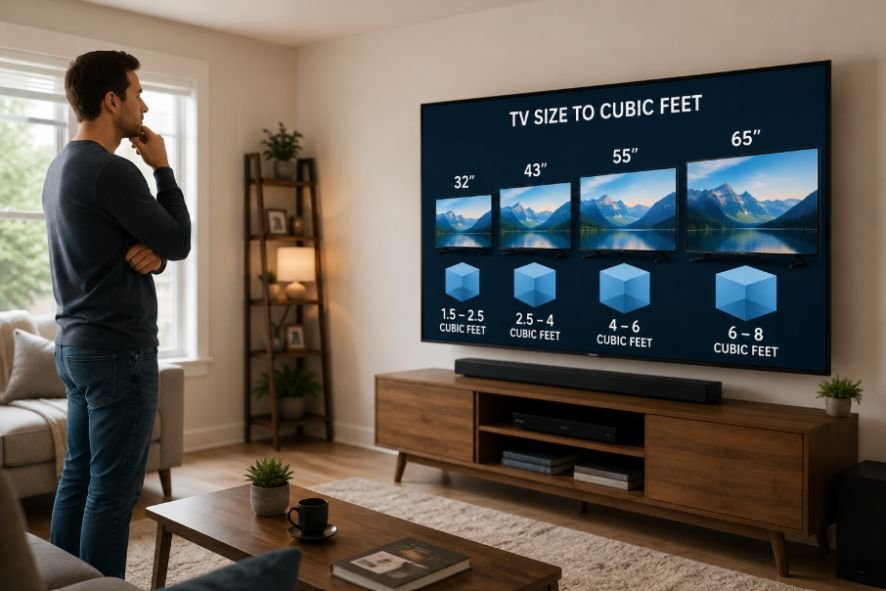
I used to think a television’s size was easy to estimate because the screen is usually described by one number, such as 55 or 65 inches. That number tells you the diagonal screen measurement, though, not how much physical space the television occupies. When you’re trying to plan a move, storage space, or a truck load, that difference becomes surprisingly important.
I also found that the television itself is often only part of the calculation. A slim flat-screen can take up relatively little space without its accessories, while the same TV packed into a protective box needs considerably more room. Once you account for the stand, padding, and box, the number can change enough to affect a moving estimate.
What Does Cubic Feet Mean for a Television?
Cubic feet measure three-dimensional space. To calculate the volume of a television, multiply its length, width, and depth after converting those measurements to feet.
For example, a TV that measures 4 feet wide, 2.5 feet tall, and 0.25 feet deep would have a physical volume of about 2.5 cubic feet.
The important detail is that screen size does not equal physical volume. A 55-inch television refers to the diagonal measurement of the display. Two televisions with the same screen size can have different widths, heights, depths, and bezels.
That is why a cubic-foot estimate should be treated as a practical range rather than a universal number for every TV model.
Estimated TV Volume by Screen Size
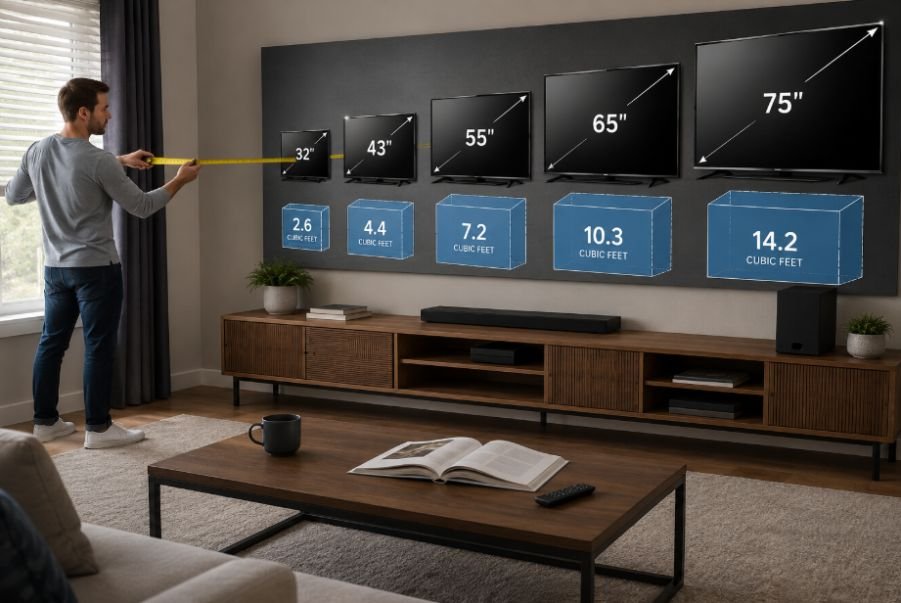
For a quick estimate, the physical panel volume generally increases as screen size increases. The following figures provide a useful starting point:
| TV screen size | Approx. panel volume | Approx. boxed or with stand |
| 32 inches | 0.75 cu. ft. | 2.5 cu. ft. |
| 43 inches | 1.4 cu. ft. | 4.6 cu. ft. |
| 55 inches | 2.2 cu. ft. | 7.5 cu. ft. |
| 65 inches | 3.1 cu. ft. | 10.4 cu. ft. |
| 75 inches | 4.2 cu. ft. | 13.9 cu. ft. |
| 85 inches | 5.4 cu. ft. | 17.8 cu. ft. |
These numbers are estimates, not fixed specifications. The actual volume depends on the television’s physical dimensions and whether you are measuring only the panel or the space required to move it safely.
For moving estimates, the second figure is usually more useful. A television that physically occupies only a few cubic feet can require considerably more truck space once protective materials are included.
Why Screen Size Does Not Tell the Whole Story
A television’s diagonal measurement gives you a quick idea of its overall size, but it does not tell you its exact dimensions.
Modern OLED televisions can be extremely thin, sometimes measuring less than an inch through parts of the panel. Some LED-LCD models are considerably deeper. Older televisions can be deeper still.
The stand can also change the calculation. If the television remains attached to a table stand, the stand can extend several inches behind or below the panel. A wall-mounted TV may have a much smaller footprint when the mount is removed, although the mounting hardware still needs to be packed separately.
This is similar to estimating other household belongings. For example, a lamp’s cubic-foot capacity depends on whether you’re measuring the lamp itself or the box and padding around it. The same principle applies to televisions.
How to Calculate the Cubic Feet of Your TV
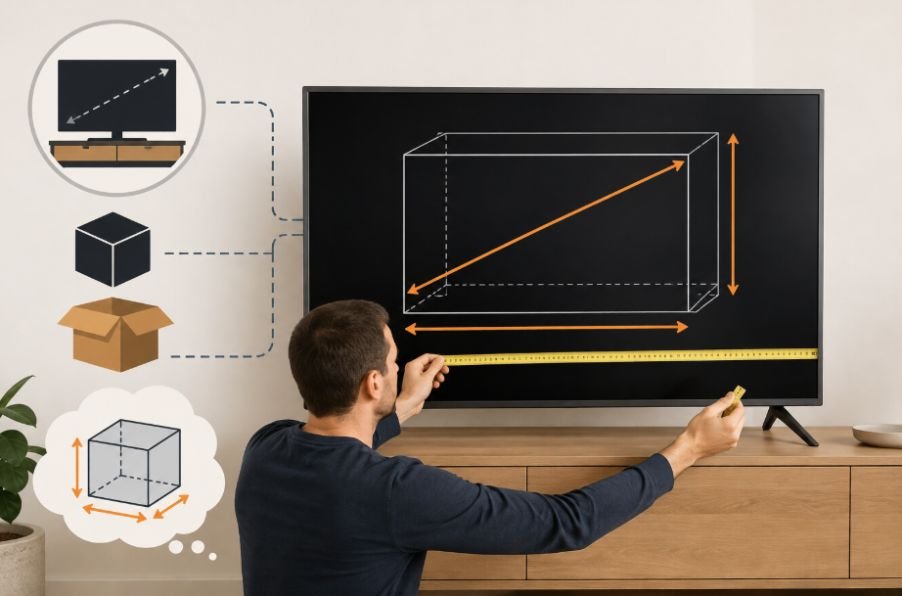
If you have the television in front of you, calculating its approximate physical volume is straightforward.
Measure:
- Width from one side to the other
- Height from the bottom to the top
- Depth from the front to the deepest point
If your measurements are in inches, multiply the three numbers and divide by 1,728 because one cubic foot contains 1,728 cubic inches.
For example, suppose a television measures 48 inches wide, 28 inches tall, and 3 inches deep:
48 × 28 × 3 = 4,032 cubic inches
4,032 ÷ 1,728 = approximately 2.33 cubic feet.
That gives you the approximate physical volume of the television. It does not account for the air space around it, packaging, or irregular shapes.
The Box Can Change the Number Dramatically
For moving purposes, the television’s bare volume is rarely the number you actually need.
A retail or moving box has to leave room for foam, corner protection, cardboard, and other packing materials. That creates empty space around the TV, but that space still occupies part of your truck or storage area.
A box also needs enough clearance to protect the screen from pressure and impact. Trying to squeeze a large television into a box that is barely bigger than the panel may save a little space but increase the risk of damage.
This is why a 55-inch TV with an estimated panel volume of around 2.2 cubic feet can require roughly 7.5 cubic feet when boxed or kept with its stand. The same effect becomes much more noticeable with larger screens.
How Much Space Should You Reserve for a Moving TV?
If you’re estimating a moving truck, don’t use only the panel’s cubic-foot figure.
For a rough household inventory, the boxed estimate gives you a more realistic starting point. A 32-inch TV may need around 2.5 cubic feet, while an 85-inch model can approach 18 cubic feet when its packaging or stand is included.
Still, measure the actual box whenever possible. Moving companies may use standard inventory estimates, but your television may have unusual dimensions.
The same approach works with other bulky household items. A curtain package, for instance, may take up considerably more room once it is bundled and packed than the fabric would suggest when laid flat.
That’s why knowing about the curtain package occupies can be useful when estimating total household volume.
What Can Increase Your TV’s Moving Volume?
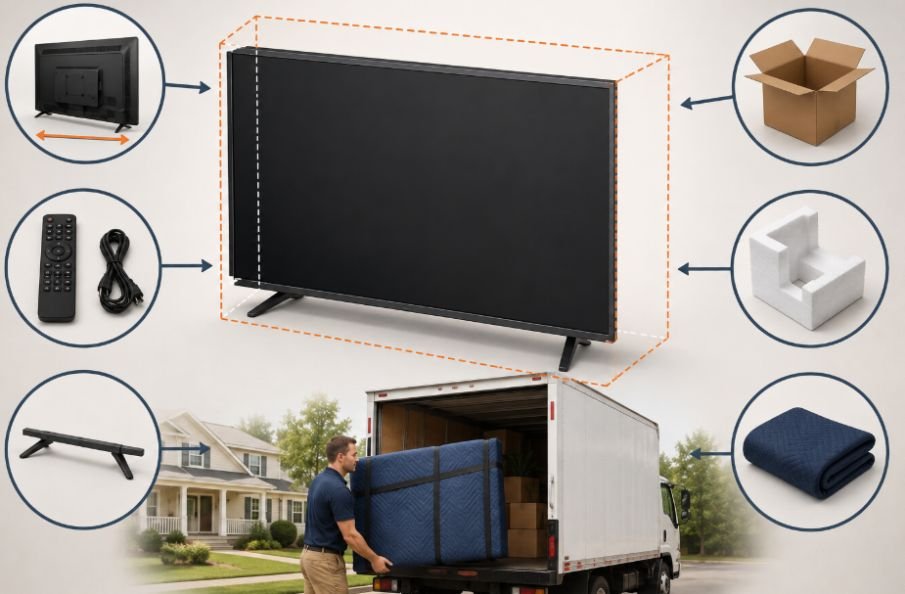
Several factors can make the required space larger than the basic panel estimate.
Packaging materials
Foam inserts, corner guards, cardboard, plastic film, and other protective materials add volume. Large screens need particularly careful protection because the panel can flex or crack under pressure.
Stand and accessories
A table stand can add depth, while a separate base, remote, cables, and other accessories need their own packing space.
Box dimensions
The box needs clearance around the television rather than matching its exact dimensions. That additional space is what makes the boxed estimate substantially higher.
Should You Use Panel Volume or Boxed Volume?
Use panel volume when you’re simply comparing the physical size of different televisions. Use boxed volume when you’re planning a move, storage area, or truck load.
That distinction prevents one of the most common mistakes in moving calculations. A television might occupy only a few cubic feet as an object, but its protected moving footprint can be several times larger.
If you’re working with a professional moving estimate, the company’s inventory method may also assign a standard volume to your TV. Your own measurements can still help you understand whether that estimate makes sense.
Frequently Asked Questions
1. How many cubic feet is a 55-inch TV?
A typical estimate puts the physical panel around 2.2 cubic feet. With a stand or protective box, the required space can be closer to 7.5 cubic feet.
2. How many cubic feet is a 65-inch TV?
A 65-inch panel is roughly 3.1 cubic feet based on estimated dimensions. Boxed or with a stand, it may require around 10.4 cubic feet.
3. Does TV screen size determine cubic feet?
No. Screen size measures the diagonal of the display. The TV’s actual width, height, depth, stand, and packaging determine its cubic volume.
4. Should I use boxed volume when planning a move?
Yes. Boxed volume is usually more useful because it reflects the space the protected television will actually occupy in the truck or storage area.
Why the Right Measurement Matters When Space Is Limited
A television may look like a flat object that barely needs any room, but moving it safely tells a different story. The screen’s physical dimensions, its depth, stand, protective padding, and box all contribute to the space it ultimately occupies.
For smaller TVs, the difference may not matter much. With a 75- or 85-inch screen, though, underestimating the required space can create a real problem when you’re trying to fit everything into a truck or storage unit.
The easiest approach is to measure the TV and, when possible, the packed box. A few minutes with a tape measure can give you a much more realistic estimate than relying on screen size alone.

Ryan Mitchell
Ryan Mitchell holds a degree in Civil Engineering and spent over a decade working in construction project estimation, where accurate volume and material calculations were part of his daily work — from concrete pours to landscaping material orders. He founded this site to bring that same precision to everyday calculations, helping DIYers, contractors, and students get fast, accurate cubic footage results without the guesswork. Ryan reviews every calculator and formula on this site for accuracy and writes guides based on real-world measurement scenarios he's encountered on job sites.


