

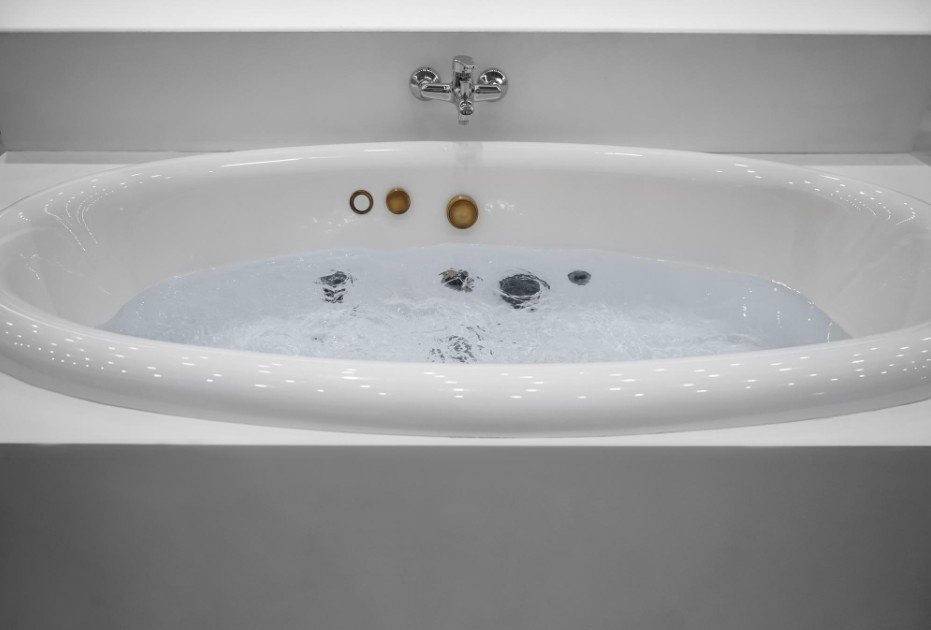
When I first tried to estimate bathtub volume, I assumed multiplying the exterior length, width, and height would provide the answer. That calculation looked convincing, but it substantially overstated how much water the tub could hold. The rim, walls, curved basin, sloped backrest, overflow drain, and space occupied by the person bathing all change the result.
The short answer to How Many Cubic Feet Is a Bathtub? is approximately 5.3 to 10.7 cubic feet of maximum water capacity for many compact and standard models. That equals roughly 40 to 80 gallons. However, an ordinary bath may use only 4.7 to 6.7 cubic feet, or about 35 to 50 gallons.
Standard Bathtub Capacity in Cubic Feet
A standard alcove bathtub commonly holds between 50 and 80 gallons when filled near its overflow opening. Dividing that capacity by 7.48 produces an estimated water volume of 6.7 to 10.7 cubic feet.
A typical bath uses less water than the tub’s maximum rating. Most people stop below the overflow, and their bodies displace part of the water. Therefore, a normal bath using 35 to 50 gallons contains approximately 4.7 to 6.7 cubic feet of water.
Compact tubs may hold around 40 to 55 gallons, equivalent to approximately 5.3 to 7.4 cubic feet. Larger soaking tubs can hold 66 to 110 gallons, or about 8.8 to 14.7 cubic feet. Two-person and oversized jetted tubs may exceed 100 gallons, placing their capacity above 13.4 cubic feet. A bathtub online cubic feet calculator can provide a faster estimate when the interior length, width, and water depth are available.
These figures are estimates rather than universal specifications. Bathtubs with the same exterior length can have significantly different interior capacities.
Exterior Size Is Not Water Capacity
A standard alcove bathtub often measures approximately 60 inches long, 30 inches wide, and 14 to 16 inches high. Multiplying those overall measurements and dividing by 1,728 produces a rectangular volume between 14.6 and 16.7 cubic feet.
That result represents the installation envelope occupied by the bathtub. It does not mean the tub holds 14.6 to 16.7 cubic feet of water.
Exterior measurements include the rim, apron, wall thickness, plumbing cavities, supports, and empty spaces surrounding the basin. The interior also narrows toward the bottom and may include armrests, molded lumbar support in the mattress, jets, seats, or a sloping backrest. Treating the entire tub as a rectangular water container will consequently exaggerate its capacity.
Exterior volume is useful when planning bathroom space, remodeling, transporting the fixture, or determining whether a replacement fits an existing alcove. Interior volume is the relevant measurement for water use, heating requirements, and filled weight.
How to Calculate Bathtub Volume
Calculate Cubic Feet From Interior Dimensions
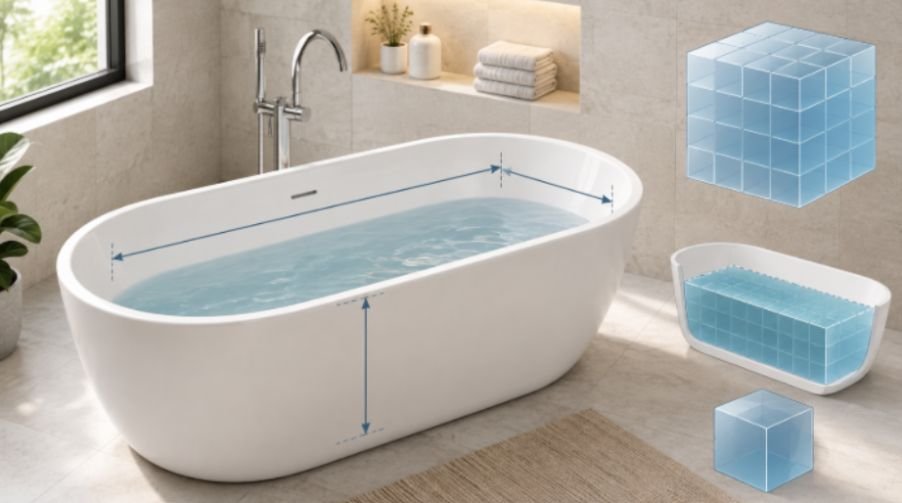
Measure the inside length and width of the bathing well rather than the outside edges. Measure the water depth from the basin floor to the bottom of the overflow opening. If the sides taper considerably, use an average width instead of the widest point.
Apply this formula:
Cubic feet = interior length × interior width × water depth ÷ 1,728
Suppose the interior measures 54 inches long, 23 inches wide, and 15 inches deep. Multiplying these dimensions produces 18,630 cubic inches. Dividing by 1,728 gives approximately 10.8 cubic feet.
Because the basin is curved and tapered, that rectangular estimate may still be too high. Multiplying the result by approximately 0.70 provides a more realistic preliminary estimate of 7.6 cubic feet, equal to about 57 gallons.
The manufacturer’s specification sheet should take priority whenever it lists the tub’s tested water capacity.
Convert Gallons to Cubic Feet
When the specification sheet provides gallons, the conversion is easier:
Cubic feet = gallons ÷ 7.48
A 60-gallon bathtub therefore holds approximately 8 cubic feet. An 80-gallon model holds about 10.7 cubic feet, while a 100-gallon soaking tub contains approximately 13.4 cubic feet at its stated capacity.
To convert the result back, multiply cubic feet by 7.48.
For smaller water measurements, a 5-gallon bucket can also provide a practical reference when comparing gallon capacity with cubic-foot measurements.
What Changes a Bathtub’s Usable Volume?
Shape is one of the biggest influences. A rectangular tub with relatively straight sides can hold more water than an oval or dramatically tapered basin occupying the same floor area. A pronounced backrest also reduces interior volume. These internal contours and the surrounding plumbing space should also be considered when planning to fit a sink waste pipe near the bathtub.
The overflow position determines the maximum practical waterline. Two tubs with identical outside dimensions may have different overflow heights and, therefore, different capacities.
Soaking depth matters more than overall height. A tall exterior apron does not necessarily create a deep bathing well. Buyers should compare the basin depth and overflow depth rather than relying only on the advertised fixture height.
The bather’s body displaces water after entering the tub. A bathtub filled to its maximum capacity before someone gets in may overflow. For everyday use, filling it several inches below the rim and allowing room for displacement is safer.
swimming pool volume calculations follow a similar principle, where dimensions, depth, and shape all affect the final capacity. A bathtub requires the same attention to its interior dimensions and curved surfaces.
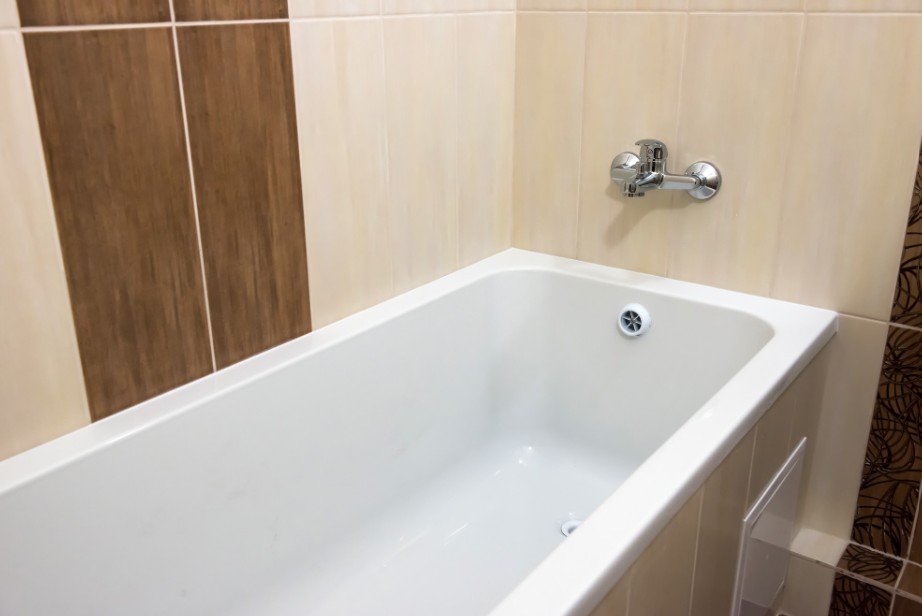
Compact tubs designed for restricted bathrooms frequently hold 40 to 55 gallons, or 5.3 to 7.4 cubic feet. Standard alcove models commonly fall between 50 and 80 gallons, equivalent to 6.7 to 10.7 cubic feet.
Clawfoot tubs often hold 40 to 60 gallons, although deeper models can exceed this range. Freestanding soaking tubs commonly provide 66 to 110 gallons of capacity. Corner tubs may hold approximately 75 to 110 gallons, depending on whether they are designed for one or two bathers.
Walk-in models frequently hold around 40 to 80 gallons. Seats and door structures reduce their usable interior space, but deeper waterlines can increase the amount needed for bathing. Large whirlpool and two-person models may require 100 to 170 gallons or more.
How Much Does a Filled Bathtub Weigh?
Water weighs approximately 8.34 pounds per gallon. A bathtub containing 60 gallons carries roughly 500 pounds of water. An 80-gallon fill weighs about 667 pounds, while 100 gallons weighs approximately 834 pounds.
The complete load also includes the bathtub, the bather, fixtures, and surrounding materials. A filled stone, cast iron, or oversized soaking tub can place a substantial concentrated load on the floor. A qualified contractor or structural professional should evaluate the installation when adding an unusually heavy model, particularly during an upper-floor renovation.
Will the Water Heater Fill the Tub?
Bathtub capacity should be compared with the water heater’s available hot-water supply. A 60-gallon tub does not necessarily require 60 gallons of hot water because the bath normally combines hot and cold water. However, a deep soaking tub can exhaust a smaller tank before reaching the desired temperature and depth.
Tank capacity alone does not provide the complete answer. The heater’s recovery rate, incoming water temperature, thermostat setting, plumbing distance, and desired bath temperature also matter. Tankless systems should be evaluated by flow rate and temperature rise.
Frequently Asked Questions
1. How Many Cubic Feet Is a Bathtub?
Many standard bathtubs hold approximately 6.7 to 10.7 cubic feet of water at maximum capacity. Actual bathwater use is commonly closer to 4.7 to 6.7 cubic feet because the tub is not filled completely and the bather displaces water.
2. How many cubic feet are in a 60-gallon bathtub?
A 60-gallon bathtub holds approximately 8 cubic feet. Divide 60 by 7.48 to obtain the conversion.
3. Does a 60 × 30-inch bathtub hold 15 cubic feet?
Not necessarily. That estimate uses exterior dimensions and treats the tub as a perfect box. The actual interior basin is smaller and typically holds considerably less water.
4. Should I measure to the rim or the overflow?
Measure from the interior basin floor to the bottom of the overflow opening. Water cannot normally remain above that point, making it a more accurate maximum waterline.
Final Thoughts
I would never rely on exterior dimensions alone when estimating bathtub capacity. For the most accurate result, I would check the manufacturer’s listed gallons and divide by 7.48. If specifications are unavailable, I would measure the interior basin to the overflow and reduce the rectangular estimate for curves and tapered walls.
For many standard tubs, 6.7 to 10.7 cubic feet is a practical maximum range, while the amount used during an ordinary bath is lower. Separating occupied space, maximum capacity, and actual water use produces a far more useful answer for remodeling, water-heater planning, structural loading, and household budgeting.

Ryan Mitchell
Ryan Mitchell holds a degree in Civil Engineering and spent over a decade working in construction project estimation, where accurate volume and material calculations were part of his daily work — from concrete pours to landscaping material orders. He founded this site to bring that same precision to everyday calculations, helping DIYers, contractors, and students get fast, accurate cubic footage results without the guesswork. Ryan reviews every calculator and formula on this site for accuracy and writes guides based on real-world measurement scenarios he's encountered on job sites.


