


When I look at a swimming pool, its water capacity is difficult to judge from appearance alone. A typical residential pool contains approximately 1,300 to 4,000 cubic feet of water, although compact above-ground models may hold considerably less. Large custom pools can exceed that range. If you are asking How Many Cubic Feet Is a Swimming Pool?, the most reliable answer comes from its internal dimensions, average water depth, shape, and built-in features.
Knowing the volume helps you estimate water requirements, calculate filling time, dose chemicals correctly, and select suitable equipment. Fortunately, you can estimate it with a tape measure and a few straightforward formulas.
Average Swimming Pool Capacity in Cubic Feet
There is no single standard capacity because swimming pools are built in numerous shapes and sizes. A small 12-by-24-foot pool with an average depth of 4.5 feet contains approximately 1,296 cubic feet. A 14-by-28-foot pool averaging 5 feet deep contains about 1,960 cubic feet.
A widely used 16-by-32-foot residential pool with a 5-foot average depth contains 2,560 cubic feet. Larger models increase quickly: an 18-by-36-foot pool at the same average depth contains 3,240 cubic feet, while a 20-by-40-foot pool contains 4,000 cubic feet.
These figures represent estimated water volume. Steps, benches, tanning ledges, curved walls, sloping sides, and the space between the waterline and coping may reduce actual capacity. These design features should also be evaluated when checking the appropriate safety standards for a swimming pool, especially those concerning water depth, barriers, entry points, and slip-resistant surfaces.
How to Calculate Pool Volume in Cubic Feet
For a rectangular pool, multiply its length by its width and average water depth:
Length × width × average depth = cubic feet
All three measurements must use feet. If part of a measurement is recorded in inches, divide the number of inches by 12 before completing the calculation. Nine inches, for example, equals 0.75 feet.
Consider a pool measuring 30 feet long and 15 feet wide, with an average depth of 5 feet. Its estimated volume is:
30 × 15 × 5 = 2,250 cubic feet
This calculation works well for a rectangular pool with straight walls and a relatively regular floor.
Finding the Correct Average Depth
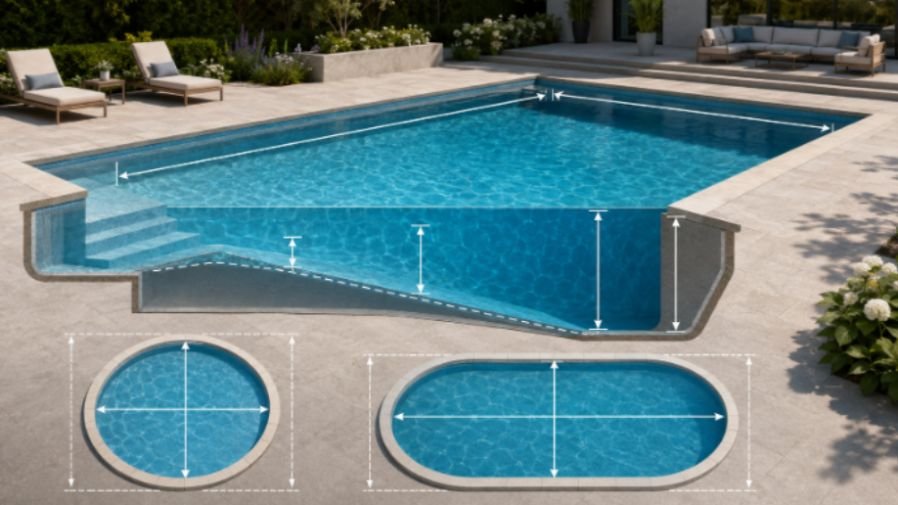
Many pools have shallow and deep ends. When the floor slopes evenly, add the two depths and divide the result by two:
Shallow depth + deep depth ÷ 2 = average depth
The calculation needs parentheses to prevent confusion:
(Shallow depth + deep depth) ÷ 2
If the shallow end is 3 feet and the deep end is 7 feet, the average depth is 5 feet. Use that result in the main volume formula.
Simple averaging is less reliable when a large shallow section ends in a short, steep drop. Divide that type of pool into shallow and deep sections. Calculate each section separately and add the results. This method better reflects the space occupied by the water.
Calculations for Different Pool Shapes
Rectangular and Square Pools
Multiply length by width and average water depth. This is the simplest and generally most accurate calculation for pools with straight sides.
Round Pools
First, divide the diameter by two to find the radius. Then use this formula:
3.14 × radius × radius × average depth = cubic feet
A round pool with a radius of 9 feet and a water depth of 4 feet holds approximately 1,017 cubic feet.
Oval Pools
Treat an oval as an ellipse:
3.14 × half the length × half the width × average depth = cubic feet
A faster approximation is length × width × 0.785 × average depth. This accounts for the rounded areas that would otherwise be included in a rectangular calculation.
Kidney-Shaped and Freeform Pools
Irregular pools require estimation. Divide the pool into smaller rectangles, circles, semicircles, or ovals. Calculate each portion and combine the results. Measuring the longest and widest points alone may overstate capacity because it treats curved, missing areas as water-filled space.
Converting Cubic Feet to Gallons
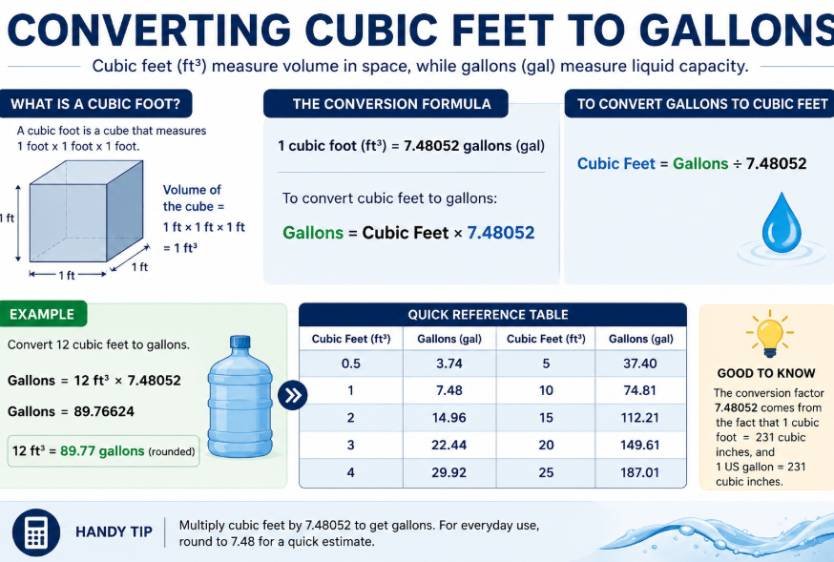
Pool supplies and equipment are frequently specified by gallon capacity. One cubic foot of water equals approximately 7.48052 US gallons. For a quick estimate, many pool guides round this number to 7.5, while a swimming pool cubic feet calculator can provide a faster result using the pool’s dimensions.
Use this formula:
Cubic feet × 7.48052 = gallons
A pool containing 2,560 cubic feet therefore holds approximately 19,150 gallons.
For a quick estimate, many pool guides round this number to 7.5, while 5-gallon bucket capacity provides a familiar reference for understanding how smaller volumes compare with a full swimming pool.
Why Accurate Pool Volume Matters
The answer to How Many Cubic Feet Is a Swimming Pool? affects more than filling the structure. Sanitizers, shock treatments, pH adjusting agents, and other products are dosed according to water volume. A large overestimate may lead to excessive treatment, wasted money, cloudy water, or swimmer discomfort. An underestimate may result in weak sanitation and recurring water-quality problems.
Water weight also matters when assessing the load placed on the pool structure or surrounding surfaces, since each cubic foot of water weighs roughly 62.4 pounds.
Capacity also influences pump flow, filter size, heater output, filling time, and energy consumption. A heater designed for a smaller pool may warm the water slowly, while improperly matched circulation equipment can operate inefficiently.
Exterior Volume Versus Actual Water Capacity
Exterior dimensions describe the space occupied by the complete pool structure. Water capacity describes only the interior space filled to the normal waterline. The two figures should not be treated as interchangeable.
Always measure along the inside edges and use actual water depth rather than wall height. If a four-foot wall holds only three-and-a-half feet of water, using the complete wall height will exaggerate capacity. SwimmingPool.com illustrates how using four feet instead of three feet can overstate volume by 33 percent.
Frequently Asked Questions
1. How Many Cubic Feet Is a Swimming Pool measuring 16 by 32 feet?
A 16-by-32-foot pool with an average depth of 5 feet contains approximately 2,560 cubic feet. That equals about 19,150 gallons of water before accounting for steps, ledges, curves, and the space above the waterline.
2. Should I measure wall height or water depth?
Measure from the pool floor to the normal waterline. Wall height can produce an inflated result because pools are not ordinarily filled to the coping.
3. How many gallons are in one cubic foot?
One cubic foot contains approximately 7.48 US gallons. Multiplying by 7.5 provides a convenient estimate.
4. Can I calculate a freeform pool accurately?
You can obtain a practical estimate by dividing it into smaller geometric sections. For greater accuracy, compare your result with metered filling records or consult a pool professional.
Final Thoughts
I would begin with the pool’s internal length, width, shape, and actual water depth. For an evenly sloped floor, I would calculate average depth before finding cubic feet and converting the result to gallons. When the design contains abrupt depth changes or extensive built-in features, I would calculate separate sections instead.
The result does not have to be perfect for every everyday purpose, but careful measurements make chemical treatment, equipment selection, water planning, and maintenance considerably more dependable.

Ryan Mitchell
Ryan Mitchell holds a degree in Civil Engineering and spent over a decade working in construction project estimation, where accurate volume and material calculations were part of his daily work — from concrete pours to landscaping material orders. He founded this site to bring that same precision to everyday calculations, helping DIYers, contractors, and students get fast, accurate cubic footage results without the guesswork. Ryan reviews every calculator and formula on this site for accuracy and writes guides based on real-world measurement scenarios he's encountered on job sites.


