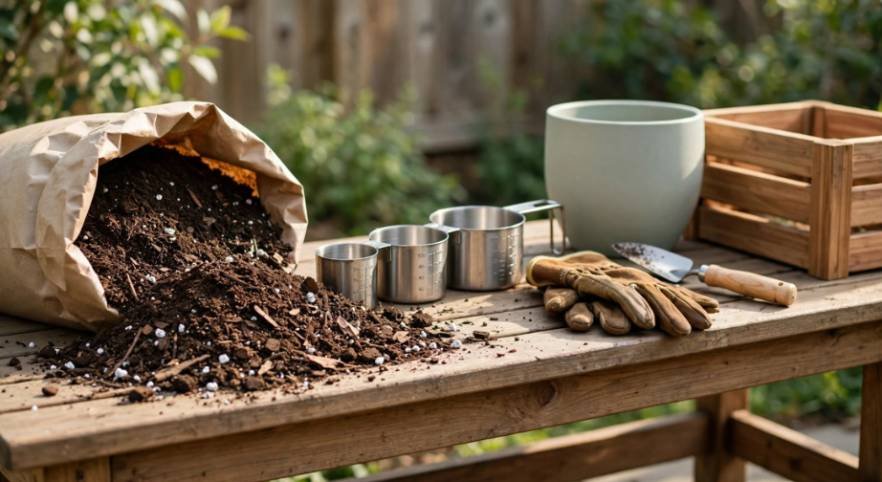
The answer to how many quarts in a cubic foot of potting soil is approximately 25.7 US dry quarts. For practical shopping, I round that figure to 26 dry quarts. This simple conversion has saved me from buying too many small bags or running short halfway through filling containers.
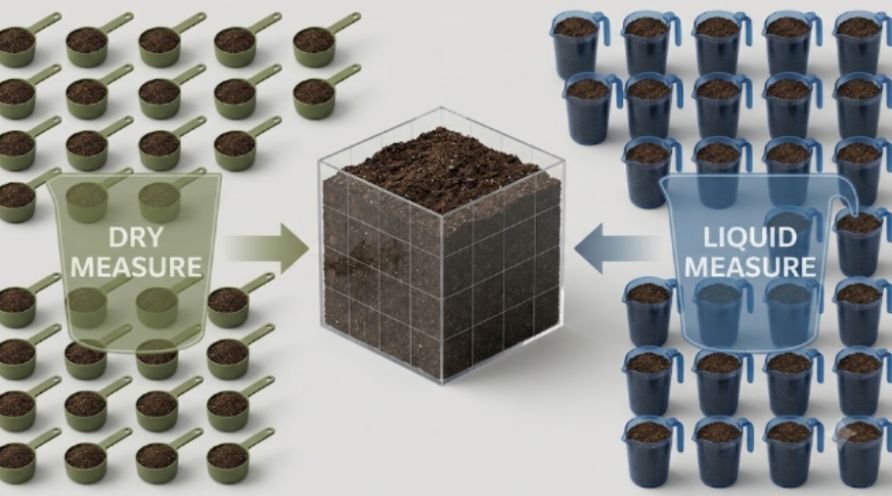
The word “dry” matters. A cubic foot also equals about 29.9 liquid quarts, but liquid quarts measure fluids. Potting soil is normally treated as a dry-volume product.
How Many Dry Quarts Equal One Cubic Foot?
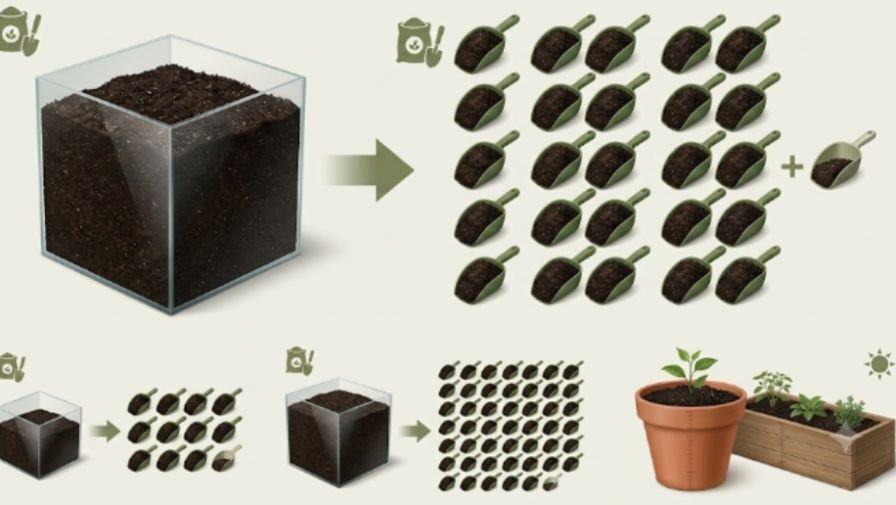
The precise conversion is:
1 cubic foot = 25.714 US dry quarts
The National Institute of Standards and Technology lists one cubic foot as 25.71405 dry quarts. It also equals 29.92208 liquid quarts.
When I calculate how many quarts in a cubic foot of potting soil, I use 25.7 rather than 30. That gives me a consistent mathematical starting point. I then add a small allowance for settling and spills.
Many gardeners encounter bags marked in quarts, while larger bags use cubic feet. The different labels can make two similar products look unrelated. Converting both packages into the same unit allows a fair comparison.
Dry Quarts Versus Liquid Quarts
A US dry quart equals about 1.101 liters. A US liquid quart equals about 0.946 liters. That difference explains why one cubic foot produces two possible answers.
Use 25.7 quarts when the package clearly states dry quarts. Do not use the 29.9-liquid-quart figure for potting mix unless the manufacturer defines its package that way.
Labels are not always perfectly consistent across brands. I check the package’s stated cubic-foot or liter equivalent before purchasing several bags.
Potting Soil Conversion Chart
These calculations use the NIST dry-volume conversion:
- 0.25 cubic foot equals about 6.4 dry quarts.
- 0.5 cubic foot equals about 12.9 dry quarts.
- 0.75 cubic foot equals about 19.3 dry quarts.
- 1 cubic foot equals about 25.7 dry quarts.
- 1.5 cubic feet equals about 38.6 dry quarts.
- 2 cubic feet equals about 51.4 dry quarts.
- 3 cubic feet equals about 77.1 dry quarts.
For a quick estimate, multiply cubic feet by 25.714. To convert in the opposite direction, divide the number of dry quarts by 25.714.
A 40-dry-quart bag, for example, contains approximately 1.56 cubic feet:
40 ÷ 25.714 = 1.56 cubic feet
How Much Potting Soil Does a Container Need?
Knowing how many quarts in a cubic foot of potting soil only solves half the problem. You must also estimate the container’s usable interior volume.
A rectangular container uses this formula:
Length × width × soil depth in inches ÷ 1,728 = cubic feet
Multiply that result by 25.714 to find dry quarts. Always measure inside the container because thick walls reduce usable space.
Worked Planter Box Example
Suppose a planter measures 24 inches long, 12 inches wide, and 10 inches deep inside.
24 × 12 × 10 = 2,880 cubic inches
2,880 ÷ 1,728 = 1.67 cubic feet
1.67 × 25.714 = approximately 42.9 dry quarts
I would buy about 47 quarts for this project. That includes roughly 10% extra for settling, small spills, and topping up after watering.
For more container-specific calculations, understanding the a planter box volume can help you compare container dimensions before choosing the right bag size.
Worked Flower Pot Example
Round pots require the cylinder formula:
3.1416 × radius² × soil depth = cubic inches
Consider a pot with a 12-inch interior diameter and 10-inch soil depth. Its radius is 6 inches.
3.1416 × 6² × 10 = approximately 1,131 cubic inches
1,131 ÷ 1,728 = 0.65 cubic feet
0.65 × 25.714 = approximately 16.8 dry quarts
A 20-dry-quart bag should fill that container with some mix left for settling. A tapered pot needs less because its base is narrower. Flower pot volume can also vary when the sides are curved or tapered.
Why the Calculated Amount May Not Fill the Pot
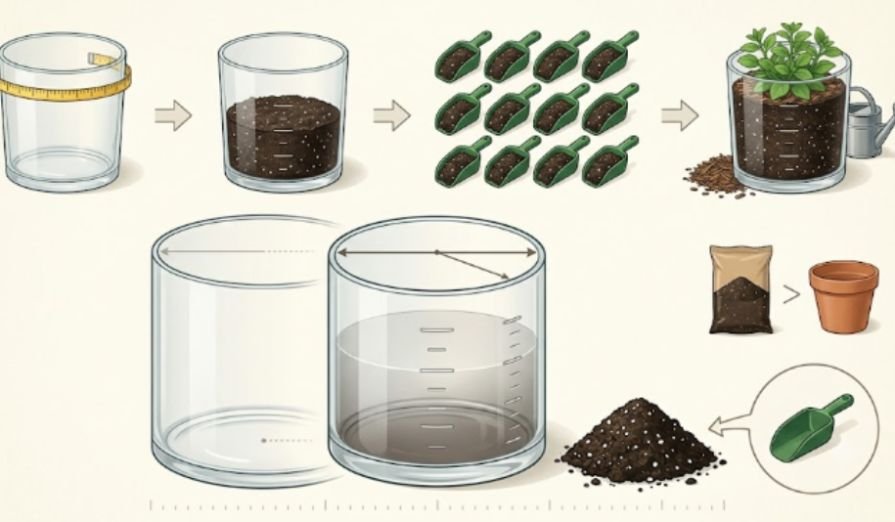
Potting mix contains air spaces. Fine particles settle around larger bark and perlite pieces after watering. The surface can drop even though the container’s physical volume remains unchanged.
North Carolina State Extension explains that media can settle or wash aside, sometimes exposing roots. Adding a surface layer may solve that problem without full repotting. Its container-plant guidance supports keeping some extra mix available.
I normally add 5% extra for small pots and about 10% for large containers. This allowance is my practical purchasing margin, not a different conversion factor.
Do not crush the mix into the pot. Heavy packing removes useful air space and can harm drainage. Gently firm the material, water it, and add more if the surface falls.
Choosing the Right Potting Mix
The answer to how many quarts in a cubic foot of potting soil tells you how much to buy, not which product plants need.
Potting mixes are designed to provide moisture, drainage, and air around container roots. Garden soil can become dense inside a pot. Virginia Cooperative Extension advises using a lightweight mix because clay-heavy garden soil can retain excessive water and limit root aeration. Review its container vegetable guidance before substituting yard soil.
Maryland Extension lists soilless mix, compost, or combinations of both as possible media for container vegetables. It recommends limiting topsoil to a small share in most containers. Its growing-media recommendations can help match a blend to the crop.
Common Potting Soil Measurement Mistakes
The most common error is treating dry and liquid quarts as identical. That can create a difference of more than four quarts per cubic foot.
Another mistake is calculating from exterior dimensions. Decorative pots often have thick walls, rounded bases, or false bottoms. These features reduce the actual soil capacity.
Gardeners also forget that roots, nursery soil, drainage inserts, and an unfilled rim occupy space. A transplanted root ball means the pot needs less new mix than an empty-volume calculation suggests.
Finally, avoid assuming every bag contains the same usable amount after compression. Break apart compacted mix before deciding that the package is short.
Frequently Asked Questions
1. Is one cubic foot of potting soil equal to 30 quarts?
It equals 25.7 dry quarts; 30 quarts is a rounded figure based closely on liquid-quart volume.
2. How many quarts are in two cubic feet of potting soil?
Two cubic feet contain approximately 51.4 US dry quarts.
3. How many pots will one cubic foot of soil fill?
It depends on each pot’s interior capacity; one cubic foot fills about six 4-quart pots before allowing for waste.
4. Should I buy extra potting mix for settling?
Yes. I recommend adding 5% to 10% for settling, spills, and later top-ups.
Soil Math Settled—Now Fill That Pot
The dependable answer to how many quarts in a cubic foot of potting soil is 25.7 dry quarts. Round it to 26 for quick estimates, but calculate from interior dimensions when accuracy matters.
My final move is simple: calculate the container, subtract any root-ball volume, and add a modest settling allowance. Buy the next available bag size above that figure. Your plants need room to grow—not a dramatic last-minute soil shortage.

Ryan Mitchell
Ryan Mitchell holds a degree in Civil Engineering and spent over a decade working in construction project estimation, where accurate volume and material calculations were part of his daily work — from concrete pours to landscaping material orders. He founded this site to bring that same precision to everyday calculations, helping DIYers, contractors, and students get fast, accurate cubic footage results without the guesswork. Ryan reviews every calculator and formula on this site for accuracy and writes guides based on real-world measurement scenarios he's encountered on job sites.