

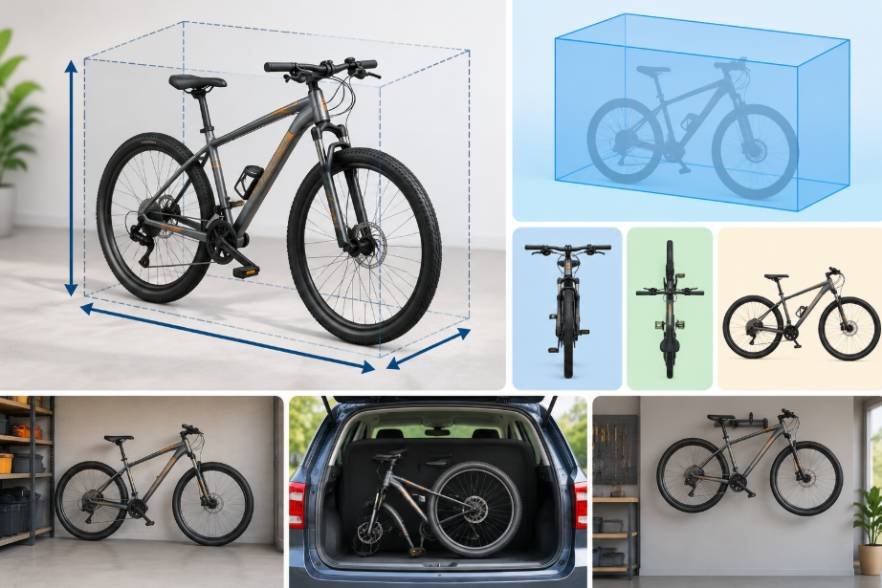
When I first tried estimating the space needed to move a bicycle, I discovered that the answer was less straightforward than expected. A bike has an irregular frame, open spaces between its components, and removable parts.
However, How Many Cubic Feet Is a Bicycle? can be answered with a practical estimate: allow approximately 10 cubic feet for a standard adult bicycle during a move. A disassembled bicycle inside a compact shipping box may occupy between 6 and 10 cubic feet, while larger boxes can require 16 to 22 cubic feet.
Quick Bicycle Volume Estimate
Professional moving inventories commonly allocate approximately 10 cubic feet to one standard bicycle. This number does not represent the physical material inside the bike. Instead, it estimates how much usable loading space the bicycle may consume when placed among boxes, furniture, and other household items.
For shipping, the measurement is based on the outside dimensions of the packed box. A common bicycle carton measuring 54 inches long, 8 inches wide, and 28 inches high has a volume of exactly 7 cubic feet. Larger cases need substantially more room because increased width or height quickly raises the total volume.
An assembled bicycle can appear to occupy 50 cubic feet or more if its full length, handlebar width, and height are treated as the dimensions of a rectangular box. This figure is rarely useful because much of that rectangular area consists of empty air.
Why a Bicycle Has No Single Exact Volume
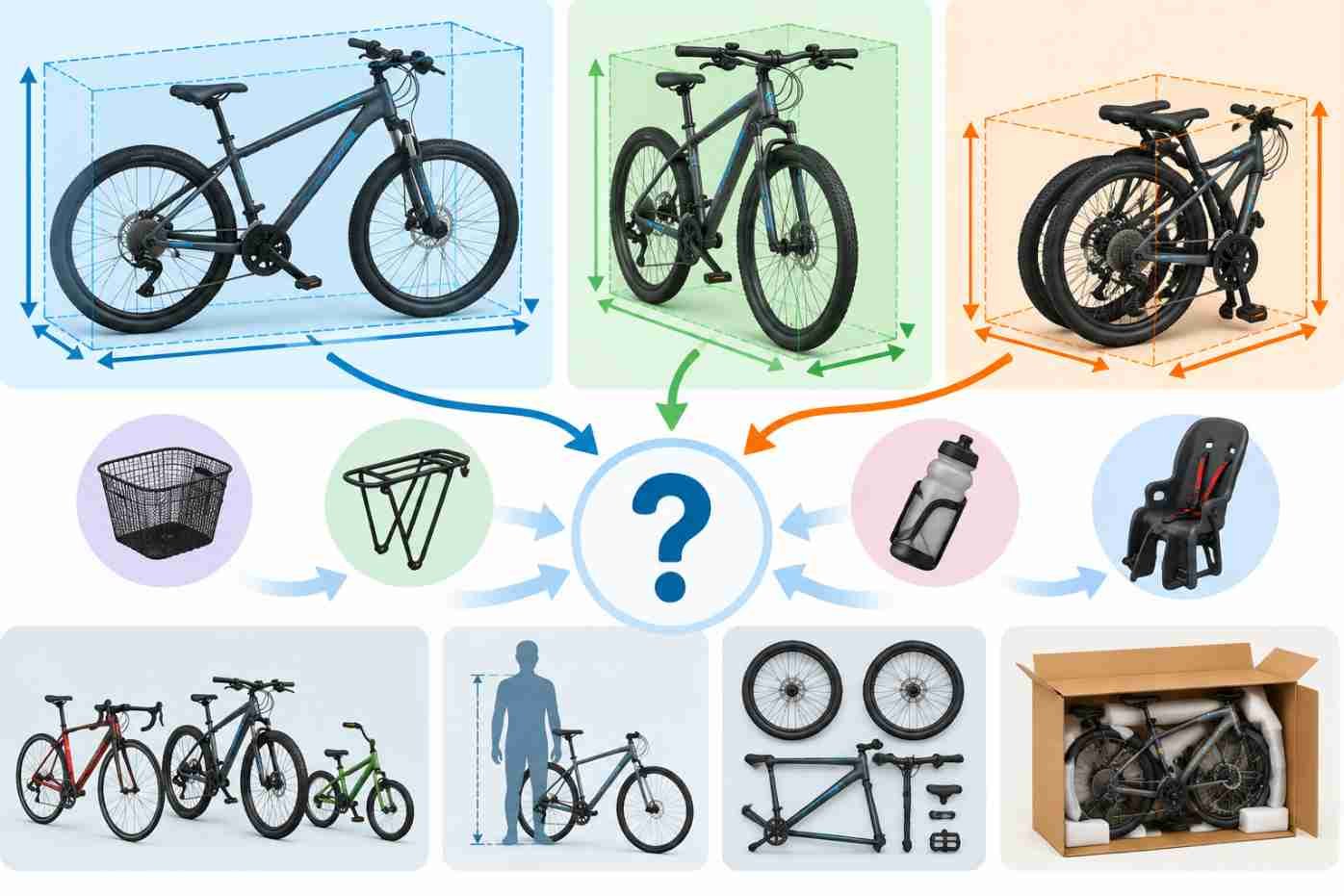
A bicycle is not shaped like a solid box. Its frame contains open triangles, its wheels are narrow circles, and its handlebars extend beyond the frame. Calculating its full rectangular footprint therefore measures the space surrounding the bicycle rather than the solid bicycle itself, much like extracting polygonal building footprints defines an object’s outer boundary without measuring all the material within it.
The intended use also changes the answer. Movers rely on standardized allowances for loading plans. Shipping companies calculate the external volume of the final package. Homeowners may only need the floor or wall space necessary to store a bike safely.
Bike type matters as well. A children’s bicycle is generally shorter and lower than an adult model. Mountain bikes may have wider handlebars and tires, while road bikes are usually narrower. Cargo bikes, tandems, and some electric bikes require much larger spaces than conventional bicycles.
How to Calculate Bicycle Cubic Feet
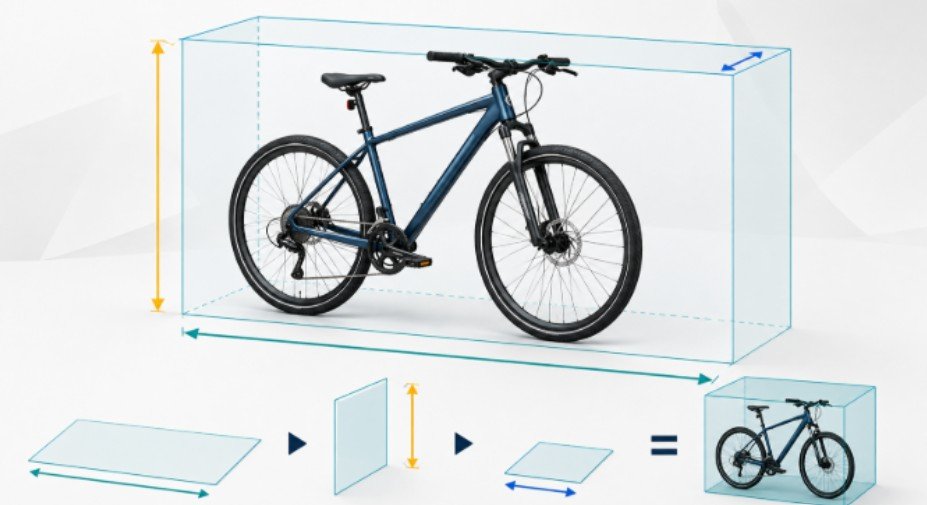
Use this basic formula when you know the outside dimensions:
Cubic feet = length × width × height ÷ 1,728
All three measurements must be in inches. The number 1,728 represents the cubic inches contained in one cubic foot.
For example, consider a packed bicycle box measuring 45 × 12 × 30 inches:
45 × 12 × 30 = 16,200 cubic inches
16,200 ÷ 1,728 = 9.38 cubic feet
Always measure the longest, widest, and tallest exterior points after packing. Include bulging cardboard, handles, wheels, straps, and uneven seams. If a measurement includes a fraction of an inch, round it up to the next whole inch when preparing a shipping estimate. This reduces the risk of incorrect dimensions and unexpected carrier adjustments.
Common Bicycle Box Volumes
Compact boxes intended for smaller or substantially disassembled bicycles may measure approximately 43 × 10 × 24 inches. That produces a volume of about 5.97 cubic feet.
A medium box measuring 45 × 12 × 30 inches provides approximately 9.38 cubic feet. It commonly requires removing both wheels, lowering or removing the seatpost, and repositioning the handlebars.
A large 64 × 14 × 32-inch box occupies approximately 16.59 cubic feet. An extra-large 56 × 21 × 32-inch container requires approximately 21.78 cubic feet. These examples demonstrate why the disassembly method and bicycle style affect the final figure so significantly.
Moving, Shipping, and Storage Differences
Moving a Bicycle
For a household move, use 10 cubic feet as a convenient planning allowance. When choosing a vehicle for the move, comparing the bicycle’s space requirement with the size of a van can help you determine how much room will remain for boxes, furniture, and other belongings.
This estimate helps account for the bike’s awkward shape and the unused space around its wheels and frame. It is especially suitable when the bicycle will travel mostly assembled.
Removing the pedals and turning the handlebars can create a flatter profile. If necessary, remove the front wheel and secure it beside the frame. This allows movers to position the bicycle more efficiently without stacking heavy objects directly on it.
Shipping a Bicycle
Shipping volume is determined by the packed container, not the exposed dimensions of the assembled bike. A standard 54 × 8 × 28-inch bike box occupies 7 cubic feet and may require the handlebars, front wheel, pedals, and seat to be removed or repositioned.
For larger shipments, it can also be useful to compare the packed bicycle’s volume with the available capacity of a 40-foot shipping container when planning consolidated freight.
Use sufficient padding around the frame, fork, derailleur, wheel hubs, and other vulnerable components. Avoid forcing the bicycle into an undersized carton simply to reduce volume, as inadequate clearance can increase the risk of damage.
Storing a Bicycle
Cubic feet alone cannot confirm whether a bicycle will fit into a storage space. Shape and dimensions remain important. A short, cube-shaped compartment may have ample total volume but still be unable to accommodate the bicycle’s length.
Measure the available length, width, and height separately. Vertical wall mounts, ceiling hooks, rotating the handlebars, or choosing to remove a rear wheel can reduce the required floor area. When storing several bicycles, alternating their direction can prevent neighboring handlebars from colliding.
Ways to Reduce the Space a Bicycle Uses
Start by turning or removing the handlebars. Remove the pedals because they project from both sides of the frame. Taking off the front wheel usually produces the greatest reduction without requiring extensive mechanical work.
For a smaller package, remove both wheels and place protective dividers between them and the frame. Lower or remove the seatpost, protect the derailleur, and secure all loose components. Keep bolts, spacers, and small parts inside a labeled bag attached securely to the bicycle.
E-bikes require additional planning because they are often heavier and may include batteries subject to special transportation requirements. Never assume that an electric bicycle can be packed or shipped under the same conditions as an ordinary bike.
Frequently Asked Questions
1. How Many Cubic Feet Is a Bicycle?
A standard bicycle is typically allocated about 10 cubic feet for moving. A partially disassembled bicycle packed for shipping commonly occupies 6 to 10 cubic feet, although large cases can require 16 to 22 cubic feet.
2. Is 10 cubic feet enough for every bicycle?
No. It is a useful allowance for an ordinary adult bicycle, but cargo bikes, tandems, tricycles, and oversized electric models may require considerably more space.
3. What is the volume of a standard bicycle box?
A 54 × 8 × 28-inch box has a volume of 7 cubic feet. Other bike boxes vary from approximately 6 cubic feet for compact designs to more than 21 cubic feet for extra-large models.
4. Should I measure an assembled bicycle or its box?
Measure the final external box when calculating shipping volume. For moving or storage, measure the bicycle in the exact position and condition in which it will be transported or stored.
Final Takeaway
From my calculations, How Many Cubic Feet Is a Bicycle? has a practical answer of approximately 10 cubic feet for moving purposes. For shipping, I would calculate the actual packed box because its volume may range from about 6 to 22 cubic feet. Accurate exterior measurements, careful disassembly, and a clear understanding of the intended use will produce a far more reliable estimate than treating every bicycle as the same size.

Ryan Mitchell
Ryan Mitchell holds a degree in Civil Engineering and spent over a decade working in construction project estimation, where accurate volume and material calculations were part of his daily work — from concrete pours to landscaping material orders. He founded this site to bring that same precision to everyday calculations, helping DIYers, contractors, and students get fast, accurate cubic footage results without the guesswork. Ryan reviews every calculator and formula on this site for accuracy and writes guides based on real-world measurement scenarios he's encountered on job sites.


