

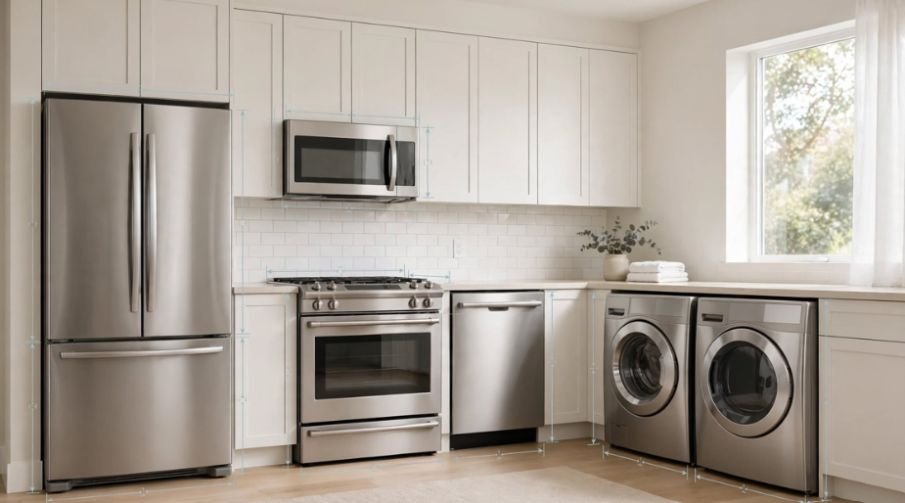
When I estimate how many cubic feet is a household appliance set, I first ask what the measurement will be used for. A standard four-piece kitchen package offers roughly 24–29 cubic feet of measurable internal capacity. Add a washer and dryer, and the combined capacity may reach about 35–45 cubic feet.
However, those figures cannot tell you how much room the appliances need inside a truck or storage unit. Exterior dimensions produce a much larger number.
The Quick Answer
A standard household appliance package can mean either a four-piece kitchen set or a larger kitchen-and-laundry collection.
| Appliance-set type | Typical combined internal capacity | Items included |
| Four-piece kitchen set | 24–29 cu. ft.* | Refrigerator, range, microwave, dishwasher |
| Laundry set | 10.5–12 cu. ft. | Washer and dryer |
| Kitchen and laundry package | 35–45 cu. ft.* | Six major appliances |
| Large-capacity package | 45–55+ cu. ft.* | Oversized kitchen and laundry models |
*Dishwashers are normally rated by place settings rather than cubic feet. Their interior space is therefore not included in the capacity total.
The direct answer to how many cubic feet is a household appliance set is usually 35–45 cubic feet when the package includes kitchen and laundry appliances. A four-piece kitchen-only package is closer to 24–29 cubic feet of rated capacity.
Typical Appliance Capacity Breakdown
Four-Piece Kitchen Package
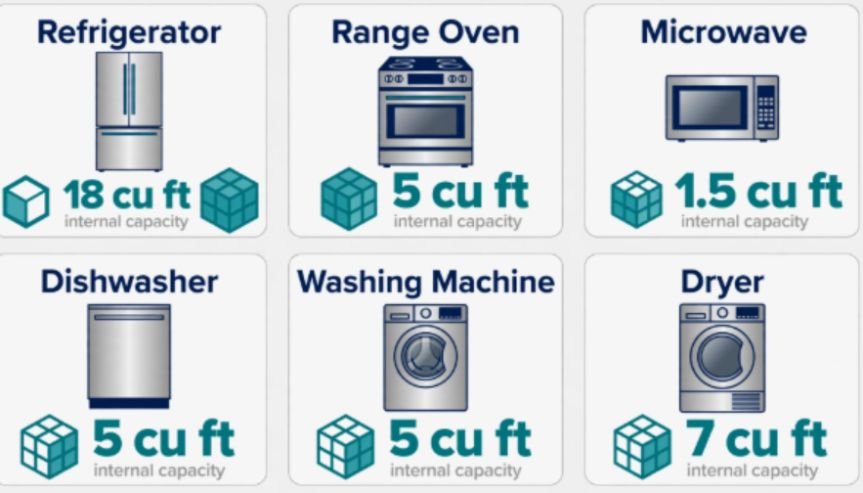
The refrigerator accounts for most of a kitchen package’s rated capacity. Whirlpool reports that medium refrigerators generally hold 14–21 cubic feet, while large models can provide 22–31 cubic feet or more.
Ranges and ovens commonly offer about 4.5–6 cubic feet. Microwaves add approximately 0.5–2.2 cubic feet. Maytag reports that most microwave interiors fall between 1 and 2.2 cubic feet, although compact units can be smaller.
| Kitchen appliance | Standard internal capacity |
| Refrigerator | 18–22 cu. ft. |
| Oven or range | 4.5–5.5 cu. ft. |
| Over-the-range microwave | 1.5–1.9 cu. ft. |
| Dishwasher | Usually rated for 12–14 place settings |
| Measurable kitchen total | About 24–29 cu. ft. |
These are planning ranges, not universal specifications. Check each product label before purchasing or moving a set.
Washer and Dryer Set
A standard washer usually holds 3.5–4.5 cubic feet. Large machines can exceed 5 cubic feet. Dryers commonly provide 7–7.5 cubic feet because clothing needs open space to tumble.
| Laundry appliance | Standard internal capacity |
| Washing machine | 3.5–4.5 cu. ft. |
| Clothes dryer | 7–7.5 cu. ft. |
| Combined laundry capacity | 10.5–12 cu. ft. |
This breakdown explains why the answer to how many cubic feet is a household appliance set changes when laundry equipment enters the calculation.
Internal Capacity vs. Exterior Appliance Volume
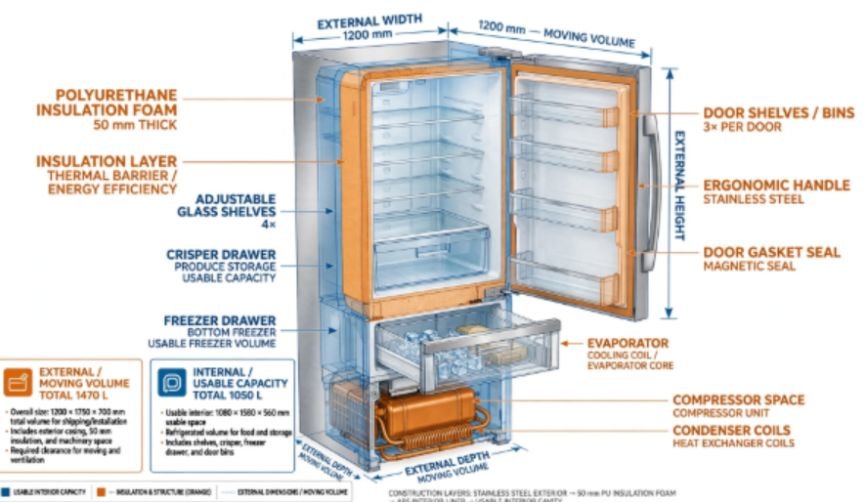
Internal capacity measures usable space inside an appliance. Refrigerator capacity describes food-storage space, while washer capacity describes drum space. It excludes walls, insulation, motors, compressors, controls, and packaging.
Exterior volume measures the rectangular space occupied by the entire unit:
Width × Height × Depth ÷ 1,728 = cubic feet
All measurements must be in inches. Whirlpool uses the same conversion method when explaining refrigerator capacity calculations.
A refrigerator advertised at 20 cubic feet might measure 30 × 66 × 33 inches externally:
30 × 66 × 33 ÷ 1,728 = 37.8 cubic feet
The refrigerator therefore holds about 20 cubic feet but occupies almost 38 cubic feet before protective wrapping. That difference matters when planning a furniture moving package or storage unit.
How to Calculate Appliance Moving Volume
Measure every appliance at its widest, tallest, and deepest points. Include handles and fixed projections unless they will be removed. Use packaged dimensions when appliances remain inside manufacturer cartons.
Worked Household Example
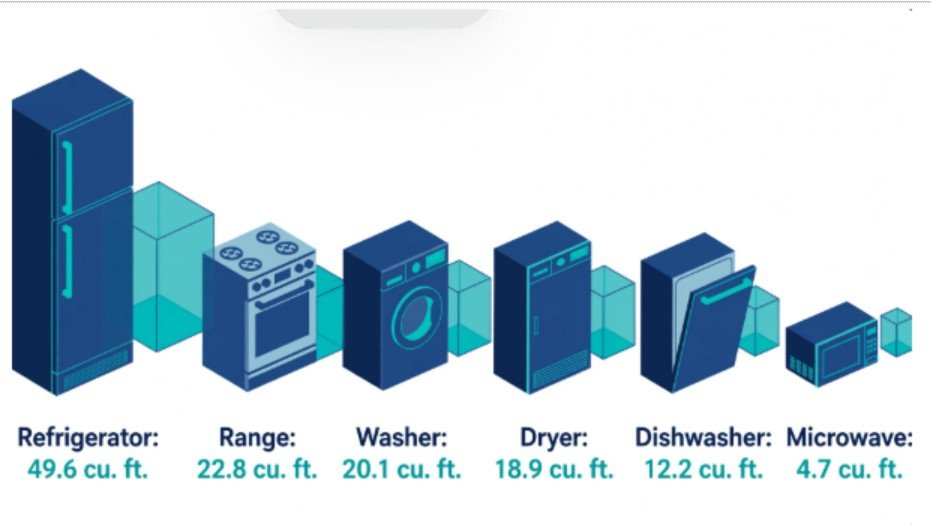
I calculated a realistic six-appliance package using representative exterior measurements:
| Appliance | Example dimensions | Exterior volume |
| Refrigerator | 36 × 70 × 34 in. | 49.6 cu. ft. |
| Range | 30 × 47 × 28 in. | 22.8 cu. ft. |
| Microwave | 30 × 17 × 16 in. | 4.7 cu. ft. |
| Dishwasher | 24 × 35 × 25 in. | 12.2 cu. ft. |
| Washer | 27 × 39 × 33 in. | 20.1 cu. ft. |
| Dryer | 27 × 39 × 31 in. | 18.9 cu. ft. |
| Total | — | 128.3 cu. ft. |
This comparison supplies the key information missing from most results. A set with roughly 35–45 cubic feet of internal capacity can occupy about 125–135 cubic feet externally.
Add 10%–20% for padding, cartons, hoses, and unavoidable gaps. The example package would need approximately 141–154 cubic feet of practical loading space.
Space Allowances People Commonly Miss
Appliance doors, handles, power cords, vents, water lines, and protective corners increase the required space. Refrigerator doors can also affect installation clearance. Whirlpool notes that standard refrigerator depths may extend to around 45 inches when the doors are open.
For a boxed appliance, use the carton measurements instead of the product’s bare dimensions. This is especially important when calculating the volume of a refrigerator box, as packaging can add several inches to every side.
Do not deduct hollow internal space when loading a truck. Movers cannot normally fill a refrigerator or washer with heavy objects. Loose items may damage shelves, drums, seals, and suspension components.
Choosing Storage or Moving-Truck Space
Knowing how many cubic feet is a household appliance set helps with comparison, but the exterior estimate controls moving decisions. A six-piece package may require 140–160 cubic feet after padding.
Leave extra room if other furniture shares the truck. Appliances also create awkward gaps because they cannot always be stacked. Keep refrigerators upright unless the manufacturer provides different transport instructions.
For storage, choose a climate-conscious location and leave narrow ventilation gaps. Drain washers, disconnect ice-maker lines, and dry appliance interiors before closing their doors.
Frequently Asked Questions
1. How many cubic feet does a four-piece kitchen appliance set have?
A standard set provides about 24–29 cubic feet of measurable internal capacity, excluding the dishwasher’s place-setting rating.
2. How many cubic feet is a household appliance set for moving?
A six-piece set can occupy roughly 125–135 cubic feet, or about 140–160 cubic feet with padding and loading gaps.
3. Does refrigerator capacity equal its moving volume?
No. A 20-cubic-foot refrigerator may occupy nearly 38 cubic feet when calculated from its exterior dimensions.
4. Should I use product or package dimensions?
Use package dimensions for boxed appliances and maximum exterior dimensions for unboxed units.
Measure the Boxes, Not the Labels
My practical answer is simple: use 35–45 cubic feet when comparing the combined internal capacity of a kitchen-and-laundry package. Use approximately 140–160 cubic feet when planning its protected moving space.
Record the width, height, and depth of every unit before booking a truck. That five-minute check can prevent a failed pickup, damaged appliance, or expensive storage upgrade.

Ryan Mitchell
Ryan Mitchell holds a degree in Civil Engineering and spent over a decade working in construction project estimation, where accurate volume and material calculations were part of his daily work — from concrete pours to landscaping material orders. He founded this site to bring that same precision to everyday calculations, helping DIYers, contractors, and students get fast, accurate cubic footage results without the guesswork. Ryan reviews every calculator and formula on this site for accuracy and writes guides based on real-world measurement scenarios he's encountered on job sites.


