


A van can look compact from the outside, but the amount of cargo it can carry may surprise you. From family road trips to cross-country moves and commercial deliveries, a van’s interior space can range from hundreds to thousands of cubic feet, depending on the design.
I have found that the biggest mistake people make is assuming every van offers similar storage capacity when the difference between a minivan, cargo van, moving van, and freight trailer is enormous.
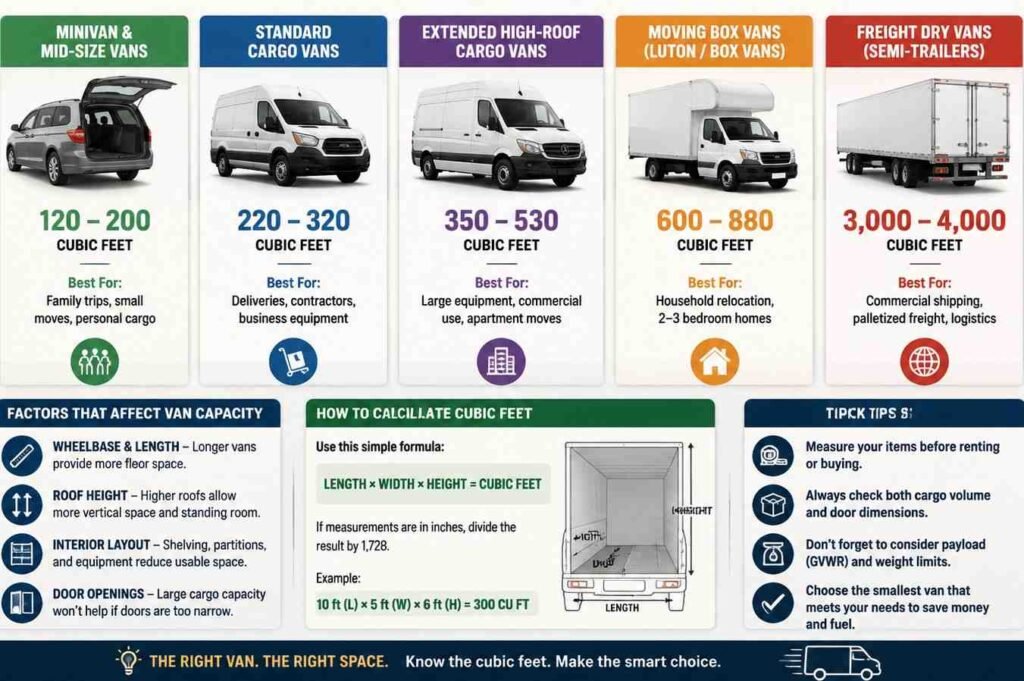
How many cubic feet a van has depends on several factors, including vehicle type, wheelbase, roof height, and interior layout. A small passenger van may provide around 120 cubic feet of usable cargo space, while an extended high-roof commercial van can exceed 500 cubic feet. If the term “van” refers to a freight dry van trailer used in logistics, the capacity can reach nearly 4,000 cubic feet.
Understanding these differences helps me choose the right vehicle for moving, business transportation, or everyday hauling without wasting money on unnecessary space. In this guide, I will break down van sizes, cargo capacities, real-world uses, and the measurements that matter most when comparing storage options.
How Many Cubic Feet Does a Typical Van Hold?
There is no single standard van size because manufacturers build vans for very different purposes. A passenger minivan, a contractor’s cargo van, and a commercial freight trailer may all be called “vans,” but their storage capacities are dramatically different.
A general breakdown looks like this:
| Van Type | Average Capacity | Common Uses |
| Minivan and midsize vans | 120–200 cubic feet | Family hauling, small moves, personal cargo |
| Standard cargo vans | 220–320 cubic feet | Deliveries, contractors, business equipment |
| Extended high-roof cargo vans | 350–530 cubic feet | Large equipment, commercial transport, apartment moves |
| Moving box vans | 600–880 cubic feet | Household relocation |
| Freight dry vans | 3,000–4,000 cubic feet | Commercial shipping |
The actual usable capacity can be lower than the advertised number because shelving, partitions, wheel wells, and interior equipment reduce available space.
How Many Cubic Feet Is a Cargo Van?

Cargo vans are among the most popular choices for US businesses because they balance maneuverability with storage capacity. They are commonly used by electricians, plumbers, delivery companies, mobile businesses, and movers.
A standard cargo van generally provides around 220 to 320 cubic feet of cargo space. Popular models such as the Ford Transit and Mercedes-Benz Sprinter offer different roof heights and wheelbase options that significantly change the interior volume. For example, Ford Transit cargo vans can range from about 246 cubic feet in smaller configurations to over 480 cubic feet in extended high-roof versions.
A standard cargo van is usually suitable for:
- Tools and equipment
- Business inventory
- Small furniture loads
- Local deliveries
- Studio apartment moves
The advantage of a cargo van is that it provides enclosed storage while remaining easier to drive and park than a box truck.
How Much Space Does a Minivan Provide?
Minivans are designed primarily for passengers, but they become surprisingly practical when the rear seats are folded or removed.
Most modern minivans provide approximately 120 to 200 cubic feet of maximum cargo volume, depending on the model and seating configuration. Vehicles such as the Chrysler Pacifica, Honda Odyssey, and Toyota Sienna are popular among US families because they combine passenger comfort with flexible storage.
A minivan works well for:
- Camping equipment
- Sports gear
- Shopping trips
- Small furniture purchases
- Weekend travel
However, the lower roof height and passenger-focused design make them less efficient than commercial cargo vans when transporting large or tall items.
How Much Cargo Space Does a High-Roof Extended Van Have?
High-roof extended vans provide some of the largest cargo areas available without moving into a dedicated moving truck.
These vans typically offer 350 to more than 530 cubic feet of interior volume. The extra height allows better vertical storage, while the longer wheelbase increases floor space.
For example, extended high-roof versions of commercial vans can approach the 500 cubic feet range. Ford Transit configurations reach more than 480 cubic feet behind the first row, while some maximum configurations exceed 530 cubic feet when optimized for cargo. Mercedes-Benz Sprinter models are also available with large cargo configurations designed for commercial applications.
These vans are commonly used for:
- Construction businesses
- Delivery services
- Mobile workshops
- Large equipment transportation
- One-bedroom apartment moves
How Many Cubic Feet Is a Moving Van or Box Van?
When people search for moving vehicles, they often mean larger box-style vans rather than traditional cargo vans.
Moving box vans and Luton-style vehicles provide much more storage because the cargo area extends above and behind the cab. These vehicles typically offer around 600 to 880 cubic feet of space.
A small moving box van can handle:
- Multi-room apartment moves
- Large furniture pieces
- Appliances
- Household boxes
Professional moving companies often use these larger vehicles because the box-shaped design creates more usable space than a standard van.
How Many Cubic Feet Is a Freight Dry Van Trailer?
In the transportation industry, a “dry van” usually refers to a fully enclosed semi-trailer rather than a traditional cargo van.
A standard 53-foot dry van trailer typically provides around 3,800 to 4,000 cubic feet of cargo capacity. These trailers are designed for palletized freight, warehouse shipments, and long-distance transportation.
A 48-foot dry van is generally smaller, offering roughly 3,000 to 3,500 cubic feet depending on interior dimensions.
This category is important because it shows how widely the word “van” can be used. A delivery company’s cargo van and a highway freight dry van serve completely different purposes.
What Factors Affect a Van’s Cubic Feet?
The listed cargo volume is only a starting point. When I evaluate storage capacity, I also consider several practical factors.
Wheelbase and Length
A longer wheelbase increases the available floor area. Extended vans can carry more cargo but may be harder to maneuver in cities or tight parking areas.
Roof Height
Roof height directly affects interior volume. High-roof vans provide additional vertical space, making them particularly useful when I need to transport bulky items or maximize usable interior volume.
Interior Layout
Factory shelving, storage racks, partitions, and built-in equipment reduce usable cargo space. An empty van and a fully equipped work van with the same specifications may have very different practical capacities.
Door Opening Size
Cargo volume does not always mean an item will fit. Large furniture or equipment may require checking rear and side door dimensions before loading.
How Do I Calculate Van Cargo Space?
If I want to estimate a van’s storage capacity, I use a simple volume calculation:
Length × Width × Height = Cubic Feet
When measurements are taken in inches, I divide the result by 1,728 because there are 1,728 cubic inches in one cubic foot.
For example, a cargo area measuring:
10 feet long × 5 feet wide × 6 feet high
equals:
10 × 5 × 6 = 300 cubic feet
A cubic feet calculator can make comparisons easier when deciding between different van sizes.
How Much Can Fit Inside a Van?

The amount a van can carry depends on the type of items being transported. A vehicle with 300 cubic feet of space may carry many boxes but may not fit oversized furniture because of shape limitations.
Similar to comparing hatchback cargo space, the available volume does not always determine practicality, since the layout, opening size, and shape of the storage area can affect what actually fits inside.
A standard cargo van can usually handle:
- Tools and business equipment
- Several dozen moving boxes
- Small apartment belongings
An extended cargo van can often handle larger household loads, while a box van is better suited for complete home relocations.
Frequently Asked Questions (FAQs)
1. How many cubic feet is a van on average?
Most everyday vans provide between 120 and 530 cubic feet of storage space. The exact amount depends on whether it is a passenger van, cargo van, or extended commercial model.
2. How many cubic feet is a cargo van?
A typical cargo van provides around 220 to 320 cubic feet, while larger high-roof extended models can exceed 500 cubic feet.
3. Is a van bigger than a moving truck?
Most cargo vans are smaller than moving trucks, but extended vans can provide enough space for smaller household moves. Larger box trucks offer significantly more capacity.
4. Can I use a van for moving furniture?
Yes. A cargo van can handle many furniture items, especially for studio apartments and smaller moves. Larger homes usually require a box truck or moving van.
Conclusion
When I choose a van, I focus on how the space will actually be used rather than only looking at the advertised number. A compact passenger van may be perfect for daily transportation, while a high-roof cargo van can provide hundreds of cubic feet for business or moving needs.
The answer to how many cubic feet a van has changes depending on the vehicle category. From smaller 120-cubic-foot passenger vans to 4,000-cubic-foot freight trailers, understanding cargo volume helps me select the right option for transportation, moving, or commercial work.
Using a cubic feet calculation tool can also help estimate available space and compare different van sizes more accurately before making a decision.

Ryan Mitchell
Ryan Mitchell holds a degree in Civil Engineering and spent over a decade working in construction project estimation, where accurate volume and material calculations were part of his daily work — from concrete pours to landscaping material orders. He founded this site to bring that same precision to everyday calculations, helping DIYers, contractors, and students get fast, accurate cubic footage results without the guesswork. Ryan reviews every calculator and formula on this site for accuracy and writes guides based on real-world measurement scenarios he's encountered on job sites.