

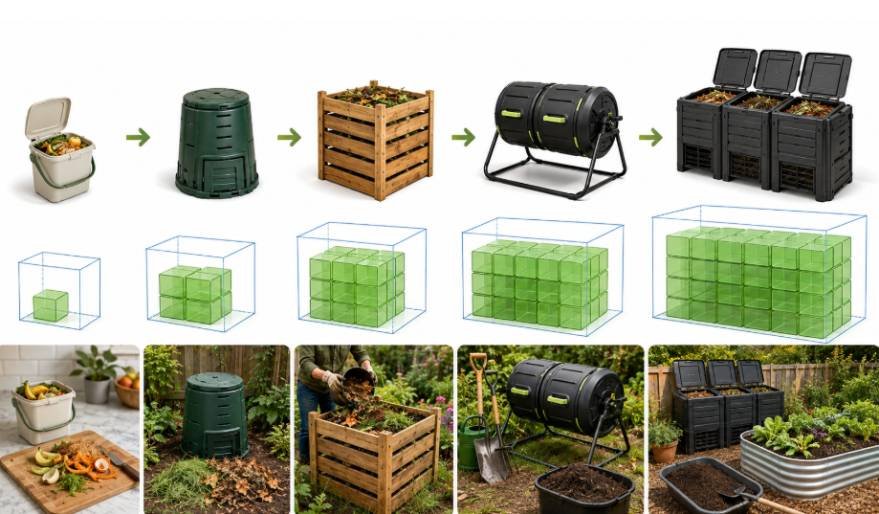
When I first compared compost bins, I noticed that manufacturers used gallons, liters, and physical dimensions interchangeably. That made a simple capacity comparison surprisingly difficult. If you are wondering How Many Cubic Feet Is a Compost Bin?, the practical answer is approximately 5 to 15 cubic feet for many manufactured outdoor models. However, a traditional backyard bin measuring 3 feet on every side provides 27 cubic feet.
The correct capacity depends on whether you mean a countertop scrap container, rotating tumbler, enclosed outdoor composter, or large wooden composting system. Understanding these differences helps prevent purchasing a bin that fills too quickly or remains too empty to produce adequate heat.
Average Compost Bin Capacity
Small kitchen containers generally hold between 1 and 5 gallons, equal to approximately 0.13 to 0.67 cubic feet. These containers collect vegetable peels, coffee grounds, eggshells, and other food scraps before they are transferred outdoors. They normally do not create finished compost independently.
Compact outdoor tumblers usually provide between 2 and 5 cubic feet. Standard rotating composters commonly hold 5 to 9 cubic feet, while larger models may offer 10 to 14 cubic feet. A 45-gallon tumbler, for example, holds approximately 6 cubic feet.
Enclosed stationary compost bins frequently range from 10 to 33 cubic feet. An 85-gallon model provides approximately 11.4 cubic feet, while a 246-gallon expandable bin offers nearly 32.9 cubic feet.
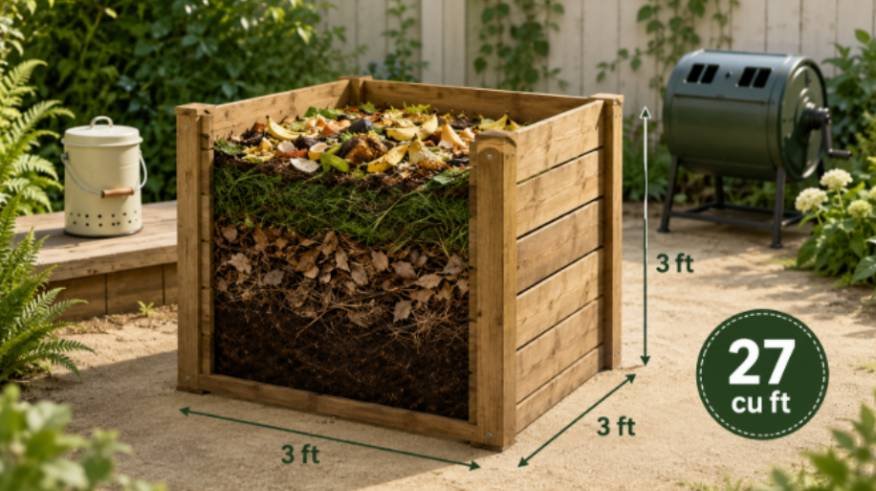
Wooden backyard bins are considerably larger and can also provide a practical way to reuse timber that might otherwise be difficult to dispose of wood responsibly. A bin measuring 3 feet long, 3 feet wide, and 3 feet high contains 27 cubic feet, or exactly one cubic yard. Increasing every side to 4 feet raises the capacity to 64 cubic feet. That single additional foot more than doubles the available volume.
Compost Bin Capacity by Type
Countertop Food-Scrap Collectors
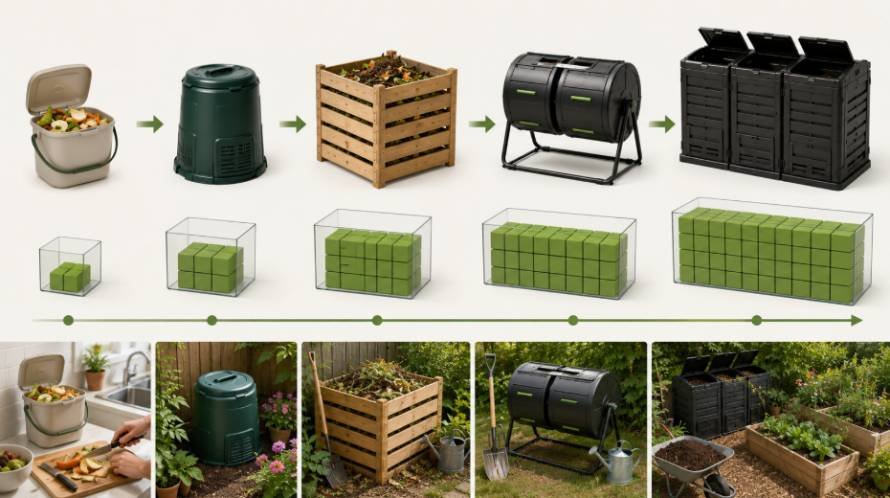
A countertop container is designed for convenience rather than active decomposition. Common capacities range from 1.3 to 5 gallons, equal to about 0.17 to 0.67 cubic feet.
A small container is easier to fit beneath a sink or beside a food-preparation area. However, it requires frequent emptying to limit moisture, odors, insects, and mold. A larger kitchen container reduces emptying frequency but occupies more cabinet or floor space.
Compost Tumblers
Tumblers are elevated containers that rotate around an axle. Compost tumbler capacity varies by model, with smaller units holding approximately 15 to 35 gallons, or 2 to 4.7 cubic feet
Dual-chamber tumblers allow one batch to mature while fresh material goes into the other chamber. Their advertised total capacity can be misleading because each chamber provides only part of the listed volume. A 6-cubic-foot dual-chamber unit may provide only about 3 cubic feet per chamber.
Enclosed Backyard Bins
Stationary plastic bins often hold between 60 and 100 gallons, equal to approximately 8 to 13.4 cubic feet. Expandable mesh or plastic systems may exceed 200 gallons.
These bins accept greater amounts of leaves, garden trimmings, and kitchen waste than most tumblers. They also conserve ground space because manufacturers frequently use tall or tapered designs. Their contents must still receive adequate moisture and airflow.
Wooden and Multi-Bay Systems
A traditional 3-foot cube provides 27 cubic feet. This size can retain enough heat for active decomposition while remaining manageable to turn. Larger 4-foot cubes offer 64 cubic feet but require substantially more compostable material.
A multi-bay system can separate fresh ingredients, actively decomposing material, and finished compost. Three 3-foot-cube chambers provide 81 cubic feet collectively, although each chamber continues to function as a separate 27-cubic-foot pile.
How to Calculate Cubic Feet
Rectangular Compost Bins
Measure the usable interior length, width, and height in feet. Multiply the three measurements:
Cubic feet = length × width × height
A bin with an interior measuring 2.5 feet long, 2 feet wide, and 3 feet high holds 15 cubic feet.
When measurements are in inches, multiply the interior length, width, and height and divide the result by 1,728. A container measuring 30 × 24 × 36 inches therefore offers 15 cubic feet.
Round Compost Bins
For a cylindrical bin, divide its interior diameter by two to determine the radius. Multiply 3.1416 by the radius squared and then by the interior height:
Cubic feet = 3.1416 × radius² × height
Keep every measurement in feet before applying the formula. If measurements remain in inches, divide the final result by 1,728.
Tapered Compost Bins
Many plastic bins are wider at the base than at the top. Multiplying the maximum exterior dimensions will overstate their usable capacity. For a practical estimate, measure the top and bottom widths, calculate their average, and use that figure with the average depth and interior height.
The manufacturer’s stated gallon capacity is usually more reliable for strongly tapered or irregularly shaped models.
Converting Gallons to Cubic Feet
One cubic foot equals approximately 7.48052 gallons. To use a compost bin cubic feet calculator, divide the advertised gallon capacity by 7.48052 to convert it into cubic feet.
A 30-gallon bin holds about 4 cubic feet. A 52-gallon composter holds approximately 6.95 cubic feet, while a 100-gallon outdoor bin provides around 13.37 cubic feet.
Remember that advertised capacity describes the maximum interior volume. The recommended working volume may be lower because compost needs air pockets and room for mixing.
Interior Capacity Versus Exterior Size
Interior capacity measures how much compostable material the bin can contain. Exterior cubic footage measures the physical space occupied by the entire unit.
Interior capacity measures how much compostable material the bin can contain. Exterior cubic footage measures the physical space occupied by the entire unit. Comparing recycling bin capacity with compost-bin capacity can also help when estimating how much space different household containers require.
Frames, handles, lids, legs, axles, wall thickness, and air gaps increase exterior dimensions without increasing usable capacity. This distinction matters when placing a tumbler beside a fence, inside a shed, or beneath a covered area. Rotating models also need clearance around the chamber and enough space to open their access panels.
Choosing the Right Compost Bin Size
A household composting only kitchen scraps may find a 4-to-7-cubic-foot tumbler sufficient. Adding leaves, grass clippings, weeds, and garden debris can quickly justify a bin holding 10 cubic feet or more.
Hot composting generally works better with a substantial mass. A 3 × 3 × 3-foot pile provides 27 cubic feet and is widely treated as a practical starting size because it can retain heat without becoming exceptionally difficult to aerate.
Waste production matters more than household size alone. A small household with a large yard may generate more material than a larger household without landscaping.
Comparing trash can capacity with compost-bin capacity can also help households estimate how much waste and organic material they produce.
Frequently Asked Questions
1. How many cubic feet does a 50-gallon compost bin hold?
A 50-gallon bin holds approximately 6.68 cubic feet. Divide 50 by 7.48052 to obtain the conversion.
2. How Many Cubic Feet Is a Compost Bin?
Most manufactured outdoor compost bins hold approximately 5 to 15 cubic feet. Compact tumblers may hold around 2 cubic feet, while a standard 3-foot backyard cube holds 27 cubic feet.
3. Is a larger compost bin always better?
No. An oversized bin may take too long to fill, while an undersized unit can become overloaded. The best size matches the volume of food scraps and yard debris regularly produced.
4. Does a kitchen compost bin make compost?
Most countertop bins only collect food scraps. The contents must usually be transferred to an outdoor composter, worm bin, municipal collection cart, or another processing system.
Final Thoughts
When I choose a compost bin, I consider usable interior capacity rather than relying only on exterior dimensions. For many households, 5 to 15 cubic feet offers a practical balance between capacity and manageability. A 27-cubic-foot backyard bin is more suitable when hot composting and substantial yard waste are involved.
Knowing How Many Cubic Feet Is a Compost Bin? makes it easier to compare gallons, evaluate available space, and avoid buying an unsuitable model. Measuring the interior and matching the result to actual waste production provides a far more reliable answer than selecting a bin based on appearance alone.

Ryan Mitchell
Ryan Mitchell holds a degree in Civil Engineering and spent over a decade working in construction project estimation, where accurate volume and material calculations were part of his daily work — from concrete pours to landscaping material orders. He founded this site to bring that same precision to everyday calculations, helping DIYers, contractors, and students get fast, accurate cubic footage results without the guesswork. Ryan reviews every calculator and formula on this site for accuracy and writes guides based on real-world measurement scenarios he's encountered on job sites.


