

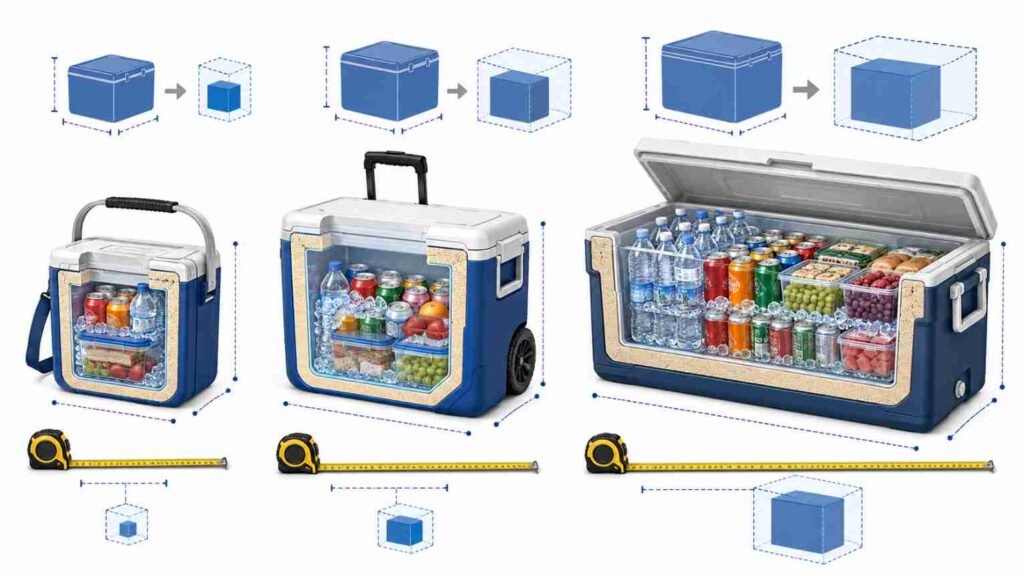
The number printed on a cooler can be surprisingly misleading. I used to assume a 50-quart model offered all that room for food and drinks, but ice, thick insulation, and irregular packaging quickly consumed the available space.
If you are wondering How Many Cubic Feet Is a Cooler?, most portable models provide between 0.17 and 5 cubic feet of advertised internal capacity. Personal coolers sit near the bottom of that range, while large expedition models can exceed 5 cubic feet.
What Is the Average Cooler Capacity in Cubic Feet?
A typical portable cooler holds approximately 0.5 to 3.3 cubic feet. The exact figure depends on whether it is designed for lunches, day trips, family camping, fishing, or extended outdoor travel.
Small personal coolers usually range from 5 to 15 quarts, equal to approximately 0.17 to 0.50 cubic feet. Models between 20 and 35 quarts provide about 0.67 to 1.17 cubic feet and work well for short trips.
Medium coolers commonly hold 40 to 75 quarts, or approximately 1.34 to 2.51 cubic feet. These sizes suit weekend travel, small families, and outdoor gatherings. Large coolers between 100 and 150 quarts offer approximately 3.34 to 5.01 cubic feet and are intended for group events, hunting, fishing, or extended travel.
These numbers describe nominal capacity. The amount of food and drink that actually fits will usually be smaller.
How to Convert Cooler Quarts to Cubic Feet
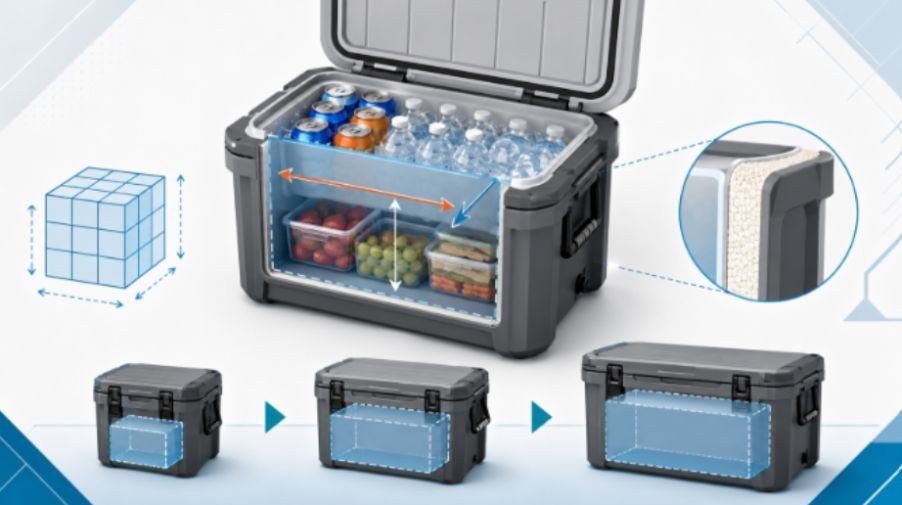
Portable cooler manufacturers usually advertise capacity in US liquid quarts instead of cubic feet. One US liquid quart equals approximately 0.03342 cubic feet. You can therefore use this calculation:
Cubic feet = quarts × 0.03342
You can also divide the cooler’s quart capacity by 29.922. Both methods produce nearly the same result.
A 30-quart cooler contains approximately 1 cubic foot. A 45-quart model provides about 1.50 cubic feet, while a 60-quart cooler holds approximately 2.01 cubic feet. A large 100-quart model has a nominal capacity of around 3.34 cubic feet.
The conversion is useful when comparing a cooler with trunk space, a garage shelf, a boat compartment, or another storage area measured in cubic feet.
How to Measure an Unmarked Cooler
A worn or older cooler may no longer have a readable capacity label. In that case, measure the usable interior rather than the outside and use the same cubic-foot measurement approach used for a mini refrigerator to estimate its capacity.
Measuring a Rectangular Interior
Measure the interior length, width, and usable depth in inches. Multiply all three measurements and divide the result by 1,728:
Cubic feet = length × width × depth ÷ 1,728
Suppose the interior measures 22 inches long, 12 inches wide, and 13 inches deep. Multiplying these dimensions produces 3,432 cubic inches. Dividing by 1,728 gives approximately 1.99 cubic feet.
Measure below the lid and exclude space occupied by internal baskets, dividers, raised drains, or wheel housings.
Accounting for Tapered Walls
Many hard-sided coolers have tapered walls, rounded corners, or sloped bases. A simple rectangular calculation may slightly overestimate their capacity, just as the shape and positioning of a wind catcher can affect the amount of space it occupies.
For a practical estimate, take measurements near the middle of the interior rather than using only the widest points. For greater accuracy, calculate the larger upper section and smaller lower section separately, then average the results.
Soft coolers are harder to measure because their shape changes depending on how they are packed. Their advertised capacity is generally more useful than an exterior-dimension calculation.
Internal Capacity Versus Exterior Cubic Footage
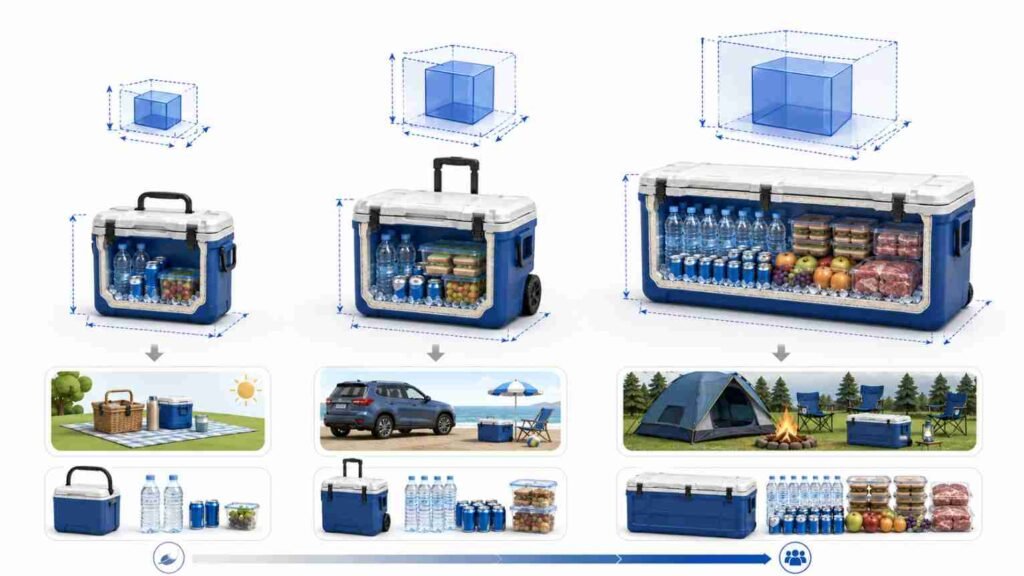
Internal capacity shows how much the cooler can hold. Exterior cubic footage shows how much physical room the entire cooler occupies in a vehicle, cabinet, or storage area.
Thick insulated walls create a major difference between these figures. A cooler with 1.5 cubic feet of internal space might occupy considerably more than 3 cubic feet externally. The same distinction matters when comparing the storage capacity of a chest freezer, where interior capacity and exterior dimensions can also differ. Handles, wheels, latches, hinges, and lid overhang can increase its storage footprint further.
To estimate exterior volume, multiply the cooler’s outside length, width, and height in inches, then divide by 1,728. This calculation helps determine whether the cooler will fit inside a trunk, beneath a tonneau cover, or on a shelf. It should not be used as the cooler’s food capacity.
How Ice Changes Usable Cooler Space
Ice may be the biggest reason advertised capacity feels different in practice. For multi-day cooling, many manufacturers recommend roughly two parts ice for every one part food and beverages. A separate food and drink in cooler cutting board hack can also create organized sections, reduce unnecessary searching, and make better use of the remaining storage space.
Under this guideline, a 60-quart cooler with 2.01 cubic feet of nominal capacity might provide only about 0.67 cubic feet for food and drinks. The remaining space would hold approximately 1.34 cubic feet of ice.
The ratio can be more flexible for a picnic or day trip. Frozen bottles and reusable ice packs may also require less messy packing than loose ice, although their cooling performance depends on the trip length and outside temperature.
Packing efficiency matters as well. Standard cans stack neatly, but bowls, bottles, food containers, and packaged meat create empty gaps. This explains why two coolers with identical quart ratings may feel different during actual use.
Choosing the Right Cooler Size
When deciding How Many Cubic Feet Is a Cooler?, capacity should be considered alongside the number of travelers, trip duration, transportation space, and the quantity of ice required.
A cooler around 0.5 cubic feet is generally adequate for one person’s lunch or a short outing. A model between 1 and 1.7 cubic feet offers more flexibility for couples, beach trips, picnics, and small gatherings.
For weekend camping, a cooler between 1.7 and 2.5 cubic feet often provides a practical balance between capacity and portability. Families and larger groups may need 3.3 cubic feet or more, especially when supplies must remain cold for several days.
Bigger is not always better. An oversized cooler is difficult to lift when filled and may perform poorly when left mostly empty. Choosing a size that can be packed efficiently helps maintain a colder internal temperature.
Frequently Asked Questions
1. How Many Cubic Feet Is a Cooler?
Most portable coolers hold between 0.17 and 5 cubic feet. A common 30-quart model is approximately 1 cubic foot, while a 50-quart model offers about 1.67 cubic feet.
2. How many cubic feet is a 45-quart cooler?
A 45-quart cooler has approximately 1.50 cubic feet of nominal internal capacity. Ice and packaging reduce the space available for food and beverages.
3. Does can capacity include room for ice?
Not always. Manufacturers may calculate can capacity using a specific ice-to-can ratio or without ice. Check the product’s stated testing method before comparing different brands.
4. Are cooler model numbers the same as capacity?
Not necessarily. A model number containing “65” does not always mean the cooler holds exactly 65 quarts. Interior insulation and product design can make the actual rated capacity different.
Final Thoughts
I would never choose a cooler from its exterior appearance alone. Quart conversion provides a reliable starting point, but usable storage depends on insulation, interior shape, packaging, and the amount of ice required.
For a quick estimate, I multiply the advertised quarts by 0.03342. I then reserve additional room for ice and check the exterior dimensions against the available vehicle or storage space. This approach gives me a much more realistic picture of whether a cooler will work for a short outing, family event, or multi-day adventure.

Ryan Mitchell
Ryan Mitchell holds a degree in Civil Engineering and spent over a decade working in construction project estimation, where accurate volume and material calculations were part of his daily work — from concrete pours to landscaping material orders. He founded this site to bring that same precision to everyday calculations, helping DIYers, contractors, and students get fast, accurate cubic footage results without the guesswork. Ryan reviews every calculator and formula on this site for accuracy and writes guides based on real-world measurement scenarios he's encountered on job sites.


