

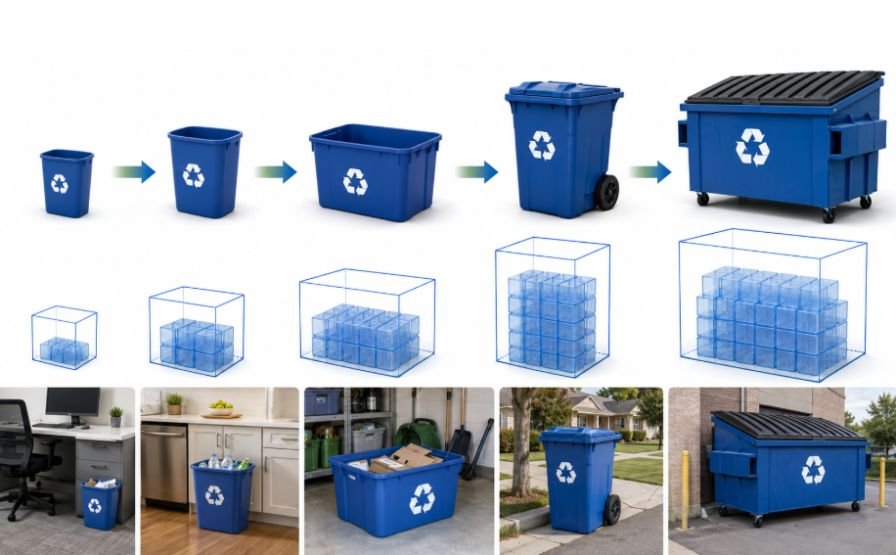
I once thought every curbside recycling container was essentially the same size. That changed when I compared a small open-top bin with a full-size wheeled cart and discovered a surprisingly large difference. How Many Cubic Feet Is a Recycling Bin? Most household models provide approximately 1.9 to 12.8 cubic feet, depending on their gallon rating, design, and intended use.
Understanding this measurement helps when choosing a container, planning garage space, estimating collection needs, or moving a bin to another property. Although manufacturers normally advertise capacity in gallons, converting that number into cubic feet is straightforward.
Average Recycling Bin Capacity
There is no universal recycling-bin size. A small indoor container may hold 10 to 16 gallons, while an open-top curbside bin commonly holds approximately 14 to 18 gallons. Wheeled residential carts are much larger and frequently come in 32-, 35-, 64-, 65-, 95-, or 96-gallon sizes.
A 14-gallon bin provides approximately 1.87 cubic feet. An 18-gallon model holds around 2.41 cubic feet, while a 32-gallon cart provides about 4.28 cubic feet. A 64-gallon cart holds approximately 8.56 cubic feet, and a 96-gallon container offers about 12.83 cubic feet.
The correct choice depends on household size, collection frequency, available storage space, and the amount of recyclable packaging generated each week.
Comparing recycling containers with trash can capacity can also help homeowners choose the right size for different types of household waste.
Common Recycling Bin Sizes Explained
Small Indoor Recycling Bins
Indoor containers generally range from 5 to 20 gallons. A 10-gallon model holds approximately 1.34 cubic feet, while a 20-gallon container offers about 2.67 cubic feet.
These bins work well in kitchens, apartments, classrooms, and offices. Their smaller size makes them easier to lift and clean, but they require more frequent emptying. Tall, narrow models can provide useful capacity without occupying excessive floor space.
Open-Top Curbside Bins
Traditional open-top recycling bins commonly hold between 14 and 18 gallons. Their capacity ranges from approximately 1.87 to 2.41 cubic feet.
They are lightweight, stackable, and easy to carry. However, they can become difficult to manage when filled with glass or heavy paper. Their open design may also expose loose materials to rain or wind.
Wheeled Recycling Carts
Wheeled carts are typically available in capacities between 32 and 96 gallons. A 32-gallon cart holds about 4.28 cubic feet, while a 35-gallon version provides approximately 4.68 cubic feet.
Medium-sized 64- and 65-gallon carts offer roughly 8.56 and 8.69 cubic feet. Large 95- and 96-gallon models provide approximately 12.70 and 12.83 cubic feet. These larger containers suit families, properties with biweekly collection, and households that regularly receive cardboard packaging.
How to Convert Gallons to Cubic Feet
Recycling containers are usually labeled in gallons because waste-collection companies use gallon ratings to standardize residential carts. One cubic foot equals approximately 7.48052 liquid gallons.
Use this formula:
Gallons ÷ 7.48052 = cubic feet
For example, dividing 64 by 7.48052 produces approximately 8.56 cubic feet. Dividing 96 by the same number gives approximately 12.83 cubic feet.
For a quick estimate, gallons can be divided by 7.5. This rounded calculation is adequate for general comparisons, but the precise conversion is better when planning a tight storage space.
The formula can also be reversed. Multiply cubic feet by 7.48052 to estimate gallons. A five-cubic-foot container, for example, holds approximately 37.4 gallons.
How to Measure an Unmarked Recycling Bin
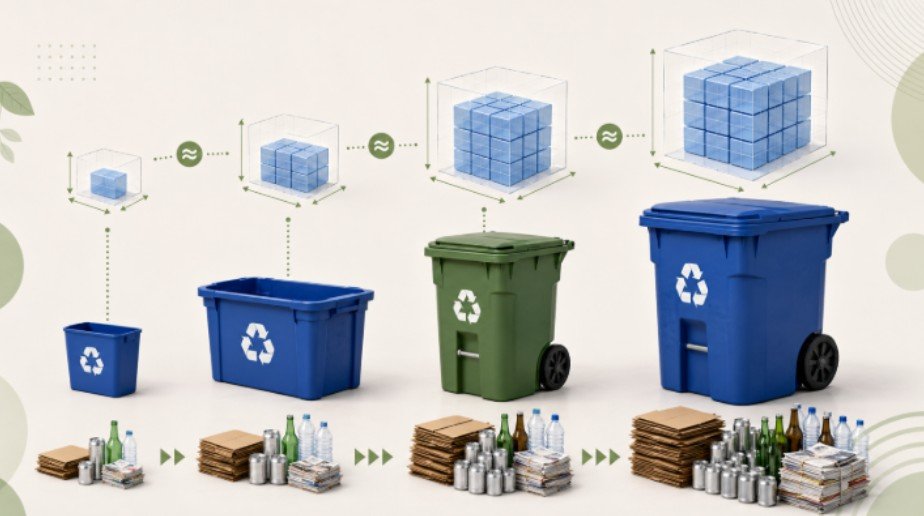
An older container may have no readable capacity label. In that case, measuring its interior can provide a reasonable estimate.
Rectangular Containers
Measure the interior length, width, and usable height in inches. Multiply the three measurements and divide the result by 1,728, the number of cubic inches in one cubic foot.
The formula is:
Length × width × height ÷ 1,728 = cubic feet
Suppose the inside measures 24 inches long, 18 inches wide, and 20 inches high. Multiplying those figures gives 8,640 cubic inches. Dividing by 1,728 produces an estimated five cubic feet.
Round Containers
For a cylindrical bin, divide its interior diameter by two to find the radius. Multiply 3.1416 by the radius squared and then by the usable interior height. Divide the result by 1,728 when the original measurements are in inches. This method allows you to use a recycling bin cubic feet calculator to estimate the container’s capacity quickly and accurately.
This formula works best for straight-sided containers. Tapered walls require an adjusted calculation because the top and bottom widths are different.
Rated Capacity and Exterior Volume Are Different
A container’s rated capacity represents the amount its interior can theoretically hold. Exterior cubic footage measures the rectangular space occupied by the complete bin.
These figures are rarely equal. Wheeled carts have tapered walls, rounded corners, lids, handles, lifting bars, reinforced sections, axles, and wheels. Multiplying the full exterior dimensions therefore produces a larger number than the advertised capacity.
Interior measurements should be used when estimating how many recyclables the container can hold. Exterior dimensions are more useful when checking whether it will fit through a gate, beside a garage, inside a storage shed, or within a moving vehicle.
Choosing the Right Capacity
A smaller household with weekly collection may find a 20- or 32-gallon cart sufficient. A family generating more cardboard, plastic containers, metal cans, and paper may benefit from a 64-gallon model. A 96-gallon cart can be helpful when collection occurs every two weeks or when the household receives frequent deliveries.
Flattening cardboard saves considerable space. Containers should also be emptied, rinsed when required, and placed loosely inside the cart. Bagging recyclables can cause problems in areas where plastic bags are not accepted by sorting facilities.
Before ordering a large cart, measure its proposed storage area and the narrowest gate or walkway along its route. It is also important to confirm which sizes the local collection provider can lift with its trucks.
Residential Carts Versus Commercial Bins
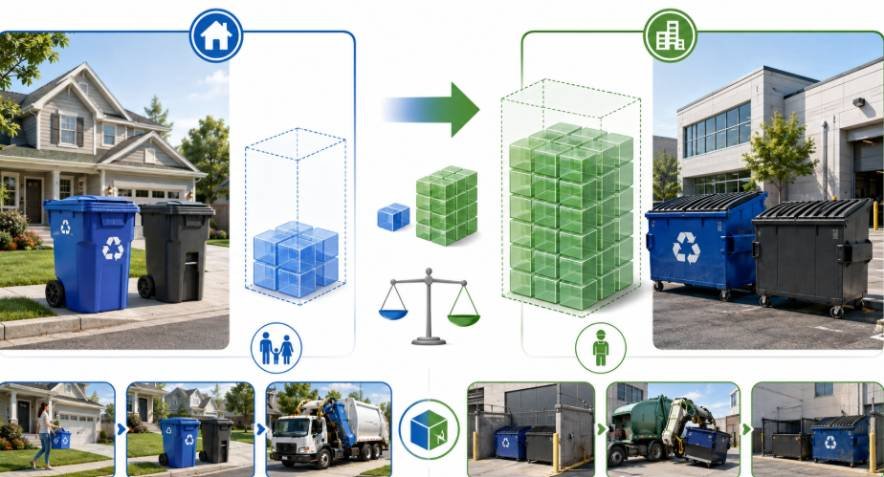
Residential recycling carts are generally measured in gallons, while commercial recycling dumpsters are normally measured in cubic yards. One cubic yard equals 27 cubic feet or approximately 202 gallons.
Comparing these larger and smaller containers with compost tumbler capacity can help illustrate how waste-management equipment varies by intended use and storage volume.
Commercial front-load containers commonly provide one to eight cubic yards. Roll-off recycling containers may offer 15 to 40 cubic yards for construction debris, bulk cardboard, or large-volume materials.
A one-cubic-yard dumpster holds more than twice the rated capacity of a 96-gallon residential cart. Businesses should consider material type, pickup frequency, enclosure dimensions, and loading access when choosing a container.
Frequently Asked Questions
1. How Many Cubic Feet Is a Recycling Bin?
A household recycling bin generally holds between 1.9 and 12.8 cubic feet. An 18-gallon bin provides approximately 2.41 cubic feet, while 64- and 96-gallon carts hold around 8.56 and 12.83 cubic feet.
2. How many cubic feet does a 32-gallon cart hold?
A 32-gallon recycling cart holds approximately 4.28 cubic feet. Its exterior footprint will usually be larger than its usable interior capacity.
3. Is a 96-gallon cart equal to half a cubic yard?
Not quite. A 96-gallon cart provides approximately 12.83 cubic feet, while half a cubic yard equals 13.5 cubic feet.
4. Should I measure the inside or outside of the bin?
Measure the inside to estimate usable capacity. Measure the outside when determining how much storage, transportation, or clearance space the complete container requires.
The Final Measure
When I select a recycling container, I look beyond the gallon number and consider how the bin will actually be used. A compact household model may hold around two cubic feet, while a large wheeled cart can approach 13 cubic feet.
Understanding How Many Cubic Feet Is a Recycling Bin? helps me compare capacities, calculate storage requirements, and avoid selecting a container that is too small or difficult to move. Checking the manufacturer’s rating is the quickest option, but accurate interior measurements offer a reliable alternative when the label is unavailable.

Ryan Mitchell
Ryan Mitchell holds a degree in Civil Engineering and spent over a decade working in construction project estimation, where accurate volume and material calculations were part of his daily work — from concrete pours to landscaping material orders. He founded this site to bring that same precision to everyday calculations, helping DIYers, contractors, and students get fast, accurate cubic footage results without the guesswork. Ryan reviews every calculator and formula on this site for accuracy and writes guides based on real-world measurement scenarios he's encountered on job sites.


