

A trash can rarely attracts attention until its liner keeps slipping, its lid will not close, or it refuses to fit inside a cabinet. I learned that the capacity printed on the label only tells part of the story.
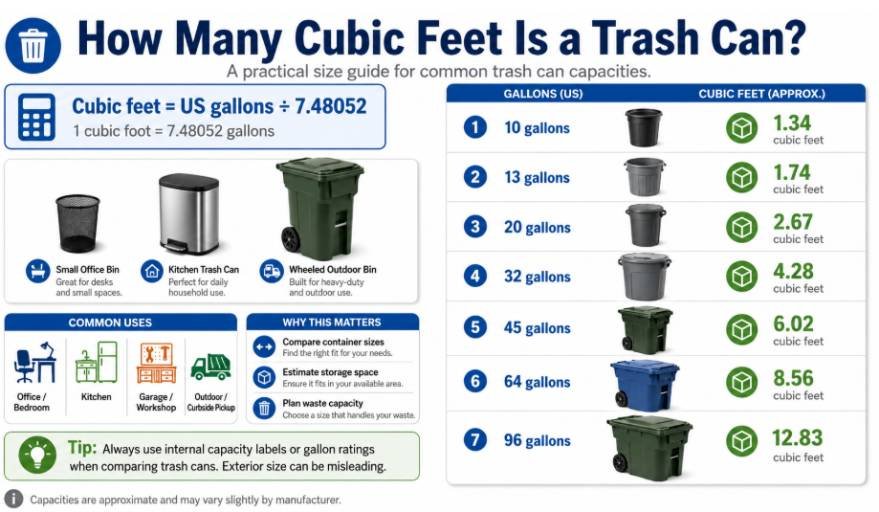
If I want to understand How Many Cubic Feet Is a Trash Can?, I must consider its gallon rating, interior dimensions, shape, and intended purpose. A typical 13-gallon kitchen trash can holds approximately 1.74 cubic feet, while other models range from less than half a cubic foot to nearly 13 cubic feet.
Knowing this measurement helps me compare products, choose suitable liners, estimate waste capacity, and determine whether a bin will fit into an available space.
Quick Answer: Average Trash Can Cubic Footage
There is no universal trash can capacity. A compact 3-gallon bathroom bin holds approximately 0.40 cubic feet, while a 5-gallon container holds about 0.67 cubic feet. Office wastebaskets commonly range from 7 to 10 gallons, providing approximately 0.94 to 1.34 cubic feet.
Kitchen trash cans usually hold between 10 and 16 gallons. This equals approximately 1.34 to 2.14 cubic feet. The familiar 13-gallon kitchen model sits near the middle of that range at approximately 1.74 cubic feet.
Larger 20- and 32-gallon containers hold approximately 2.67 and 4.28 cubic feet, respectively. Commercial 44- and 55-gallon cans provide about 5.88 and 7.35 cubic feet. A 64-gallon wheeled cart holds approximately 8.56 cubic feet, while a large 96-gallon cart provides around 12.83 cubic feet.
Converting Trash Can Gallons Into Cubic Feet
Trash cans are frequently advertised in gallons rather than cubic feet. One cubic foot equals approximately 7.48052 gallons. To determine how many cubic feet is a trash can, divide its advertised capacity in gallons by 7.48052.
The formula is:
Cubic feet = gallons ÷ 7.48052
For a 13-gallon trash can, the calculation is 13 ÷ 7.48052, producing approximately 1.74 cubic feet. For a 32-gallon can, dividing 32 by 7.48052 produces about 4.28 cubic feet.
This conversion estimates the container’s rated internal capacity. It does not necessarily show how much exterior space the trash can occupies.
How to Measure Trash Can Volume
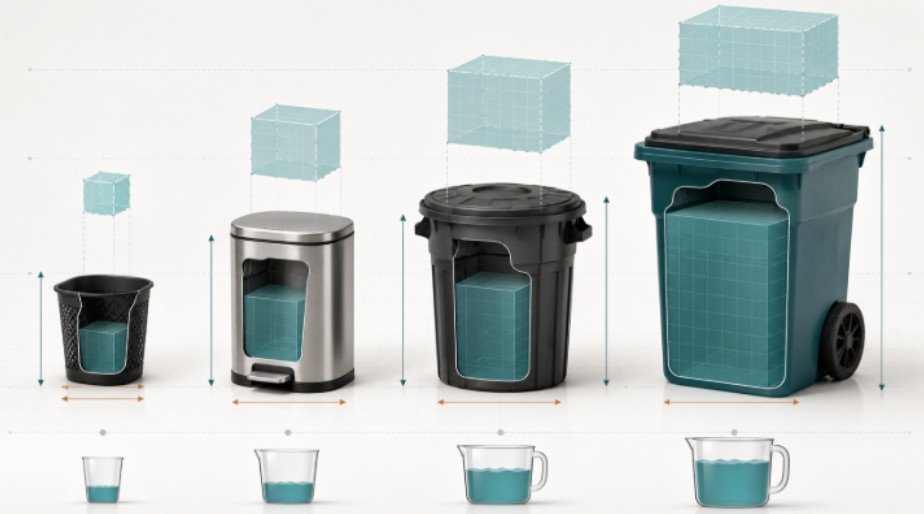
If the original label is missing or unreadable, dimensions can provide a reasonable capacity estimate. Measurements should be taken inside the container because thick walls, handles, wheels, and pedals do not contribute to usable volume.
The same volume calculations can be useful for estimating the space occupied by other common materials and containers, such as a bag of soil, when planning storage or garden projects.
Measuring a Rectangular Trash Can
Measure the internal length, width, and usable height in inches. Multiply all three values and divide the result by 1,728, the number of cubic inches in one cubic foot.
Cubic feet = length × width × height ÷ 1,728
For example, a rectangular container with internal measurements of 15 inches long, 12 inches wide, and 24 inches high has a theoretical volume of 4,320 cubic inches. Dividing 4,320 by 1,728 produces 2.5 cubic feet.
This is a maximum geometric estimate. Rounded corners, a tapered base, or an internal bucket can reduce the actual capacity.
Measuring a Round Trash Can
For a cylindrical container, measure the interior diameter and height. Divide the diameter by two to find the radius. Multiply pi by the radius squared and then by the usable height. Divide the answer by 1,728 when the dimensions are measured in inches.
Cubic feet = π × radius² × height ÷ 1,728
This formula works best for a can with straight vertical sides. Many round bins become narrower near the bottom, so treating them as perfect cylinders can overestimate their usable volume.
Measuring a Tapered Trash Can
A tapered can resembles a truncated cone or pyramid. An accurate calculation requires the upper dimensions, lower dimensions, and height. When only a quick estimate is needed, calculate it as a regular cylinder or rectangular box and treat the answer as the maximum possible volume.
Using the manufacturer’s stated capacity will usually be more reliable for a heavily tapered or irregularly shaped container.
How Many Cubic Feet Is a Trash Can in Different Rooms?
Trash-can capacity often depends on placement. Bathroom models generally hold 2 to 5 gallons, equal to approximately 0.27 to 0.67 cubic feet. Their small footprint allows them to fit beside a toilet, beneath a vanity, or in a narrow corner.
Bedroom and office wastebaskets typically hold 5 to 10 gallons, or approximately 0.67 to 1.34 cubic feet. These bins are suitable for paper, tissues, wrappers, and other lightweight waste.
Kitchen models commonly provide 10 to 16 gallons of capacity, equal to approximately 1.34 to 2.14 cubic feet. Households that cook frequently may prefer a larger model, while those that compost and recycle may need less general-waste capacity.
Garage and utility-room bins commonly range from 20 to 32 gallons. Larger commercial and outdoor models may hold between 44 and 96 gallons, depending on waste volume and collection frequency.
Usable Capacity Versus Exterior Cubic Footage
Interior capacity and occupied space answer two different questions. The same distinction between product capacity and physical space can be useful when comparing materials such as a bag of mulch for storage or landscaping projects.
Interior cubic footage estimates how much waste a container can hold. Exterior cubic footage shows how much physical room the entire trash can requires.
The exterior measurement includes wall thickness, rims, hinges, handles, wheels, foot pedals, liner rings, and lid mechanisms. A bin may therefore occupy substantially more space than its advertised internal capacity suggests.
Lid clearance is particularly important. A trash can that fits beneath a counter while closed may be unusable if there is not enough vertical space to raise its lid. Whether the bin sits beneath a modern counter or inside a Hoosier cabinet, its lid must open without striking the surrounding surface. Pull-out cabinet bins also need room for slides, plumbing, door frames, and mounting hardware.
Why Shape Changes Practical Capacity
Containers with identical gallon ratings can have different dimensions. A tall, narrow bin uses less floor space but may be difficult to position beneath a counter. A wide, shallow bin needs more floor area but can be easier to access.
Rectangular cans fit efficiently against walls and inside cabinets. Round cans have no tight corners, which can make cleaning and bag removal easier. However, a round container placed in a square cabinet leaves unused space around its sides.
Dual-compartment bins divide the interior between trash, recycling, or compost. Their total advertised capacity may sound generous, but each individual compartment can be relatively small.
Choosing the Right Trash Can Capacity
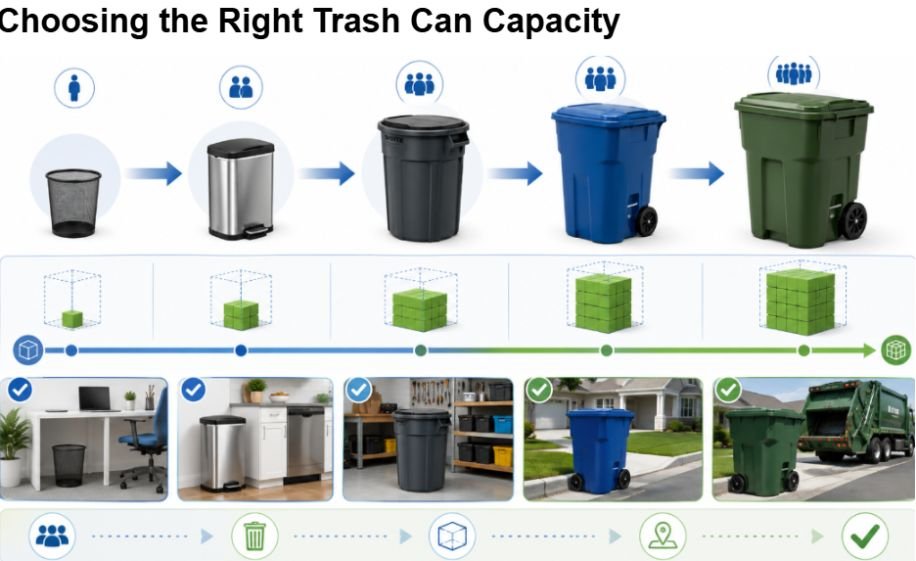
Before selecting a size, monitor the amount of waste produced between collections. Consider how frequently the bin will be emptied and whether recycling or composting reduces general waste.
Measure the intended location, including the lid-open height. For outdoor carts, check pathways, gates, steps, and storage areas. A large cart provides more capacity, but it may be difficult to maneuver when full.
The liner must also fit the container’s shape and rim. It should cover the opening, extend over the sides, and leave enough material to tie securely. Choosing a bag solely by gallon rating can lead to slipping or tearing because two cans with the same capacity may have different openings.
Frequently Asked Questions
1. How Many Cubic Feet Is a Trash Can?
A standard 13-gallon kitchen trash can holds approximately 1.74 cubic feet. Smaller bathroom cans may hold 0.27 to 0.67 cubic feet, while a 96-gallon wheeled cart holds about 12.83 cubic feet.
2. How many cubic feet does a 32-gallon can hold?
A 32-gallon trash can holds approximately 4.28 cubic feet. Divide 32 by 7.48052 to calculate the conversion.
3. Does exterior size equal interior capacity?
No. Exterior size includes the walls, lid, wheels, handles, pedals, and other structural components. Interior capacity only represents the usable space available for waste.
4. Can I calculate capacity from exterior dimensions?
Exterior dimensions provide an estimate of occupied space, not precise usable capacity. Interior measurements are more accurate because they exclude the container’s structural components.
Final Takeaways
I find trash-can sizing much easier when I separate advertised capacity from exterior space. Gallon conversion tells me how much waste the bin can theoretically hold, while physical measurements show whether it will fit where I want to place it.
A standard 13-gallon kitchen model provides approximately 1.74 cubic feet, but shape, tapering, internal buckets, and lid mechanisms affect practical use. By measuring carefully, checking bag compatibility, and considering collection frequency, I can choose a bin that offers enough capacity without wasting valuable space.

Ryan Mitchell
Ryan Mitchell holds a degree in Civil Engineering and spent over a decade working in construction project estimation, where accurate volume and material calculations were part of his daily work — from concrete pours to landscaping material orders. He founded this site to bring that same precision to everyday calculations, helping DIYers, contractors, and students get fast, accurate cubic footage results without the guesswork. Ryan reviews every calculator and formula on this site for accuracy and writes guides based on real-world measurement scenarios he's encountered on job sites.


