

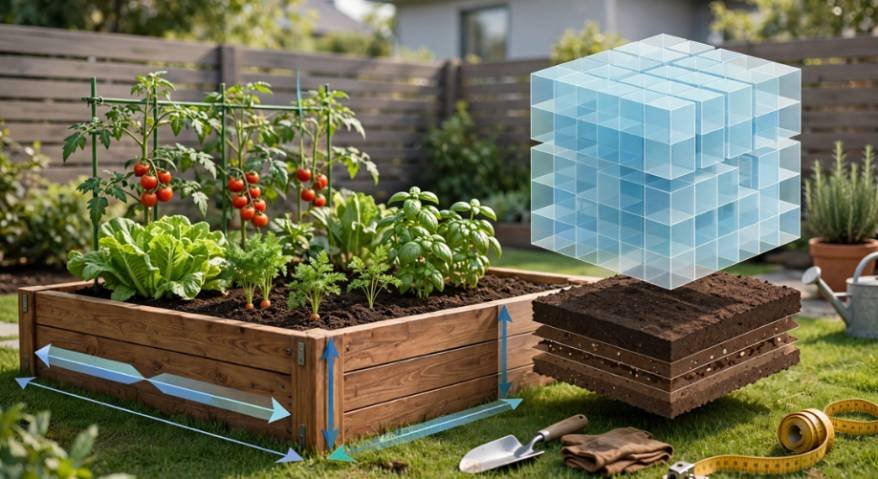
A raised garden bed can hold anywhere from a few cubic feet to more than 100 cubic feet of soil, depending on its dimensions. If you are planning a backyard vegetable garden, knowing how many cubic feet is a raised garden bed? helps you buy the correct amount of soil without wasting money or making extra trips to the garden center.
When I build or refill raised beds, I always calculate the volume before buying soil. A simple measurement prevents one of the most common gardening mistakes: underestimating how much material a bed actually requires. A standard 4 ft × 8 ft raised garden bed filled 12 inches deep contains 32 cubic feet of soil.
The easiest calculation uses three measurements: length, width, and depth. Once those numbers are converted into feet, the total volume becomes clear.
How to Calculate Raised Garden Bed Soil Volume
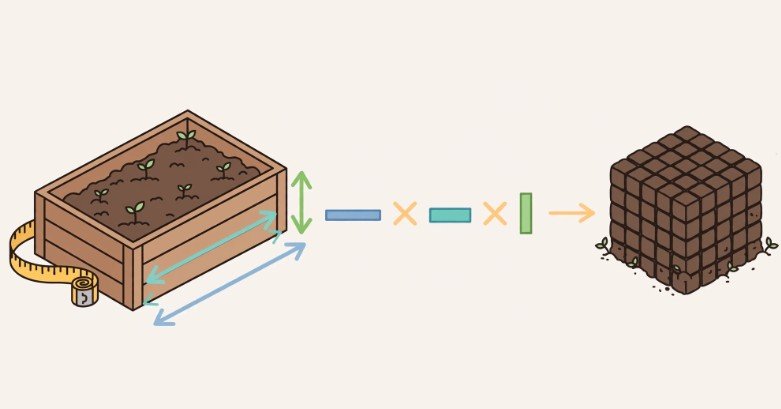
The basic formula for finding raised garden bed volume is:
Length (feet) × Width (feet) × Depth (feet) = Cubic Feet
For example, a common American backyard raised bed measures:
- Length: 8 feet
- Width: 4 feet
- Depth: 1 foot
The calculation is:
8 × 4 × 1 = 32 cubic feet
This means the bed needs about 32 cubic feet of growing material when filled completely.
For gardeners comparing different designs, my recommendation is to calculate the inside dimensions rather than the outside frame measurements. The wood, metal, or composite walls take up space and slightly reduce the usable soil area.
If you are comparing projects, my related guide on how many cubic feet is a garden bed can help you understand how similar container sizes differ.
Raised Garden Bed Cubic Feet Formula Explained
The formula works because cubic feet measure three-dimensional space. A garden bed is essentially a rectangular container, so multiplying the three dimensions gives the amount of space available.
A shallow bed measuring 4 feet wide, 8 feet long, and 6 inches deep does not need the same soil amount as a deeper bed. Depth changes the calculation significantly.
Since 6 inches equals 0.5 feet:
8 × 4 × 0.5 = 16 cubic feet
This is half the soil requirement of a 12-inch-deep bed with the same footprint.
Converting Garden Bed Depth From Inches to Feet
Most raised garden beds are advertised by height in inches. Since cubic feet calculations require feet, convert the depth first.
Use this conversion:
Depth in inches ÷ 12 = Depth in feet
Examples:
- 6 inches ÷ 12 = 0.5 feet
- 12 inches ÷ 12 = 1 foot
- 18 inches ÷ 12 = 1.5 feet
A small conversion mistake can create a large soil shortage, especially with larger beds.
Common Raised Garden Bed Sizes and Cubic Feet Chart
| Raised Bed Size | Depth | Soil Volume |
| 2 ft × 4 ft | 12 inches | 8 cubic feet |
| 3 ft × 6 ft | 12 inches | 18 cubic feet |
| 4 ft × 4 ft | 12 inches | 16 cubic feet |
| 4 ft × 8 ft | 12 inches | 32 cubic feet |
| 4 ft × 8 ft | 6 inches | 16 cubic feet |
A 4 × 8 raised bed remains one of the most popular sizes in the United States because it provides enough growing space while keeping the gardener within easy reach of the center.
How Many Bags of Soil Does a Raised Garden Bed Need?

After calculating cubic feet, the next question is usually how many bags to purchase.
Most garden soil bags sold at US home improvement stores contain either:
- 1 cubic foot
- 2 cubic feet
A 32-cubic-foot raised bed requires:
- 32 bags if buying 1-cubic-foot bags
- 16 bags if buying 2-cubic-foot bags
Buying in bulk may be cheaper for larger gardens. One cubic yard equals 27 cubic feet, so a 32-cubic-foot bed requires slightly more than one cubic yard of soil.
Gardeners handling multiple beds should also estimate transportation and delivery costs. A bulk order may save money but requires space for unloading.
Calculating Soil Bags for Different Bed Sizes
A simple method is:
Total cubic feet needed ÷ bag size = number of bags
For example:
A 16-cubic-foot raised bed using 2-cubic-foot bags:
16 ÷ 2 = 8 bags
This approach works for garden soil, compost blends, and raised bed mixes.
If you are comparing soil quantities with other materials, knowing about the how much is the cubic feet is a bag of potting soil explains common bag sizes and conversions.
Why Extra Soil Is Needed After Settling
Fresh soil rarely stays at the same height after installation. Water, gravity, and natural decomposition cause the soil level to drop over time.
I usually add about 10% extra material when filling a new raised bed. For a 32-cubic-foot bed:
32 × 1.10 = 35.2 cubic feet
This small adjustment helps maintain the correct planting depth after the soil settles.
Factors That Change a Raised Garden Bed’s Actual Volume
The calculated number represents maximum volume. Real-world conditions often reduce the amount of soil needed.
Soil Settling and Internal Space Loss
Compost, organic matter, and lightweight soil mixes compress differently. A bed filled with loose material may require more top-off soil after several months.
Plant roots, mulch layers, and amendments also change the final fill level.
Bed Shape, Liners, and Growing Materials
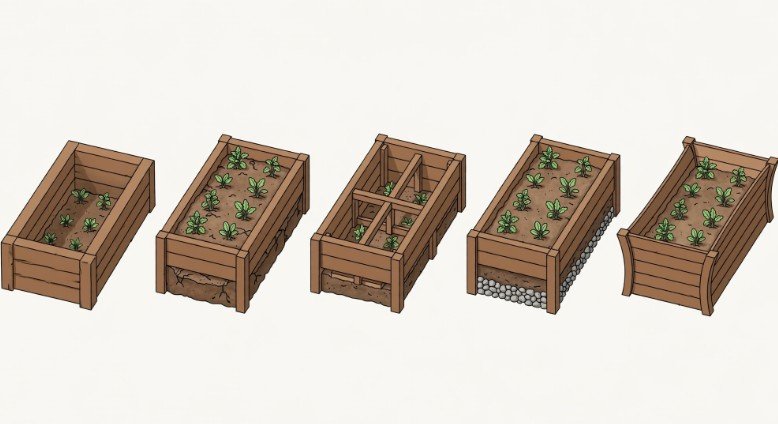
Not every raised bed is a perfect rectangle. Circular, tiered, and keyhole designs require different calculations.
Internal supports, drainage layers, rocks, and liners can reduce available soil space. This is why I measure the actual planting area instead of relying only on advertised dimensions.
The same principle applies when transporting materials. A wheelbarrow’s capacity matters when moving soil around the yard, and knowing how many cubic feet is a wheelbarrow explains how much material one load can carry.
My Practical Method for Estimating Raised Bed Soil Needs
After working with raised beds, I use a simple three-step approach:
First, I measure the inside length, width, and soil depth.
Second, I convert all measurements into feet.
Third, I calculate cubic feet and add approximately 10% extra for settling.
For a new 4 × 8 × 12-inch bed, I would not buy exactly 32 cubic feet. I would plan closer to 35 cubic feet so the bed reaches the desired level after settling.
This small adjustment saves time and keeps plants from growing in a shallow soil layer.
Frequently Asked Questions
1. How many cubic feet is a raised garden bed that is 4×8 feet?
A 4×8 raised garden bed with a 12-inch depth holds 32 cubic feet of soil.
2. How many bags of soil do I need for a raised garden bed?
Divide the required cubic feet by the bag size; a 32-cubic-foot bed needs 16 two-cubic-foot bags.
3. Does a deeper raised garden bed need more soil?
Yes, increasing depth increases volume because cubic feet depend on length, width, and height.
4. How do I calculate soil volume for unusual garden beds?
Measure the interior space and divide complex shapes into smaller sections before calculating cubic feet.
Final Thoughts: Fill Smart, Grow Better
Calculating how many cubic feet is a raised garden bed? is not just a math exercise. It determines how much soil you buy, how much money you spend, and how well your plants grow.
I have found that measuring carefully and adding a small amount for settling creates better results than buying soil by guesswork. A few minutes with a tape measure can prevent wasted bags and unfinished garden projects.
Before ordering soil, measure your bed’s inside dimensions, calculate the cubic feet of potting soil , and plan for settling. Your future plants will reward that extra preparation.

Ryan Mitchell
Ryan Mitchell holds a degree in Civil Engineering and spent over a decade working in construction project estimation, where accurate volume and material calculations were part of his daily work — from concrete pours to landscaping material orders. He founded this site to bring that same precision to everyday calculations, helping DIYers, contractors, and students get fast, accurate cubic footage results without the guesswork. Ryan reviews every calculator and formula on this site for accuracy and writes guides based on real-world measurement scenarios he's encountered on job sites.


