
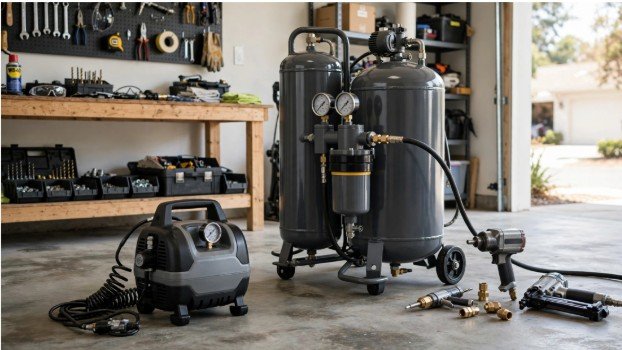
A compressor’s size is not measured by one simple cubic feet number. When people ask how many cubic feet is an air compressor, they usually mean either the amount of air stored inside the tank or how much air the machine can deliver each minute.
I have seen many buyers focus only on tank size and miss the more important CFM rating. A 6-gallon compressor may work perfectly for nailers but struggle with tools that need continuous airflow. Understanding both measurements helps you avoid buying a compressor that is either too small or unnecessarily expensive.
Manufacturers typically rate compressors by tank capacity, airflow (CFM), pressure (PSI), and horsepower. CFM is especially important because it shows how much air the compressor supplies to your tools.
Understanding What Cubic Feet Means in an Air Compressor

The phrase “cubic feet” creates confusion because an air compressor uses two different measurements.
Tank capacity describes how much compressed air the receiver tank can hold. This measurement is usually listed in gallons.
Airflow describes how quickly the compressor produces usable air. This is measured in cubic feet per minute (CFM).
A larger tank gives you a longer air reserve, but it does not automatically mean the compressor creates more airflow. A smaller compressor with a strong CFM rating can outperform a larger tank when running certain tools.
Tank Capacity vs Air Delivery Rate
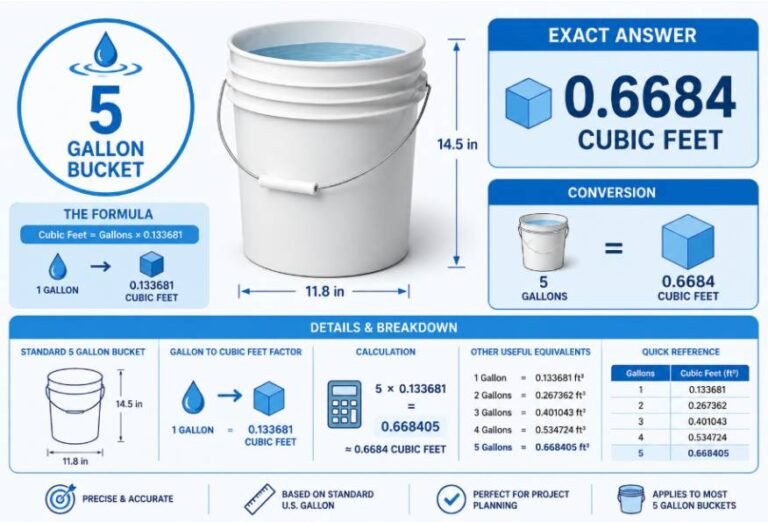
Think of the compressor tank like a water bucket. A bigger bucket stores more water, but the size of the faucet determines how quickly water flows out.
The same idea applies to compressed air:
- Tank size = stored air volume
- CFM = continuous air supply
- PSI = air pressure
These volume concepts can be easier to understand by comparing them with pantry storage volume, which is another practical example of measuring available space in cubic feet.
Air Compressor Tank Size in Cubic Feet: Quick Conversion Chart

Most consumer compressors list tank size in gallons. Since 1 cubic foot equals about 7.48 US gallons, you can estimate storage capacity by dividing gallons by 7.48.
For comparison, understanding mini refrigerator cubic feet can also help put cubic-foot measurements into perspective.
| Air Compressor Tank Size | Approximate Cubic Feet |
| 1–3 gallon portable compressor | 0.13–0.40 cubic feet |
| 6 gallon pancake compressor | 0.80 cubic feet |
| 20 gallon workshop compressor | 2.67 cubic feet |
| 30 gallon workshop compressor | 4.01 cubic feet |
| 60 gallon industrial compressor | 8.02 cubic feet |
| 80 gallon industrial compressor | 10.69 cubic feet |
A typical homeowner using a nail gun, inflator, or small cleaning tools often needs only a compact tank. Larger tanks become useful when running tools that consume air continuously.
How Many Cubic Feet Does an Air Compressor Deliver Per Minute?

When shopping for performance, you should pay close attention to CFM. This measurement tells you the volume of air the compressor can deliver every minute.
A compressor producing 5 CFM can supply five cubic feet of air per minute under its rated conditions. Tools that consume more air require higher CFM output.
CFM Requirements for Common Air Tools
| Tool or Application | Typical CFM Need |
| Tire inflator | 0.5–2 CFM |
| Airbrush | 0.5–2 CFM |
| Brad nailer | 0.3–2 CFM |
| Framing nailer | 2–5 CFM |
| Impact wrench | 2–5+ CFM |
| Paint sprayer | 4–12+ CFM |
| Angle grinder | 4–12+ CFM |
For example, a small 6-gallon compressor may easily handle occasional framing nails but may struggle with continuous spray painting because the tool demands steady airflow.
How to Choose the Right Air Compressor Size for Your Needs
I recommend choosing a compressor based on your most demanding tool instead of your smallest one.
Start by checking the CFM requirement printed on your tool. Then choose a compressor that provides slightly more airflow than required. This prevents the motor from constantly running and reduces performance issues.
A common mistake is buying based only on horsepower. Horsepower tells you motor strength, but CFM tells you whether your tools will actually work properly.
Example: Matching a Compressor to a Garage Project
Imagine you want to run an impact wrench requiring 5 CFM.
A small 2-gallon compressor may have enough stored air for short bursts, but it will quickly lose pressure during longer use. A 20–30 gallon compressor with a higher CFM rating would provide a smoother experience.
For occasional tire inflation, a compact unit is enough. For automotive repairs, painting, or workshop use, airflow becomes the deciding factor.
Common Mistakes When Measuring Air Compressor Size
Many buyers make the mistake of assuming a bigger tank always equals more power.
A 60-gallon tank with low airflow may still struggle with demanding tools. The compressor’s pump output determines how quickly the tank refills.
Another mistake is ignoring PSI ratings. Most pneumatic tools operate within a specific pressure range. A compressor must provide both the required PSI and enough CFM at that pressure.
You should also consider duty cycle. A compressor designed for short tasks may overheat if used continuously for long periods.
FAQs About Air Compressor Cubic Feet
1. How many cubic feet is a 6 gallon air compressor?
A 6-gallon air compressor tank holds about 0.80 cubic feet of compressed air.
2. Is CFM more important than tank size on an air compressor?
Yes. CFM usually matters more because it determines how well the compressor powers air tools continuously.
3. How many cubic feet does a 20 gallon air compressor hold?
A 20-gallon compressor tank holds approximately 2.67 cubic feet of air storage.
4. What size air compressor do I need for a garage?
Most garage users need around 3–6 CFM for common tools, but larger tools like sanders and paint sprayers require higher airflow.
The Final Pressure Check: Pick the Right Compressor, Not Just the Bigger One
The real answer to how many cubic feet is an air compressor depends on what you are measuring. Tank volume tells you how much air is stored, while CFM tells you how much air your compressor can actually deliver.
Before buying, check your tools first. Match the compressor’s CFM and PSI ratings to your workload, then choose a tank size that supports your usage. The right compressor is not always the biggest one—it is the one that keeps your tools running without constant frustration.

Ryan Mitchell
Ryan Mitchell holds a degree in Civil Engineering and spent over a decade working in construction project estimation, where accurate volume and material calculations were part of his daily work — from concrete pours to landscaping material orders. He founded this site to bring that same precision to everyday calculations, helping DIYers, contractors, and students get fast, accurate cubic footage results without the guesswork. Ryan reviews every calculator and formula on this site for accuracy and writes guides based on real-world measurement scenarios he's encountered on job sites.