

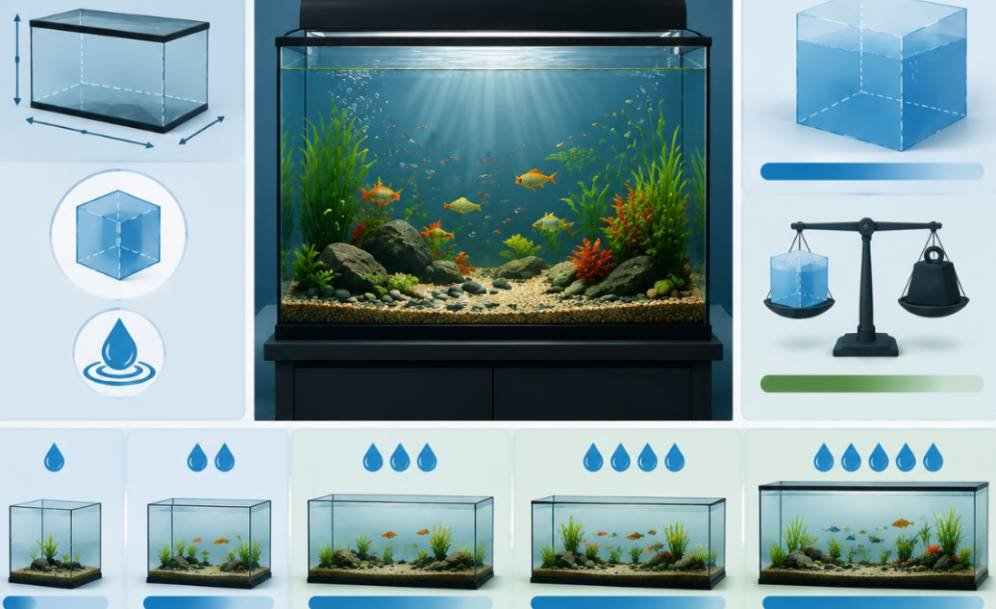
When I first tried to calculate how many cubic feet is an aquarium, I discovered that a tank can have three surprisingly different volume measurements. Its exterior size describes the room it occupies, its advertised capacity represents a nominal amount, and its actual water volume falls after adding gravel, equipment, plants, and decorations.
As a quick estimate, divide the aquarium’s capacity in US gallons by 7.48. A 10-gallon aquarium represents about 1.34 cubic feet, while a 55-gallon model represents approximately 7.35 cubic feet. A 75-gallon tank is close to 10 cubic feet. However, these conversions describe nominal capacity and may not reveal exactly how much water is inside a furnished aquarium.
Quick Aquarium Capacity Estimates
Aquariums vary from desktop nano tanks holding less than one cubic foot to elaborate home installations exceeding 20 cubic feet. A 5-gallon aquarium equals approximately 0.67 cubic feet. A 20-gallon tank is about 2.67 cubic feet, while a 29-gallon aquarium is approximately 3.88 cubic feet.
A 40-gallon tank converts to about 5.35 cubic feet. Common 55-gallon aquariums equal approximately 7.35 cubic feet, and 75-gallon models equal about 10.03 cubic feet. Larger 90-gallon aquariums represent roughly 12.03 cubic feet. A 125-gallon tank is approximately 16.71 cubic feet, while a 150-gallon model is about 20.05 cubic feet.
These values provide convenient comparisons, but tanks with identical advertised capacities can have different lengths, widths, and heights. A long aquarium may require more floor or cabinet space than a tall tank holding the same number of gallons.
How to Calculate Aquarium Volume in Cubic Feet
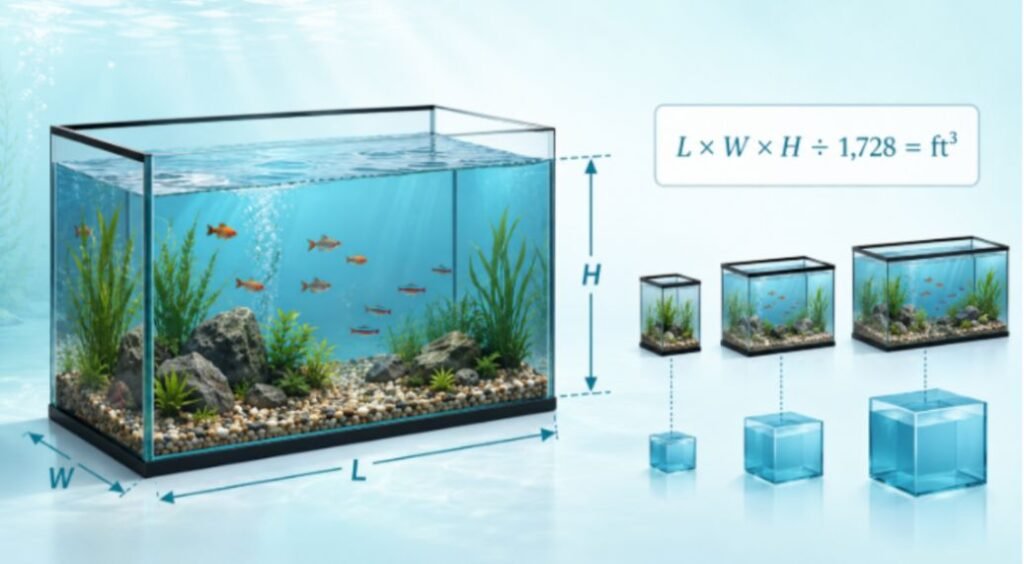
For a rectangular aquarium, measure its length, width, and height. All three measurements must use the same unit before multiplication.
When measuring in feet, use this formula:
Cubic feet = length × width × height
When measuring in inches, multiply the three dimensions and divide the result by 1,728:
Cubic feet = length in inches × width in inches × height in inches ÷ 1,728
For example, an aquarium measuring 48 inches long, 18 inches wide, and 21 inches high has a geometric exterior volume of 10.5 cubic feet. The calculation is 48 × 18 × 21 ÷ 1,728.
If the aquarium’s gallon capacity is already known, divide the number of US gallons by 7.48:
Cubic feet = US gallons ÷ 7.48
A tank labeled as 60 gallons therefore represents approximately 8.02 cubic feet. Because Imperial gallons and US gallons are different units, confirm which gallon measurement appears on the product information before converting it.
Exterior Volume Is Not Water Capacity
Exterior volume measures how much physical space the aquarium occupies. It is useful when selecting furniture, arranging a room, planning transportation, or checking whether the tank can pass through a doorway.
Gross internal capacity describes the theoretical amount the empty aquarium could hold if it were filled completely. Actual water volume measures the water present during normal operation.
The frame, glass or acrylic walls, silicone joints, and built-in filtration compartments consume part of the exterior space. Measuring the outside of the aquarium consequently produces a larger figure than measuring its interior.
This same exterior versus interior gap shows up with kitchen appliances too my microwave oven size guide covers why the advertised cavity size is often smaller than the unit’s outer footprint.
Use external measurements when planning space. For a quick estimate through an online cubic feet calculator, enter the tank’s exterior dimensions. Use its internal length, width, and normal water height when calculating water capacity for maintenance or treatment.
Why Actual Water Volume Is Lower
An aquarium is rarely filled to its upper edge. The gap between the normal waterline and the rim can remove a meaningful amount from its theoretical capacity. Even a small gap becomes significant across a long, wide tank.
Substrate also occupies space. Sand, gravel, aquasoil, rocks, driftwood, decorations, plants, internal filters, heaters, and other equipment displace water. Heavily aquascaped tanks may hold considerably less water than their advertised rating suggests.
Manufacturer capacities can also be rounded into convenient commercial sizes. A tank sold as a 30-gallon model might produce a slightly different result when calculated from its dimensions. Product dimensions may include the frame rather than representing the interior water chamber.
A practical estimate for a decorated aquarium may be 10% to 20% below its nominal capacity, although the reduction depends on the fill level and quantity of material inside it. Measuring the amount added during an initial fill offers a more reliable result.
Calculating Different Aquarium Shapes
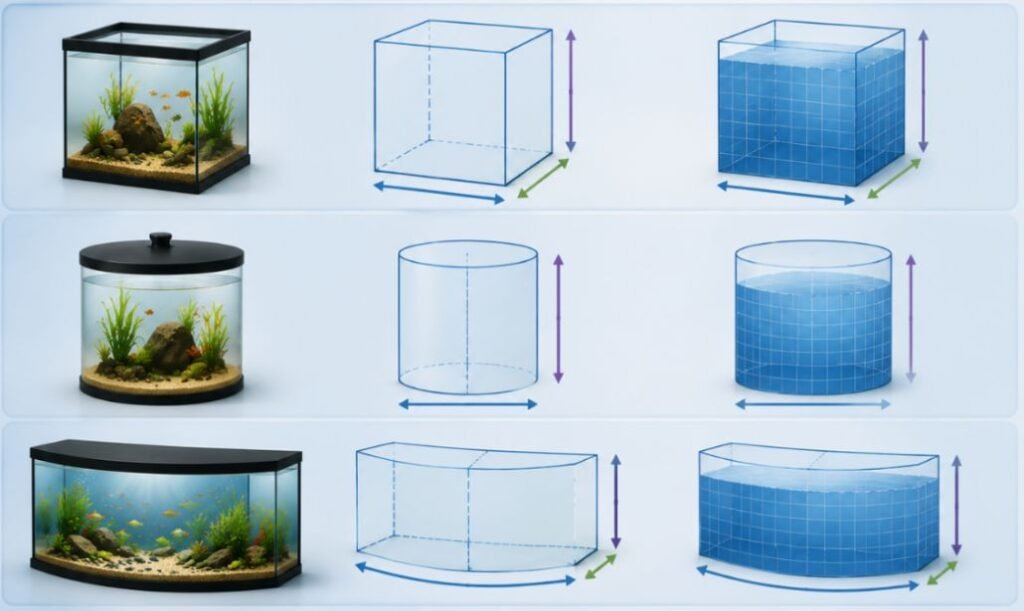
Rectangular tanks are straightforward, but not every aquarium has flat, straight sides. Cubes use the same basic formula, with equal length, width, and height.
For anyone planning to build an acrylic aquarium with a cylindrical shape, multiply pi by the radius squared and then by the water height. If the measurements are in inches, divide the resulting cubic inches by 1,728 to obtain cubic feet. Remember that the radius is half the cylinder’s diameter.
Bow-front, hexagonal, corner, half-cylinder, and L-shaped aquariums need shape-specific formulas. Dividing an irregular tank into simpler geometric sections can provide an estimate, but a dedicated aquarium-volume calculator is generally more reliable.
Regardless of shape, use internal measurements and the normal waterline when actual capacity matters.
Why Accurate Aquarium Volume Matters
Knowing water volume helps determine water-change quantities. If an aquarium contains eight cubic feet of water, it holds approximately 59.8 US gallons. A 25% water change would therefore require close to 15 gallons of prepared replacement water.
Accurate capacity is also important when using conditioners, medications, fertilizers, mineral supplements, and salt mixes. Calculating a dose from the advertised tank size can cause excessive treatment when rocks, substrate, and equipment have substantially reduced the actual water volume.
Heaters, filters, pumps, and circulation equipment are frequently selected according to aquarium capacity. Accurate water volume can also help determine the correct dosage for swim bladder treatment and other aquarium products. Nevertheless, volume alone does not establish an appropriate stocking level. Adult fish size, swimming behavior, territorial needs, available surface area, filtration, water quality, and maintenance frequency remain important.
Cubic Feet Do Not Reveal Total Aquarium Weight
Volume and weight answer different questions. One cubic foot of freshwater represents approximately 7.48 US gallons. Since a gallon of freshwater weighs about 8.34 pounds, one cubic foot of water weighs roughly 62.4 pounds.
Access to clean freshwater is essential for ecosystems, agriculture, household use, and maintaining healthy aquatic environments.
The final installation also includes the aquarium shell, stand, lid, substrate, rocks, decorations, filters, and other equipment. A 75-gallon setup can therefore weigh considerably more than the water alone.
The same volume versus weight distinction applies when placing heavy appliances too my mini refrigerator size guide covers how cubic footage relates to unit weight and floor support needs.
Large aquariums require a strong, level stand and suitable placement. Cubic footage can describe the tank’s size, but it cannot confirm whether a floor or cabinet can support the completed installation.
Common Aquarium Measurement Mistakes
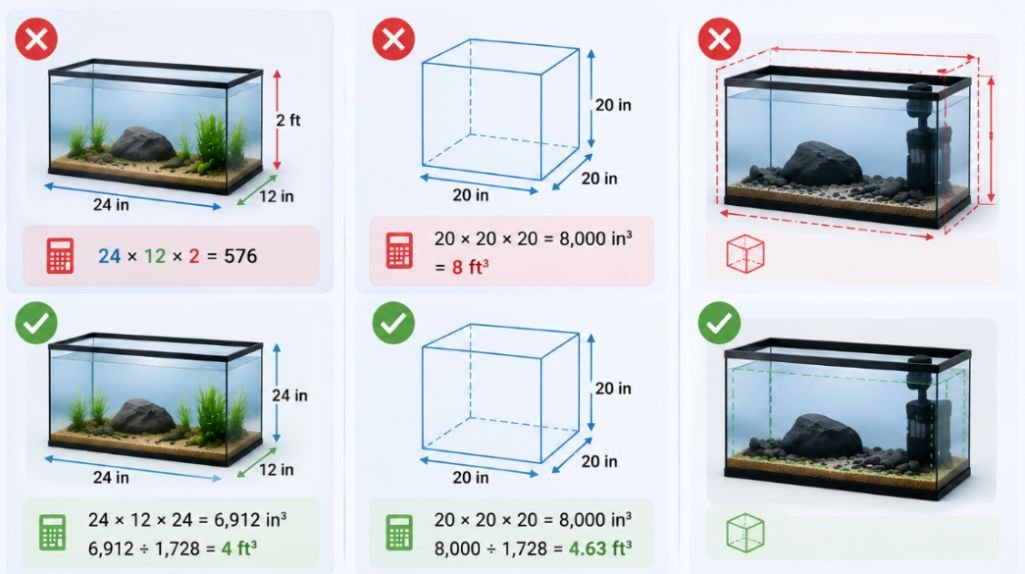
One frequent mistake is mixing inches and feet in the same equation. Another is forgetting to divide cubic inches by 1,728. Measuring outside edges when calculating a treatment dose can also overstate capacity.
Using the full tank height instead of the actual water height produces another inaccurate result. Owners may also overlook water held in a sump or external filter. For aquarium systems with connected equipment, calculate each water-holding component separately and combine the results.
Frequently Asked Questions
1. How many cubic feet is an aquarium with a 55-gallon capacity?
A 55-gallon aquarium represents approximately 7.35 cubic feet because 55 divided by 7.48 equals about 7.35. Its actual water volume may be lower after accounting for the fill gap, substrate, decorations, and equipment.
2. How many gallons are in one cubic foot?
One cubic foot equals approximately 7.48 US gallons, 6.23 Imperial gallons, or 28.32 liters. Check the gallon standard before making conversions.
3. Should I measure inside or outside the aquarium?
Use exterior dimensions when planning furniture, transportation, or room space. Use interior dimensions and the actual water height when estimating usable water capacity.
4. Does aquarium shape affect cubic footage?
Yes. Rectangular, cylindrical, hexagonal, bow-front, and corner tanks use different geometric formulas. Two aquariums with similar outside dimensions may consequently have different capacities.
Final Thoughts
When I evaluate an aquarium, I calculate exterior size and actual water volume separately. The first figure tells me whether the tank will fit, while the second helps me plan water changes, equipment, and dosing.
The simplest shortcut is to divide US gallons by 7.48, but internal measurements provide a better estimate when accuracy matters. I also account for the waterline, substrate, hardscape, and equipment rather than assuming the advertised capacity equals the water currently inside the tank.

Ryan Mitchell
Ryan Mitchell holds a degree in Civil Engineering and spent over a decade working in construction project estimation, where accurate volume and material calculations were part of his daily work — from concrete pours to landscaping material orders. He founded this site to bring that same precision to everyday calculations, helping DIYers, contractors, and students get fast, accurate cubic footage results without the guesswork. Ryan reviews every calculator and formula on this site for accuracy and writes guides based on real-world measurement scenarios he's encountered on job sites.


