

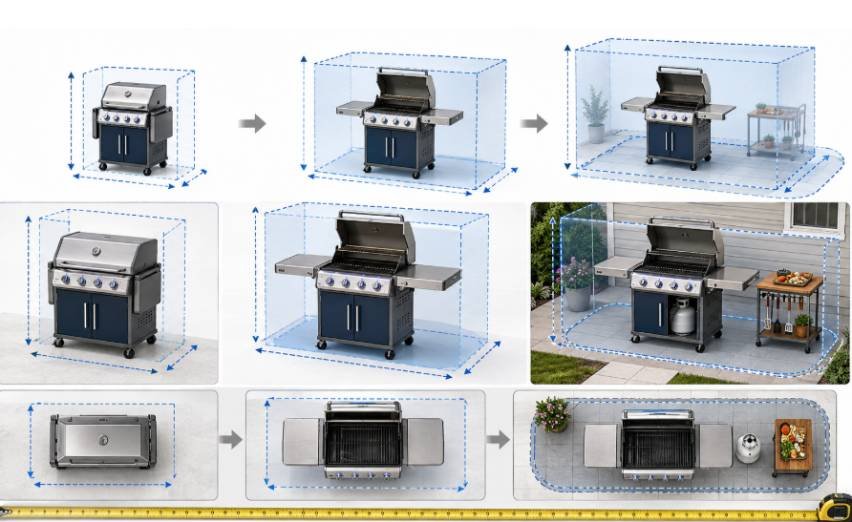
When I look at a grill, its cooking surface seems like the obvious measurement to check. However, that number does not tell me whether the entire unit will fit inside a shed, garage, vehicle, or designated patio area. For those decisions, I need its exterior volume.
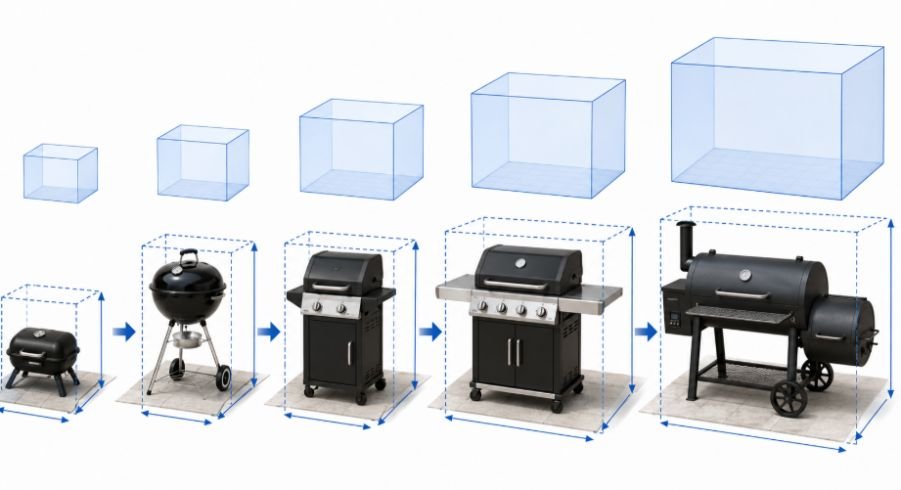
How Many Cubic Feet Is a Grill? A portable model may occupy approximately 3 cubic feet, while standard cart-style grills commonly require 25 to 35 cubic feet. Large pellet and combination grills can occupy 40 to 55 cubic feet or more.
Average Grill Size in Cubic Feet
There is no single standard cubic-foot capacity for every grill. Fuel type, burner count, side shelves, lid design, cart construction, and additional cooking features all affect the exterior dimensions.
Compact tabletop grills generally occupy about 2 to 5 cubic feet. Their short legs and folding components make them suitable for camping, balconies, tailgating, and vehicle transport.
A small two-burner gas grill may require approximately 20 to 28 cubic feet. Standard three- and four-burner models frequently occupy 25 to 40 cubic feet when their side shelves remain extended. Oversized combination grills, pellet smokers, and outdoor cooking stations can exceed 50 cubic feet.
The calculated volume is a bounding-box measurement. A grill has curved panels, wheels, open framing, handles, and empty space beneath its cooking chamber, so it does not physically fill every cubic inch of that rectangular area.
Typical Volume by Grill Type
Portable and Tabletop Grills
Portable grills are the smallest category. A unit measuring approximately 25 inches wide, 15 inches deep, and 14 inches high occupies just over 3 cubic feet.
The compact exterior makes this type easier to place in a car trunk or storage cabinet, especially when you need to organize your garage efficiently. Handles, detachable stands, and propane connections may still increase the practical clearance required around it.
Gas Grills
Gas grills show considerable variation because their side shelves and enclosed carts increase overall width. A two-burner model measuring about 46 inches wide, 24 inches deep, and 42 inches high occupies approximately 27 cubic feet.
A larger four- or six-burner grill can occupy between 35 and 50 cubic feet. The propane cylinder may sit within the cart, but its location must be considered when measuring storage clearance.
Charcoal Grills
A simple kettle grill has a smaller physical body than a cart-style gas grill, although its rounded bowl makes the calculation less exact. Measuring its widest points provides a safe estimate for storage or transportation.
Cart-style charcoal grills commonly occupy approximately 25 to 35 cubic feet. Side trays, chimneys, lower shelves, and adjustable charcoal pans can increase their exterior dimensions.
Pellet Grills and Smokers
Pellet grills tend to be longer than basic charcoal models because they include a hopper, control system, shelves, and a large cooking barrel. Mid-size units may occupy around 28 to 40 cubic feet, while larger models can exceed 45 cubic feet.
Vertical smokers may use less floor space but require greater overhead clearance. Using an online cubic feet calculator for grill dimensions can help you compare the total volume with the available floor footprint before selecting a storage position.
Combination Grills
Combination units place gas and charcoal cooking chambers within one frame. Some also include side burners, warming areas, or smoker boxes. These additions can push the exterior volume beyond 50 cubic feet.
A large model measuring roughly 74 inches wide, 28 inches deep, and 47 inches high occupies approximately 56 cubic feet. Folding a shelf may reduce the required width, but only when the manufacturer has designed it to fold safely.
How to Calculate Grill Volume
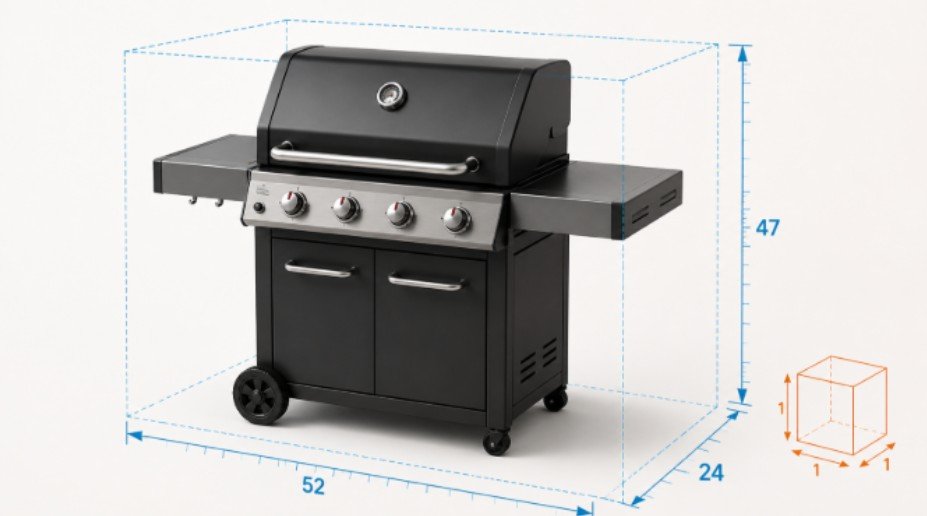
A grill’s exterior cubic footage can be estimated with this formula:
Length × width × height = cubic feet
All three measurements must use feet. When the dimensions are listed in inches, use this version:
Length × width × height ÷ 1,728 = cubic feet
For example, consider a grill measuring 46 inches wide, 24 inches deep, and 42 inches high. Multiplying those measurements produces 46,368 cubic inches. Dividing by 1,728 gives approximately 26.83 cubic feet.
The same dimensional approach can be used when planning kitchen cabinet storage, where available space also depends on the cabinet’s length, depth, and height.
Measure the grill at its widest, deepest, and highest points. Include handles, control knobs, wheels, chimneys, fixed shelves, and any other parts that cannot be removed or folded.
Exterior Volume Is Not Cooking Capacity
Cooking space is usually advertised in square inches because the cooking grill grate is a flat surface. Exterior storage space is measured in cubic feet because it includes width, depth, and height.
A grill with 500 square inches of primary cooking surface does not have a capacity of 500 cubic inches. These units measure entirely different things.
Manufacturers may combine primary grates and warming racks when stating total cooking area. For a more useful comparison, examine the primary cooking surface separately. Depending on the food and spacing required, approximately 50 to 100 square inches per person can serve as a general planning range.
Assembled Size Versus Package Size
The shipping carton may have a very different volume from the fully assembled grill. Manufacturers often pack the legs, shelves, wheels, handles, and cooking chamber tightly into a rectangular box.
Packaged dimensions are useful when collecting a new grill from a store or arranging delivery.
Assembled dimensions are more important when planning patio placement, covers, storage, and movement through gates or doorways. This same approach to measuring cooler storage space can also help when planning space for other outdoor equipment.
Never assume a grill that fits inside a vehicle while boxed will fit after assembly. Measure both the available opening and the interior transportation space.
Allow Space for Safe and Practical Use
The grill’s calculated cubic footage describes the unit itself, not the entire area needed to operate it. Heat, smoke, grease, ventilation, and lid movement require additional clearance.
Follow the clearance requirements in the manufacturer’s manual. These instructions vary according to fuel type, grill construction, and nearby materials. Never position an active grill in an enclosed storage room, garage, tent, or poorly ventilated area.
Check overhead clearance with the lid fully open. Side shelves, utensils, propane hoses, electrical cables, pellet-hopper lids, and access doors also need usable space.
Frequently Asked Questions
1. How many cubic feet is a standard gas grill?
A standard cart-style gas grill generally occupies around 25 to 40 cubic feet of exterior space. Burner count, shelves, cart design, and overall height can move the figure outside this range.
2. How Many Cubic Feet Is a Grill?
Most grills occupy approximately 3 to 55 cubic feet. Portable units sit near the lower end, standard backyard grills often require 25 to 35 cubic feet, and large combination or pellet models approach the upper end.
3. Should I measure a grill with its lid open?
Use the closed-lid dimensions to calculate its basic storage volume. Measure the open-lid height separately when planning operating clearance or overhead placement.
4. Do folding shelves reduce grill volume?
Folding shelves can substantially reduce exterior width and storage volume. Confirm that the shelves fold completely and measure the grill in its actual storage configuration.
Final Takeaways
When I plan space for a grill, I treat cubic footage as an exterior storage measurement rather than cooking capacity. How Many Cubic Feet Is a Grill? The most useful general answer is approximately 3 to 55 cubic feet, depending on its design and fuel type.
I would always calculate the dimensions of the specific model instead of relying only on an average. By measuring every fixed component and accounting for the open lid, ventilation, and operating clearance, I can avoid buying a grill that is difficult to store, transport, or use safely.

Ryan Mitchell
Ryan Mitchell holds a degree in Civil Engineering and spent over a decade working in construction project estimation, where accurate volume and material calculations were part of his daily work — from concrete pours to landscaping material orders. He founded this site to bring that same precision to everyday calculations, helping DIYers, contractors, and students get fast, accurate cubic footage results without the guesswork. Ryan reviews every calculator and formula on this site for accuracy and writes guides based on real-world measurement scenarios he's encountered on job sites.


