

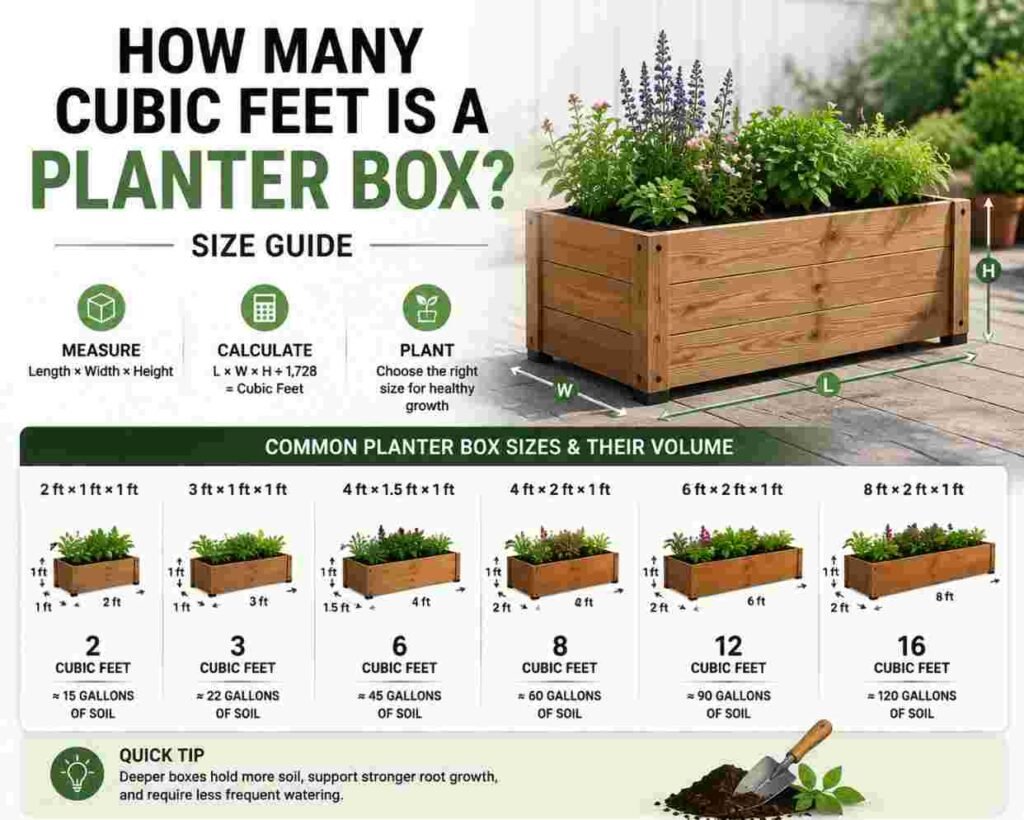
Buying soil without calculating volume can leave you with an unfinished planter or several unwanted bags. So, how many cubic feet is a planter box? A small box may hold 3 to 4 cubic feet, while a large 8-by-4-foot planter can hold 32 cubic feet at a 12-inch depth.
I calculate capacity by multiplying the planter’s interior length, width, and soil depth. Measuring the interior matters because thick boards, liners, and decorative frames reduce the usable space.
Quick Answer: Planter Box Capacity Explained
There is no single standard capacity. The answer depends on the three interior dimensions.
A 2-foot-long box that is 2 feet wide and 1 foot deep holds 4 cubic feet. A 4-by-2-foot planter at the same depth holds 8 cubic feet. Doubling the planting depth doubles the required soil.
When someone asks how many cubic feet is a planter box?, my fastest answer is:
Length × width × soil depth = cubic feet
All three measurements must be in feet. If they are in inches, divide the final cubic-inch result by 1,728.
Common Planter Box Sizes and Soil Volumes
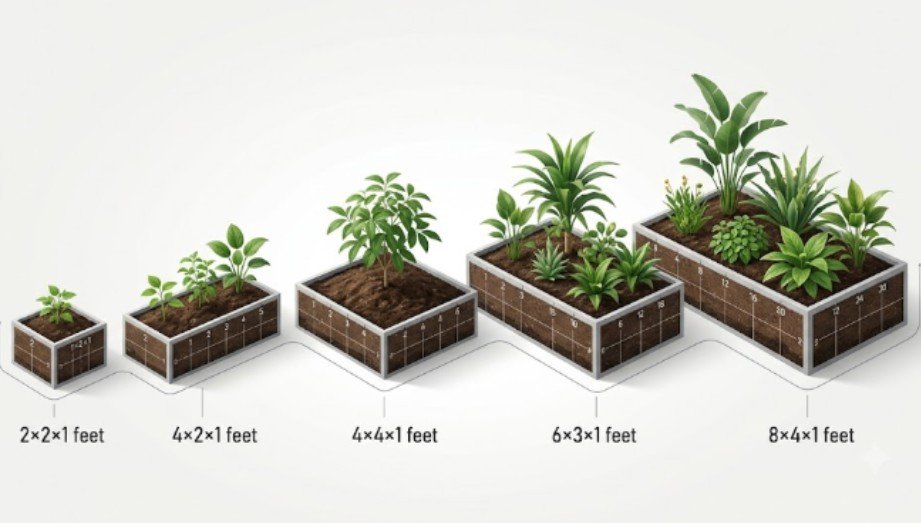
The following estimates assume square interior walls and a full 12-inch soil depth.
| Interior planter size | Volume | 1.5-cu.-ft. bags needed |
| 2 ft × 2 ft × 1 ft | 4 cu. ft. | 3 bags |
| 3 ft × 1 ft × 1 ft | 3 cu. ft. | 2 bags |
| 4 ft × 2 ft × 1 ft | 8 cu. ft. | 6 bags |
| 4 ft × 4 ft × 1 ft | 16 cu. ft. | 11 bags |
| 6 ft × 3 ft × 1 ft | 18 cu. ft. | 12 bags |
| 8 ft × 4 ft × 1 ft | 32 cu. ft. | 22 bags |
Always round the bag count upward. For example, 8 cubic feet divided by 1.5 equals 5.33 bags, so six bags are required.
Smaller containers need a different approach because they may taper toward the base. Flower pot capacity can vary with shape, so tapered or curved sides need to be considered when estimating the actual volume.
Planter Box Volume Formula
The basic formula works for rectangular and square planters:
Cubic feet = interior length × interior width × soil depth
Measure the available soil space instead of the planter’s exterior. A box advertised as 48 inches long may have only 45 inches of usable interior length.
Calculating Measurements in Feet
Suppose a planter measures 4 feet long, 2 feet wide, and 1 foot deep:
4 × 2 × 1 = 8 cubic feet
This box needs about six bags when each bag contains 1.5 cubic feet.
If you are still wondering how many cubic feet is a planter box?, this calculation provides the nominal capacity. The amount you actually add may be slightly lower because soil should not reach the rim.
Calculating Measurements in Inches
Measure the inside length, width, and intended fill depth. Multiply those figures, then divide by 1,728:
Cubic feet = length in inches × width in inches × depth in inches ÷ 1,728
A box measuring 36 inches long, 12 inches wide, and 12 inches deep contains:
36 × 12 × 12 = 5,184 cubic inches
5,184 ÷ 1,728 = 3 cubic feet
Mixed units often cause mistakes. Convert every measurement into inches or feet before multiplying.
Nominal Volume Versus Practical Fill Volume
The most useful answer to how many cubic feet is a planter box? is not always its maximum geometric volume. Practical fill volume is usually lower.
Consider a 4-by-2-foot planter with 12-inch walls. Its nominal capacity is 8 cubic feet. However, leaving a 2-inch watering space reduces the soil depth to 10 inches, or 0.833 feet:
4 × 2 × 0.833 = 6.67 cubic feet
If I allow another 10% for settling, I would purchase about 7.34 cubic feet. Five 1.5-cubic-foot bags provide 7.5 cubic feet, which is a practical purchase.
This headspace-and-settling method is the article’s key planning difference. It produces a better shopping estimate than filling the planter to its theoretical maximum.
Drainage rocks also occupy space, although a thick rock layer is not automatically beneficial. A container needs effective drainage system and a suitable growing medium. Record the actual soil depth above any internal layer.
Converting Cubic Feet Into Bags of Soil
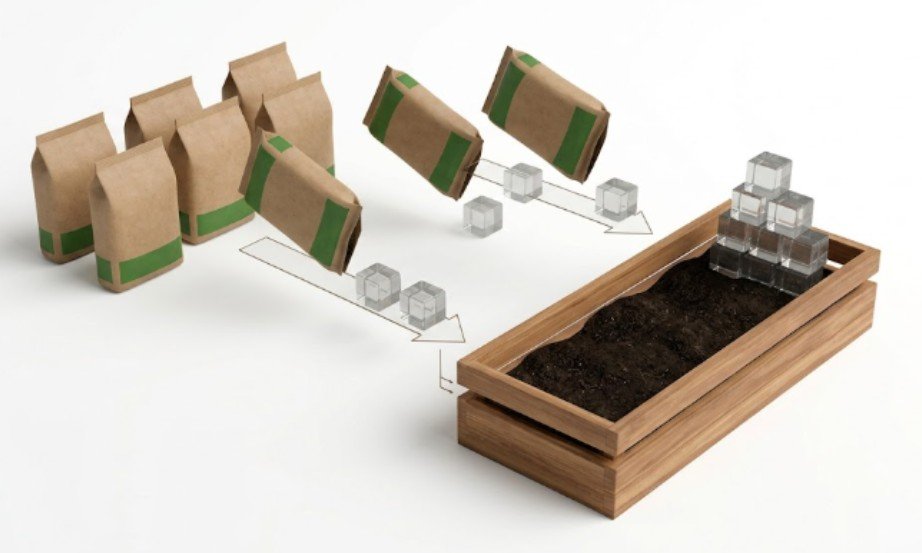
Once I know how many cubic feet is a planter box?, I divide the required volume by the number printed on the soil bag.
For a planter needing 12 cubic feet:
12 ÷ 1.5 = 8 bags
12 ÷ 2 = 6 bags
Round partial results upward. Soil settles after watering, so a small reserve can help restore the original level.
Large beds may be cheaper to fill with bulk material. One cubic yard equals 27 cubic feet. A 32-cubic-foot planter therefore needs about 1.19 cubic yards. The University of Minnesota Extension notes that bulk topsoil is generally less expensive than individual bags for raised beds.
Choosing the Right Soil Depth
Capacity should follow the plants rather than the height of the decorative walls. Shallow-rooted herbs and leafy greens need less soil than tomatoes or deep-rooted vegetables.
Penn State Extension states that most vegetables need at least 6 inches of soil. Some raised-bed guidance recommends 18 to 24 inches for greater rooting room and less frequent watering. The correct depth still depends on the crop and the soil below the planter. Penn State Extension provides additional guidance on vegetable-bed depth.
For an open-bottom planter sitting on healthy ground, roots may grow below the box. A closed balcony planter restricts roots to its interior, making usable depth more important.
When planning a larger planting area, comparing garden bed volume can help you estimate the amount of soil required more accurately.
Mistakes That Distort Your Calculation
Using exterior dimensions is the most common error I see in volume estimates. Thick lumber can remove several inches from each side.
Other errors include measuring the full wall height instead of the fill line, mixing inches with feet, and rounding down the soil-bag count. Tapered boxes also hold less than rectangular boxes with the same top dimensions.
Compaction creates another problem. Pressing soil firmly into the box can reduce pore space and harm drainage. I settle the mix with gentle watering instead of packing it heavily.
Frequently Asked Questions
1. How many cubic feet is a 4-by-2 planter box?
A 4-by-2-foot box holds 8 cubic feet when its usable soil depth is 1 foot.
2. How many bags of soil fill a planter box?
Divide its cubic-foot capacity by the volume per bag, then round the result up.
3. How many cubic feet is a planter box?
Multiply its interior length, width, and soil depth in feet; common boxes hold about 3 to 32 cubic feet.
4. Does planter-box soil settle after filling?
Yes. Buying roughly 5% to 10% extra provides material for topping up after watering and settling.
Soil Math Finished—Now Fill That Box
I would never order planter soil from the exterior dimensions alone. Interior measurements, the real fill line, and the bag size create a far more useful estimate.
The next step is simple: measure the empty box, calculate its practical fill volume, and round the purchase upward. Your plants want room for roots—not a planter abandoned half-full beside a pile of optimistic math.

Ryan Mitchell
Ryan Mitchell holds a degree in Civil Engineering and spent over a decade working in construction project estimation, where accurate volume and material calculations were part of his daily work — from concrete pours to landscaping material orders. He founded this site to bring that same precision to everyday calculations, helping DIYers, contractors, and students get fast, accurate cubic footage results without the guesswork. Ryan reviews every calculator and formula on this site for accuracy and writes guides based on real-world measurement scenarios he's encountered on job sites.


