A moving truck is more than just a vehicle with extra space—it is a carefully measured storage area designed to carry everything from a few boxes to an entire household. Choosing the wrong size can turn a simple relocation into a frustrating experience, either by forcing multiple trips or leaving me with unnecessary rental costs.
That is why understanding how many cubic feet a moving truck is one of the smartest steps I can take before planning a move.
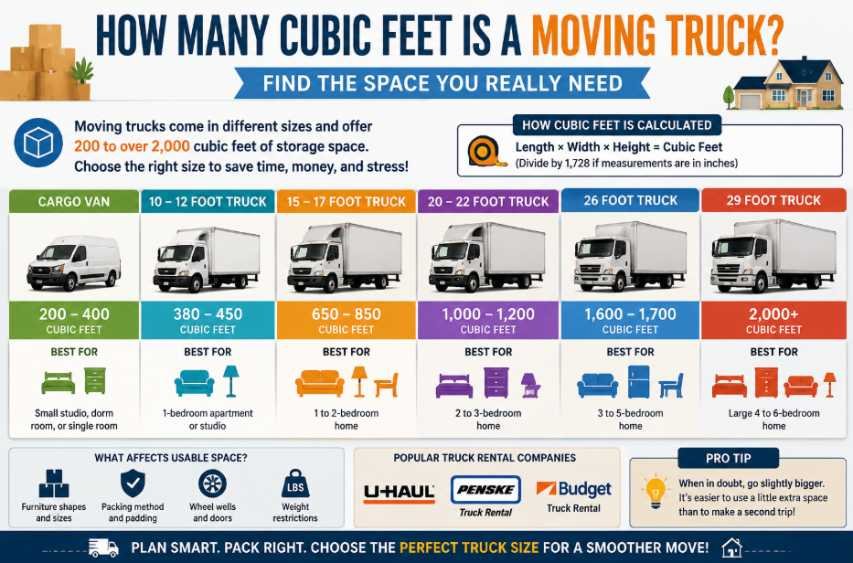
The available space can range from about 200 cubic feet in a compact cargo van to more than 2,000 cubic feet in the largest moving trucks. By comparing truck capacities, interior dimensions, and real-world loading needs, I can choose a vehicle that matches my belongings and makes my move more efficient.
How Many Cubic Feet Do Different Moving Trucks Hold?
The cubic footage of a moving truck depends mainly on its interior length, width, and height. While manufacturers advertise truck sizes by length, the actual storage capacity is measured in cubic feet.
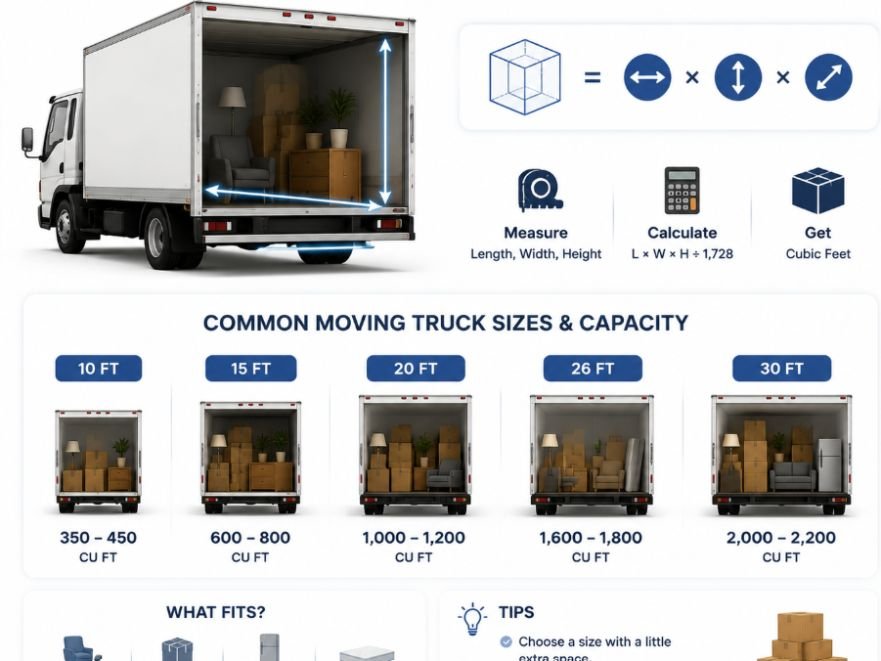
Here is a general moving truck cubic feet breakdown for common U.S. rental options:
| Moving Truck Size | Average Capacity | Best For |
| Cargo Van | 200–400 cubic feet | Studio apartment, dorm room, single-room moves |
| 10–12 Foot Truck | 380–450 cubic feet | Studio or one-bedroom apartment |
| 15–17 Foot Truck | 650–850 cubic feet | One- to two-bedroom home |
| 20–22 Foot Truck | 1,000–1,200 cubic feet | Two- to three-bedroom home |
| 26 Foot Truck | 1,600–1,700 cubic feet | Three- to five-bedroom home |
| 29 Foot Truck | 2,000+ cubic feet | Four- to six-bedroom home |
Exact capacities vary between rental companies and vehicle models. Comparing official moving truck sizes and dimensions can help me understand differences in cargo volume, interior measurements, and recommended household sizes before selecting a truck.
For smaller moves, comparing cargo van storage capacity with compact box trucks can help me avoid paying for more space than I need.”
How Do I Calculate the Cubic Feet of a Moving Truck?
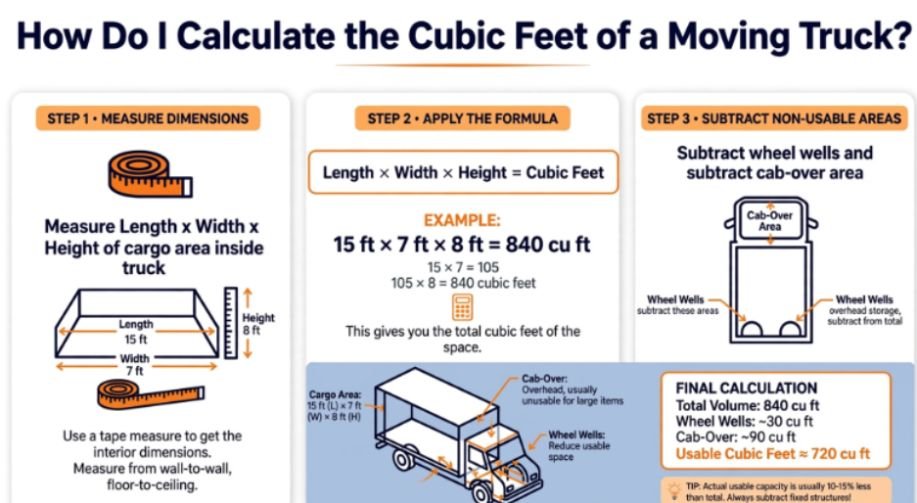
If I want to estimate a truck’s capacity myself, I use a simple volume calculation:
Length × Width × Height = Cubic Feet
For example, if a moving truck has an interior cargo area measuring:
- 20 feet long
- 8 feet wide
- 7 feet tall
The calculation would be:
20 × 8 × 7 = 1,120 cubic feet
If the measurements are provided in inches, I divide the final number by 1,728 because one cubic foot equals 1,728 cubic inches.
However, this calculation gives the total interior volume. The usable moving space may be slightly lower because furniture shapes, wheel wells, loading areas, and packing gaps can reduce how efficiently I can use the available space.
What Size Moving Truck Do I Need for My Home?
Choosing the right moving truck depends on more than just the number of rooms in my home. The amount of furniture, appliances, storage items, and boxes I own can significantly change the truck size I need.
A cargo van or 10-foot truck is usually enough for smaller moves such as a dorm room, studio apartment, or one-bedroom apartment. A 15- or 17-foot moving truck is often a better choice for a one- or two-bedroom home with standard furniture.
For larger household relocations, a 20-foot truck can provide enough room for multiple bedrooms, while a 26-foot or 29-foot moving truck is better suited for large family homes.
How Much Fits Inside a 10-Foot Moving Truck?
A 10-foot moving truck typically provides around 400 cubic feet of storage space. It is one of the smallest box trucks available and works well for people moving from smaller apartments.
I can usually fit:
- A mattress and bed frame
- Small sofa
- Dining table
- Basic appliances
- Several moving boxes
This size is ideal when I have fewer bulky items and want an affordable rental option.
How Much Fits Inside a 15-Foot or 20-Foot Moving Truck?
A 15-foot moving truck offers roughly 650 to 850 cubic feet, making it a popular choice for apartment and small-home moves. It provides enough room for larger furniture collections without requiring the size of a commercial-style truck.
A 20-foot moving truck increases capacity to around 1,000 to 1,200 cubic feet. Comparing moving truck rental companies can also help me understand how available truck sizes, loading capacities, and rental options differ between providers.
How Much Space Does a 26-Foot or 29-Foot Moving Truck Have?
The largest residential moving trucks provide the most storage capacity. A 26-foot truck typically holds about 1,682 cubic feet, while a 29-foot truck can exceed 2,000 cubic feet.
A 26-foot truck is commonly used for:
- Three- to five-bedroom homes
- Long-distance moves
- Large furniture collections
- Complete household relocations
The 29-foot truck provides additional room for very large moves where reducing the number of trips is a priority.
Does a Moving Truck’s Cubic Foot Capacity Equal Usable Space?
Knowing how to load a moving truck efficiently can make a major difference because careful stacking reduces empty gaps and allows more of the advertised cargo volume to be used.
The advertised cubic feet number represents the maximum interior volume, but I cannot always use every available inch. Moving requires strategic packing because items rarely form a perfect cube.
Factors that reduce usable capacity include:
- Irregular furniture shapes
- Empty spaces between items
- Protective wrapping around fragile belongings
- Weight restrictions
- Door and loading limitations
A professionally packed truck can hold significantly more than a poorly organized one because movers maximize vertical space and arrange items efficiently.
How Do Moving Truck Sizes Compare With Storage Units?
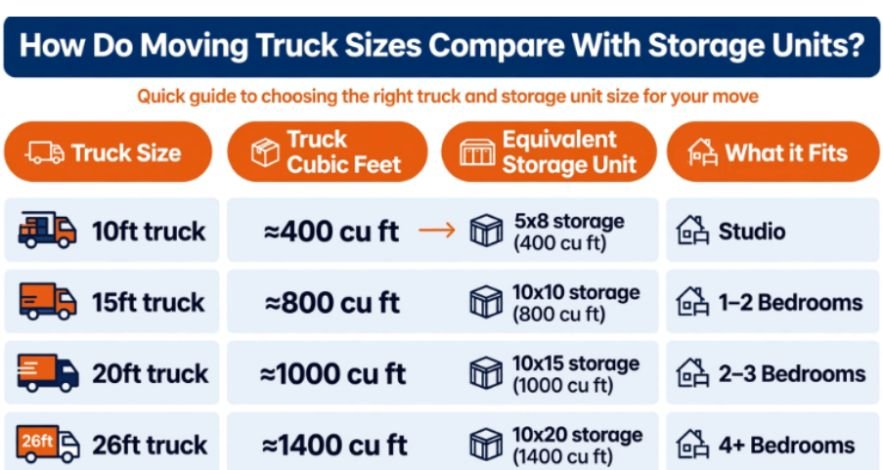
Many people compare moving trucks with storage units when planning a relocation. A small moving load truck may be similar to a small storage unit, while larger trucks can hold the contents of several rooms.
This is the same trade-off Forbes Home weighs when it compares truck size options against pricing tiers across major rental companies, since the right size depends as much on cost as on capacity.
For example, a 26-foot moving truck offers enough capacity for many large household moves, while a cargo van is better suited for smaller temporary storage needs.
Understanding the difference helps me avoid renting unnecessary space. Before choosing the right vehicle or storage option, I can use a moving volume calculator to estimate the amount of space required and make a more accurate decision.
Frequently Asked Questions
1. How many cubic feet is a moving truck?
A moving truck can range from about 200 cubic feet for smaller cargo vans to more than 2,000 cubic feet for the largest rental trucks.
2. How many cubic feet is a 26-foot moving truck?
A 26-foot moving truck usually provides around 1,600 to 1,700 cubic feet of storage space and is commonly used for larger household moves.
3. What size moving truck do I need for a three-bedroom house?
A 20- to 26-foot moving truck is typically suitable for a three-bedroom home, depending on the amount of furniture and personal belongings.
4. How do I estimate moving truck capacity?
I estimate capacity by multiplying the interior length, width, and height of the cargo area. The result gives the approximate cubic feet available for storage.
Conclusion
When I compare moving truck options, I focus on more than just the truck length. Capacity, household size, furniture quantity, and packing efficiency all determine whether a vehicle is the right fit. Knowing how many cubic feet a moving truck has allows me to choose a rental size that matches my move without wasting money or making extra trips.
From small cargo vans to large 29-foot moving trucks, understanding cubic footage makes the entire moving process easier. By comparing truck sizes, calculating available space, and considering my actual belongings, I can make a smarter decision for a smoother relocation.

Ryan Mitchell
Ryan Mitchell holds a degree in Civil Engineering and spent over a decade working in construction project estimation, where accurate volume and material calculations were part of his daily work — from concrete pours to landscaping material orders. He founded this site to bring that same precision to everyday calculations, helping DIYers, contractors, and students get fast, accurate cubic footage results without the guesswork. Ryan reviews every calculator and formula on this site for accuracy and writes guides based on real-world measurement scenarios he's encountered on job sites.