
I used to think closet size was mostly about width and floor space, but that leaves out one of the biggest factors: height. Once I started looking at the full three-dimensional space, the numbers became much more useful.
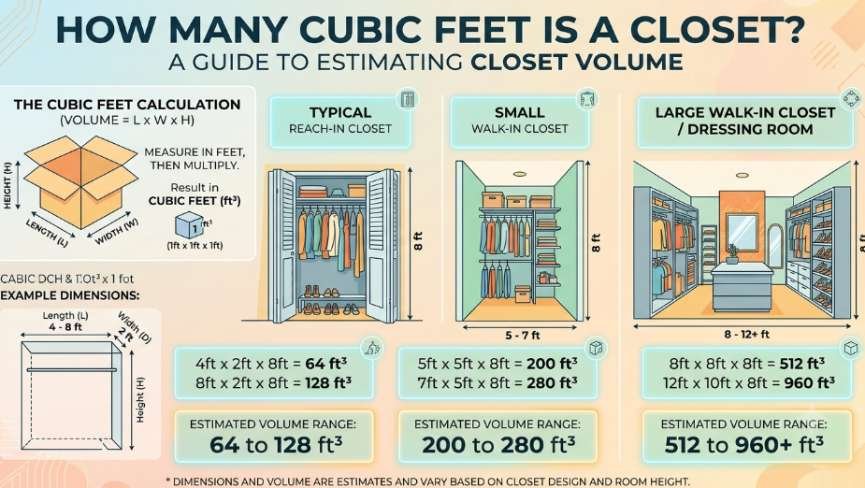
So, How Many Cubic Feet Is a Closet? A typical reach-in closet can hold roughly 48 to 150 cubic feet of gross space, while walk-in closets may range from about 200 to 800 cubic feet or more.
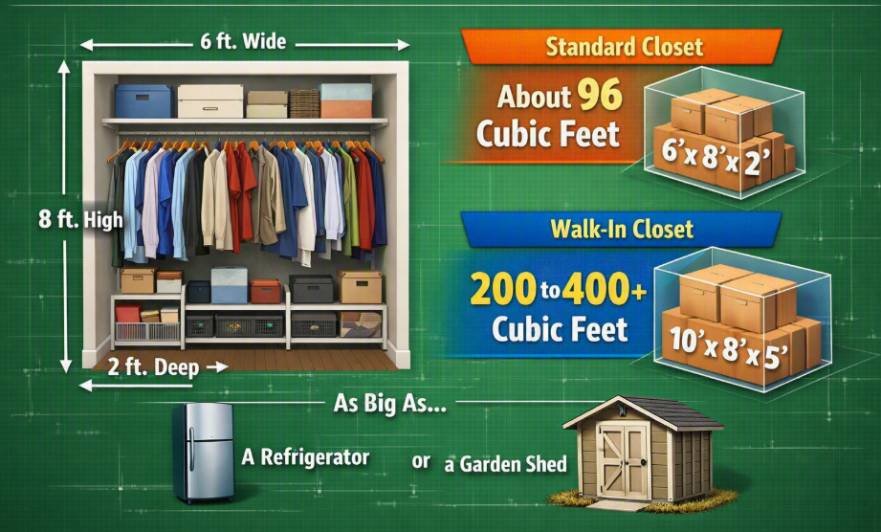
The exact figure depends on the closet’s width, depth, and ceiling height. A common 6-by-2-by-8-foot reach-in, for example, contains 96 cubic feet. That number gives me a much clearer way to compare closet capacity, plan storage, and understand how much space I can realistically use.
What Is the Average Closet Size in Cubic Feet?
There is no single standard closet volume for every American home. Bedroom size, floor plan, home age, and closet type all affect the dimensions. Still, common US closet sizes give me a useful reference point.
| Closet Type | Common Dimensions | Approximate Volume |
| Small reach-in or linen | 3 × 2 × 8 ft | 48–100 cu ft |
| Standard reach-in | 6 × 2 × 8 ft | About 96–150 cu ft* |
| Small walk-in | 5 × 5 × 8 ft | About 200–250 cu ft |
| Standard walk-in | 5 × 10 × 8 ft | About 400 cu ft |
| Large primary walk-in | 10 × 10 × 8 ft | About 800 cu ft |
*The exact volume of a 6 × 2 × 8-foot closet is 96 cubic feet. Higher figures in the range apply to wider, deeper, or taller reach-in closets.
How Do I Calculate Closet Cubic Feet?
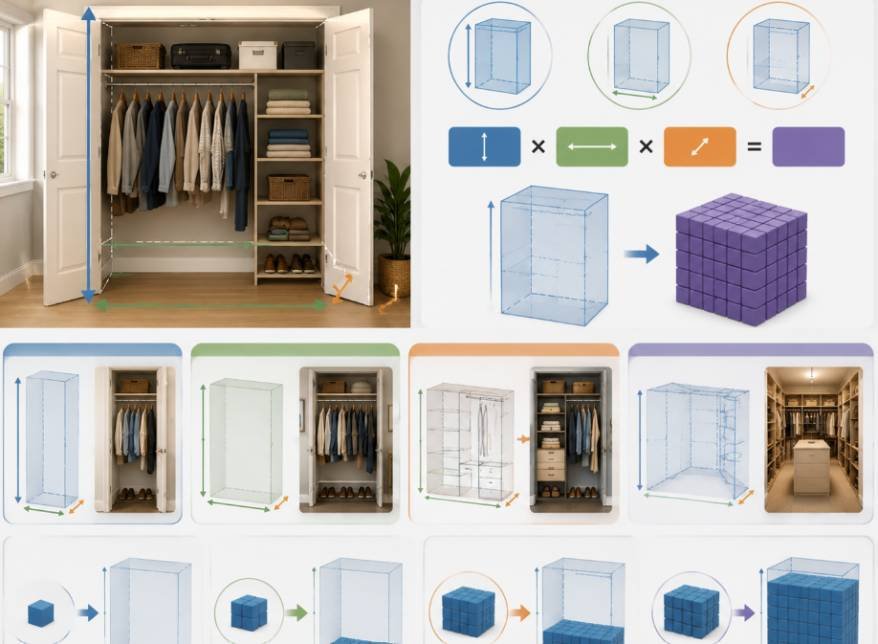
The basic closet volume formula is simple:
Width × Depth × Height = Total Cubic Feet
If my closet measures 6 feet wide, 2 feet deep, and 8 feet high, I calculate 6 × 2 × 8 = 96 cubic feet.
A 5 × 5 × 8-foot walk-in contains 200 cubic feet, while a 5 × 10 × 8-foot closet contains 400 cubic feet. A large 10 × 10 × 8-foot primary closet reaches 800 cubic feet.
How Do I Calculate Closet Volume From Inches?
In the United States, tape measures and closet plans commonly use inches. If all three measurements are in inches, I multiply them and divide the result by 1,728 because one cubic foot contains 1,728 cubic inches.
Length × Width × Height ÷ 1,728 = cubic feet
For example, a closet measuring 72 inches wide, 24 inches deep, and 96 inches high contains 165,888 cubic inches. Dividing by 1,728 gives 96 cubic feet.
How Many Cubic Feet Does a Reach-In Closet Have?
Reach-in closets remain common in US bedrooms because they provide practical clothes storage without using the floor area required for a walk-in closet.
A depth of around 24 inches is common for hanging clothes. A 3 × 2 × 8-foot reach-in contains 48 cubic feet. A 4 × 2 × 8 closet contains 64 cubic feet, a 5 × 2 × 8 closet contains 80 cubic feet, and a 6 × 2 × 8 closet contains 96 cubic feet.
Some American homes have wider reach-in closets extending across much of a bedroom wall. Those closets can reach 100 to 150 cubic feet or more, especially when they are deeper than 24 inches or have ceilings above 8 feet.
How Much Volume Does a Walk-In Closet Provide?
Walk-in closet dimensions vary much more because their layouts range from compact step-in spaces to large primary-suite dressing areas.
A 4 × 4 × 8-foot closet contains 128 cubic feet, although that footprint offers limited walking room. A 5 × 5 × 8-foot small walk-in provides 200 cubic feet.
A 5 × 10 × 8-foot standard walk-in provides 400 cubic feet. Larger layouts can reach 500 or 600 cubic feet, while a 10 × 10 × 8-foot primary walk-in contains 800 cubic feet.
When I compare walk-in closet capacity, I also look at aisle clearance, hanging depth, shelving, drawers, and access. More cubic footage does not automatically mean better organization.
Why Is Usable Closet Capacity Lower Than Gross Volume?
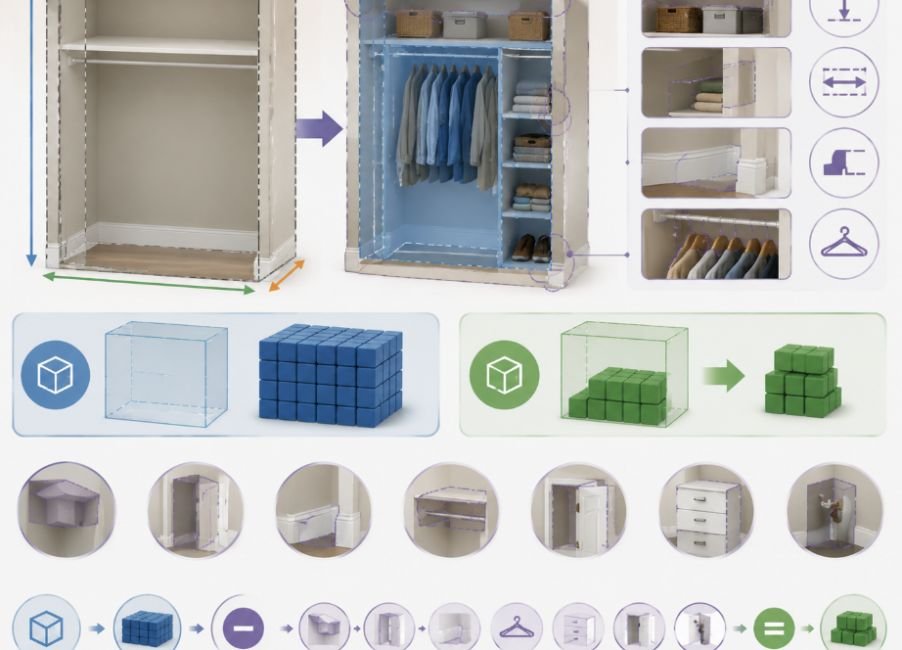
The standard cubic-foot calculation treats a closet like an empty rectangular box. A real closet contains storage systems and needs accessible open space.
Closet rods, shelves, drawer units, shoe racks, cabinets, doors, vents, lighting fixtures, and hanging clothes all occupy part of the interior. Walk-in closets also require an aisle so I can move comfortably and reach stored items.
That means a 400-cubic-foot closet does not provide 400 cubic feet of stackable storage.
This gross-vs-usable gap shows up in nearly every storage space . I walk through the same problem for smaller units in my storage locker, where boxes, luggage, and seasonal gear eat into the advertised volume the same way.
An efficient closet organization system can improve usable capacity, but it does not change the closet’s actual volume.
Is Closet Space Measured in Square Feet or Cubic Feet?
Both measurements matter, but they answer different questions.
Square footage measures floor area. A 5 × 10-foot closet has 50 square feet of floor space.
Cubic footage includes ceiling height. With an 8-foot ceiling, that same closet contains 400 cubic feet.
I use square footage when thinking about floor plans, walking space, renovations, or real estate layouts. I use cubic feet when comparing total storage volume.
How Do I Measure an Irregular Closet?
Not every closet has four straight walls and a flat ceiling. Sloped ceilings, under-stair closets, angled walls, built-in cabinetry, plumbing chases, and structural columns can make a simple calculation less accurate.
I divide an irregular closet into smaller rectangular sections, calculate each section separately, and add the results together. For more accurate estimates, I use a calculate cubic feet from measurements tool to determine the total volume.
For storage planning, I prefer interior measurements because trim, wall thickness, doors, and built-ins can reduce the space I can actually use.
How Can I Make Better Use of Closet Cubic Footage?
I focus on vertical space before assuming I need a larger closet. Double hanging rods, upper shelves, adjustable shelving, drawers, and correctly sized storage bins can substantially increase functional storage.
A thoughtfully organized reach-in can sometimes feel more practical than a larger walk-in with wasted corners and poorly positioned shelves.
The same principle applies to garage storage my garage storage cabinet guide covers how shelf layout and cabinet depth can matter more than raw cubic footage.
Frequently Asked Questions
1. How Many Cubic Feet Is a Closet?
A typical reach-in may contain about 48 to 150 cubic feet, depending on its width, depth, and height. Small walk-ins often start around 200 cubic feet, while standard and large walk-ins can range from roughly 400 to 800 cubic feet or more.
2. How Many Cubic Feet Is a 6 × 2 × 8 Closet?
A 6-foot-wide, 2-foot-deep, and 8-foot-high closet contains exactly 96 cubic feet.
3. How Many Cubic Feet Is a 5 × 5 Walk-In Closet?
A 5 × 5-foot walk-in closet with an 8-foot ceiling contains 200 cubic feet of gross volume.
4. Does Ceiling Height Change Closet Capacity?
Yes. A 5 × 5 closet with an 8-foot ceiling contains 200 cubic feet, while the same floor dimensions with a 10-foot ceiling provide 250 cubic feet.
Final Takeaway
When someone asks me, ” How many cubic feet is a closet? ” I start with the actual dimensions rather than relying on one average. Reach-in closets commonly range from about 48 to 150 cubic feet, while walk-ins can range from roughly 200 cubic feet to 800 cubic feet or more.
I multiply the interior width, depth, and height to calculate gross volume. Then I consider shelves, rods, drawers, doors, hanging clothes, and walking space. That final step gives me a much more realistic picture of how much usable storage the closet actually provides.

Ryan Mitchell
Ryan Mitchell holds a degree in Civil Engineering and spent over a decade working in construction project estimation, where accurate volume and material calculations were part of his daily work — from concrete pours to landscaping material orders. He founded this site to bring that same precision to everyday calculations, helping DIYers, contractors, and students get fast, accurate cubic footage results without the guesswork. Ryan reviews every calculator and formula on this site for accuracy and writes guides based on real-world measurement scenarios he's encountered on job sites.