
When I estimate soil for a planter or raised bed, I ignore the bag’s physical size and check its labeled volume first. So, how many cubic feet is a bag of soil? A typical large bag contains about 1 to 2 cubic feet, with 1.5- and 2-cubic-foot bags especially common in U.S. garden centers.
Smaller bags may show dry quarts instead. Weight-based bags need more caution because 40 pounds of one soil mix may occupy a different volume than 40 pounds of another.
How Many Cubic Feet Is a Bag of Soil in Common Sizes?
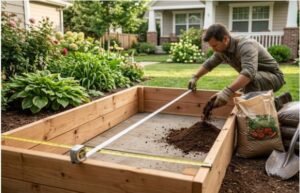
The practical answer to how many cubic feet is a bag of soil? depends on the product and package size. Potting mix, garden soil, topsoil, compost, and raised-bed mixes do not follow one universal bag size.
Current U.S. retail examples show 1.5-cubic-foot garden soil bags and 2-cubic-foot potting mix bags. PRO-MIX also sells compressed products that expand to a stated 2 cubic feet after opening.
| Bag Label | Approx. Cubic Feet | Typical Use |
| 8 dry qt | 0.31 cu. ft. | Small containers |
| 20 dry qt | 0.78 cu. ft. | Several flower pots |
| 25 dry qt | 0.97 cu. ft. | Roughly 1 cu. ft. |
| 1 cu. ft. | 1.00 cu. ft. | Planters and small beds |
| 1.5 cu. ft. | 1.50 cu. ft. | Common garden-soil bag |
| 2 cu. ft. | 2.00 cu. ft. | Raised beds and large pots |
| 40 lb topsoil | Varies | Check stated dry volume |
A 40-pound topsoil bag is often estimated near 0.75 cubic foot for some retail products, but that is not a universal conversion. One Lowe’s product Q&A, for example, reports about 0.75 cubic foot for a specific 40-pound topsoil product.
The same volume-first approach can help when estimating bulky items stored nearby, such as how many cubic feet is a garden tool set.
Why Soil Bag Weight Does Not Equal Volume
Answering how many cubic feet is a bag of soil? becomes harder when the package lists only pounds.
Weight and volume measure different things. Soil weight changes with moisture, organic matter, sand content, compaction, and lightweight ingredients such as peat or perlite.
USDA guidance defines soil bulk density as dry soil mass divided by its bulk volume. USDA also treats water content as a separate measurement. That means two bags with identical weights can occupy different amounts of space.
For that reason, I do not use a universal “pounds to cubic feet” conversion for soil. I first look for the manufacturer’s dry-volume statement.
If the package only provides pounds, any cubic-foot result should be treated as an estimate.
This same difference between physical size and capacity matters when comparing outdoor equipment, including how many cubic feet is a pressure washer.
Converting Dry Quarts to Cubic Feet
Another common version of how many cubic feet is a bag of soil? appears when a bag is labeled in quarts.
The key detail is that soil is a dry product. U.S. dry quarts and U.S. liquid quarts are not the same volume.
NIST lists one U.S. dry quart as approximately 0.038889 cubic foot.
Use this formula:
Cubic feet = dry quarts × 0.038889
That gives these useful conversions:
20 dry quarts × 0.038889 = about 0.78 cubic foot.
25 dry quarts × 0.038889 = about 0.97 cubic foot.
38.5 dry quarts × 0.038889 = about 1.50 cubic feet.
A current garden-soil listing labels one product as both 1.5 cubic feet and 38.5 quarts, which closely matches the dry-quart calculation.
This distinction creates useful information gain because using the familiar liquid-quart conversion can produce the wrong result for bagged soil.
How to Calculate Cubic Feet of Soil for a Garden Bed

Knowing how many cubic feet is a bag of soil? is only half the calculation. I also need the volume of the space being filled.
For a rectangular garden bed:
Cubic feet = length × width × depth
All three measurements must be in feet.
Calculating raised garden bed volume first also makes it easier to estimate the exact number of soil bags needed for deeper planting areas.”
If the soil depth is measured in inches, use:
Cubic feet = length × width × (depth ÷ 12)
After finding the required volume, divide it by the cubic feet printed on the bag.
Worked Example: A 4 × 8-Foot Raised Bed
Suppose I have a raised bed measuring 4 feet long and 8 feet wide. I want 6 inches of soil.
First, convert 6 inches to feet:
6 ÷ 12 = 0.5 foot
Now calculate:
4 × 8 × 0.5 = 16 cubic feet
With 2-cubic-foot bags:
16 ÷ 2 = 8 bags
With 1.5-cubic-foot bags:
16 ÷ 1.5 = 10.67
Since I cannot buy 0.67 of a bag, I round up to 11 bags.
That produces 16.5 cubic feet. In this example, rounding naturally gives me an extra 0.5 cubic foot.
I prefer this method over automatically adding a large arbitrary percentage. For irregular beds or expected settling, I may allow more material.
Similar volume calculations can also help with storage planning for equipment such as how many cubic feet is an air compressor.
How Much Area Does One Bag of Soil Cover?
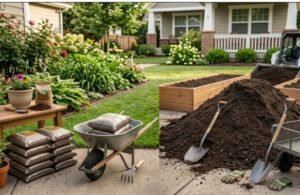
The question how many cubic feet is a bag of soil? becomes much more useful when cubic feet are translated into square-foot coverage.
Use:
Coverage = bag volume ÷ depth in feet
A 2-cubic-foot bag spread 2 inches deep covers about 12 square feet.
At 3 inches deep, the same bag covers about 8 square feet.
At 6 inches deep, it covers only 4 square feet.
A 1.5-cubic-foot bag covers about 9 square feet at 2 inches deep, 6 square feet at 3 inches, and 3 square feet at 6 inches.
This is why soil depth matters so much. The same depth-based calculation applies to mulch bag coverage, where spreading material more deeply reduces the total area each bag can cover.”
Double the depth and the project requires twice as much soil.
When Buying Soil by the Cubic Yard Makes More Sense
For larger projects, how many cubic feet is a bag of soil? often leads to another question: should I keep buying bags or order bulk soil?
One cubic yard contains exactly 27 cubic feet.
That means one cubic yard equals:
27 bags at 1 cubic foot each, 18 bags at 1.5 cubic feet each, or 13.5 bags at 2 cubic feet each.
For small pots, bagged soil is convenient. Once I am filling several large raised beds, I compare the cost of bags with bulk delivery.
For example, a project requiring 54 cubic feet needs exactly 2 cubic yards. At that volume, bulk soil may reduce hauling and packaging, though local delivery charges still affect the final cost.
Frequently Asked Questions
1. How many cubic feet is a 40 lb bag of soil?
There is no fixed conversion, although some 40-pound topsoil products are around 0.75 cubic foot; always check the package volume.
2. How many bags of soil equal one cubic yard?
One cubic yard equals 27 one-cubic-foot bags, 18 1.5-cubic-foot bags, or 13.5 two-cubic-foot bags.
3. How many cubic feet are in a 20-quart bag of soil?
Using U.S. dry quarts, a 20-quart soil bag contains about 0.78 cubic foot.
4. How many cubic feet is a bag of soil for a raised bed?
Most large bags hold 1 to 2 cubic feet; calculate the bed’s volume and divide it by the bag’s labeled cubic-foot capacity.
Don’t Let the Bag Fool You: Measure Before You Buy
When I plan a soil purchase, I trust volume before weight. A heavy bag is not automatically a large bag, and a quart label needs the correct dry-volume conversion.
So, the next time you wonder how many cubic feet is a bag of soil?, check the printed dry volume first. Then measure your bed, calculate its cubic feet, divide by the bag size, and round up to the nearest whole bag.
That tiny bit of math beats discovering you’re one bag short with half a raised bed still empty.

Ryan Mitchell
Ryan Mitchell holds a degree in Civil Engineering and spent over a decade working in construction project estimation, where accurate volume and material calculations were part of his daily work — from concrete pours to landscaping material orders. He founded this site to bring that same precision to everyday calculations, helping DIYers, contractors, and students get fast, accurate cubic footage results without the guesswork. Ryan reviews every calculator and formula on this site for accuracy and writes guides based on real-world measurement scenarios he's encountered on job sites.