Whenever I prepare cartons for storage, delivery, or freight, I want to know how much space they will actually occupy. The answer to How Many Cubic Feet Is a Shipping Carton? depends entirely on its external length, width, and height. Most everyday parcel cartons occupy between 0.25 and 6 cubic feet, while unusually small mailers or large freight cartons can fall outside that range.
A carton measuring 12 inches long, 12 inches wide, and 12 inches high equals exactly one cubic foot. However, there is no universal carton capacity because manufacturers produce boxes for everything from jewelry and books to appliances and industrial equipment.
What Does Cubic Footage Mean for a Carton?
Cubic footage measures the three-dimensional space occupied by a closed carton. It considers length, width, and height rather than only the floor area covered by the box.
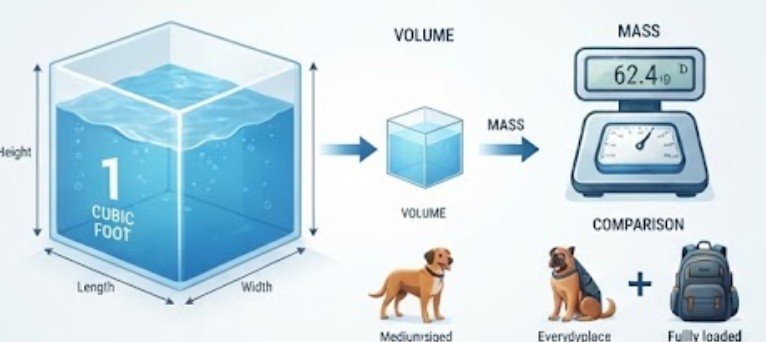
One cubic foot represents a cube measuring one foot on every side. Since one foot contains 12 inches, one cubic foot contains 1,728 cubic inches:
12 × 12 × 12 = 1,728 cubic inches
Cubic footage helps with warehouse planning, vehicle loading, freight quotations, moving estimates, shelf allocation, and packaging decisions. It can also help businesses compare different carton sizes before ordering packaging supplies.
Common Shipping Carton Capacities
Small mailer cartons measuring around 8 × 6 × 4 inches occupy approximately 0.11 cubic feet. They are useful for accessories, cosmetics, electronic components, and other compact products.
A 12 × 9 × 4-inch carton occupies 0.25 cubic feet, while a 12 × 12 × 12-inch box holds exactly one cubic foot. These sizes are common for apparel, books, household products, and small online orders.
Medium cartons vary considerably. A 16 × 12 × 12-inch box occupies approximately 1.33 cubic feet. An 18 × 12 × 12-inch carton occupies 1.5 cubic feet, while an 18 × 14 × 12-inch carton uses 1.75 cubic feet.
Larger cartons may occupy 3 to 6 cubic feet. An 18 × 18 × 16-inch box equals 3 cubic feet, and a 24 × 18 × 24-inch carton equals 6 cubic feet. Large cartons are often used for bedding, clothing, decorations, lightweight appliances, and other bulky items.
How to Calculate Shipping Carton Cubic Feet
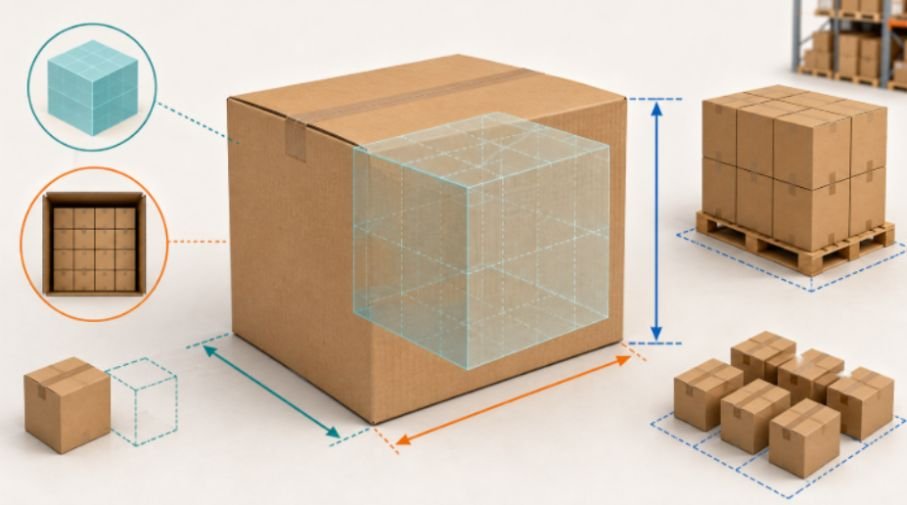
When carton dimensions are listed in inches, use this formula:
Length × Width × Height ÷ 1,728 = cubic feet
Suppose a packed carton measures 18 inches long, 14 inches wide, and 12 inches high. Multiply the three measurements:
18 × 14 × 12 = 3,024 cubic inches
Divide the result by 1,728:
3,024 ÷ 1,728 = 1.75 cubic feet
The closed carton therefore occupies 1.75 cubic feet.
If the measurements are already in feet, multiply them directly without dividing by 1,728. A carton measuring 2 feet by 1.5 feet by 2 feet occupies 6 cubic feet.
Should You Measure Inside or Outside the Carton?
Use exterior measurements when calculating transportation, storage, pallet, or shelving space. The outside of the finished carton determines how much physical room it occupies.
Use interior dimensions when determining whether a product and its protective packaging will fit inside. Corrugated walls, flaps, liners, dividers, and inserts reduce usable interior capacity. A carton can therefore occupy more external space than it provides internally.
Some packaging suppliers advertise internal dimensions. Those figures are helpful for product fit but may slightly understate the finished shipping cube. Always check how the manufacturer defines its dimensions before relying on a product listing.
Measure the Finished Package Correctly
Measure the carton only after it has been packed, closed, and sealed. Begin with the longest side as the length, measure the shorter horizontal side as the width, and measure from the bottom to the highest point as the height.
Include any bulging panels, protruding products, corner protectors, wrapping, or external reinforcement. Carriers and warehouse operators are interested in the greatest distance in each direction because that represents the space the carton prevents other cargo from using.
Avoid measuring a flat, unassembled carton because its storage footprint before assembly does not represent its occupied shipping volume. For an accurate calculation for carton shipping, assemble, pack, close, and seal the carton before measuring its exterior dimensions.
Calculating Cubic Feet for Multiple Cartons
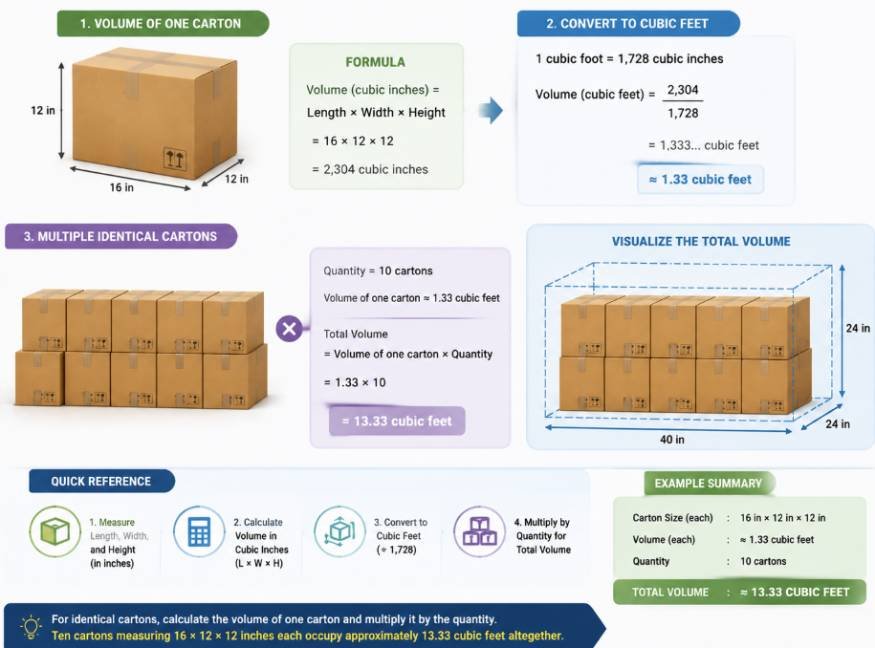
For identical cartons, calculate the volume of one carton and multiply it by the quantity. Ten cartons measuring 16 × 12 × 12 inches each occupy approximately 13.33 cubic feet altogether.
For cartons with different dimensions, calculate every size group separately and add the results. Do not multiply the maximum length, width, and height across an entire collection unless all cartons form one tightly wrapped shipping unit.
Palletized cartons require a slightly different approach. Once the boxes are stacked and secured, measure the complete pallet load as one unit, including the pallet base, any overhang, wrapping, protective corners, and top reinforcement. The final dimensions reflect the actual space the loaded pallet occupies during storage or transport.
Cubic Feet Versus Dimensional Weight
Cubic feet and dimensional weight describe related but different measurements. Cubic feet show the physical volume of a carton. To calculate volume of a box, multiply its length, width, and height. Dimensional weight converts that volume into a theoretical billable weight using a carrier’s divisor.
Carriers may compare dimensional weight with actual scale weight and charge according to whichever is greater. This prevents a large, lightweight carton from being priced like a small package even though it occupies considerably more vehicle space.
The same actual versus dimensional pricing logic applies at freight scale too my freight package size guide covers how density and volume together affect a shipping quote.
Because carrier formulas, rounding rules, service levels, and divisors can change, check the current terms of the chosen delivery company before estimating a final shipping charge.
Frequently Asked Questions
1. How Many Cubic Feet Is a Shipping Carton?
Most ordinary shipping cartons occupy approximately 0.25 to 6 cubic feet, but the exact capacity depends on the box’s dimensions. Multiply its external length, width, and height in inches, then divide by 1,728.
2. Is a 12 × 12 × 12-Inch Carton One Cubic Foot?
Yes. Multiplying 12 by 12 by 12 produces 1,728 cubic inches, which equals exactly one cubic foot.
3. How Many Cubic Feet Is a 24 × 18 × 24-Inch Box?
A 24 × 18 × 24-inch box occupies 6 cubic feet because 24 × 18 × 24 equals 10,368 cubic inches, and 10,368 divided by 1,728 equals 6.
4. Does Carton Shape Affect the Calculation?
A rectangular carton uses the standard length-times-width-times-height formula. For an irregular, damaged, or bulging package, measure the longest distance in each direction to estimate its occupied rectangular space.
Final Thoughts
When I need dependable packaging figures, I calculate the external volume of the fully packed carton rather than relying on a general size label.
Understanding How Many Cubic Feet Is a Shipping Carton? makes it easier to plan shelving, freight space, storage capacity, and packaging purchases. With three accurate measurements and the 1,728 conversion factor, I can obtain a practical estimate in seconds.

Ryan Mitchell
Ryan Mitchell holds a degree in Civil Engineering and spent over a decade working in construction project estimation, where accurate volume and material calculations were part of his daily work — from concrete pours to landscaping material orders. He founded this site to bring that same precision to everyday calculations, helping DIYers, contractors, and students get fast, accurate cubic footage results without the guesswork. Ryan reviews every calculator and formula on this site for accuracy and writes guides based on real-world measurement scenarios he's encountered on job sites.