
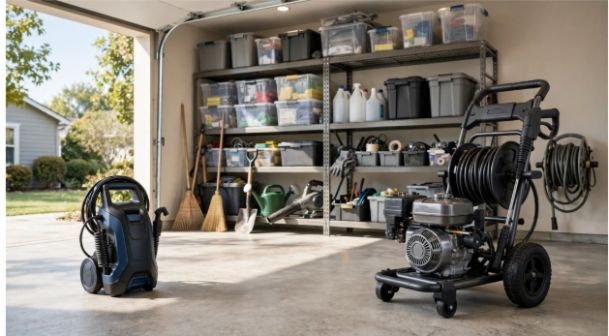
If you are asking how many cubic feet is a pressure washer, you probably need to know whether it will fit in a garage, shed, shelf, or vehicle. Most residential electric units occupy about 1 to 3.5 cubic feet, while larger gas models often need 8 to 11+ cubic feet of exterior storage envelope. Compact electric designs can come in near 1 cubic foot.
The key is knowing what “cubic feet” means here. Pressure washers are rated by PSI and GPM, not interior capacity. I use cubic feet only to estimate the physical space a machine takes up.
How Many Cubic Feet Is A Pressure Washer by Type?
When I calculate how many cubic feet is a pressure washer, I treat its length, width, and height as a rectangular storage envelope.
| Pressure washer type | Approximate storage envelope | Typical use |
| Compact electric | 0.8–1.2 ft³ | Cars, furniture, small patios |
| Upright residential electric | 1.5–3.5 ft³ | Siding, decks, sidewalks |
| Larger electric/cart design | 3–5 ft³ | Frequent household cleaning |
| Residential gas | 8–11+ ft³ | Driveways, concrete, large areas |
A current TechGearLab comparison lists “volume of unit” figures for ten tested pressure washers from 1.9 to 11.2 cubic feet. The average is about 5.54 cubic feet. It shows how widely designs vary rather than defining one “standard” size.
The figures above describe the rectangular space surrounding the machine. A pressure washer does not physically fill every cubic inch inside that box.
How to Calculate Pressure Washer Cubic Feet
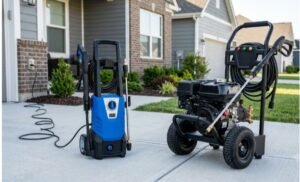
You only need three measurements:
Length × Width × Height ÷ 1,728 = cubic feet
There are 1,728 cubic inches in one cubic foot.
This formula is more useful for storage planning than guessing from product photos.
Electric Pressure Washer Example
Home Depot lists a Ryobi RY142012 at 25 inches high, 14.5 inches wide, and 11 inches deep.
25 × 14.5 × 11 = 3,987.5 cubic inches
3,987.5 ÷ 1,728 = 2.31 cubic feet
For this model, how many cubic feet is a pressure washer has a practical answer of about 2.3 cubic feet.
A more compact configuration of the same Ryobi line is listed at 7.75 × 11.875 × 18.375 inches. That works out to about 0.98 cubic feet.
This is one reason I would never use one universal pressure-washer volume. Handle position and storage orientation can change the answer considerably.
Gas Pressure Washer Example
Gas machines usually need more room because they include an engine, steel frame, fuel system, wheels, and pump.
Simpson lists its PW61431-S at 41 × 21 × 27 inches.
Using the same formula gives approximately 13.45 cubic feet of rectangular exterior space.
Another Simpson MegaShot measures 21 × 24 × 34 inches. That works out to about 9.92 cubic feet.
Those real dimensions explain why how many cubic feet is a pressure washer cannot be answered accurately with one universal number. They also show why assuming every gas pressure washer occupies only 3 to 5 cubic feet can seriously underestimate its garage footprint.
Electric vs. Gas Pressure Washer Dimensions
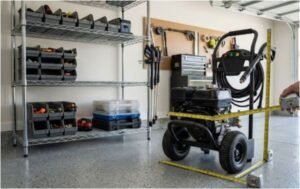
Electric pressure washers are usually easier to store. Their motors and pumps can fit inside compact housings. Many also use telescoping or folding handles.
Ryobi, for example, promotes onboard storage for the hose, wand, nozzles, foamer, and electrical cord on its RY142012.
Gas models generally need wider frames and more clearance. Simpson’s Clean Machine uses a steel frame and 12-inch wheels. Those features improve mobility but increase the physical footprint.
When comparing several pieces of garage equipment, I use the same dimension-based method to work out the storage space an air compressor takes up on a shelf and generator. Measuring each machine’s storage envelope makes shelf and floor-space comparisons much more useful.
PSI and GPM Matter More Than Cubic Feet for Cleaning
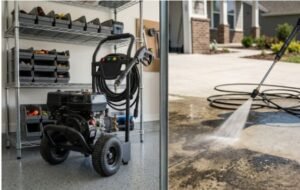
If your real question is cleaning power rather than storage, how many cubic feet is a pressure washer is the wrong performance metric.
Pressure washers use two much more important numbers: PSI and GPM.
Home Depot explains that PSI represents cleaning force, while GPM represents the amount of water delivered. It also recommends multiplying PSI by GPM when comparing overall cleaning output.
PSI: Pressure at the Surface
PSI means pounds per square inch. Higher PSI gives the water stream more force.
It is useful when removing stubborn dirt from concrete, brick, or other durable surfaces. More pressure is not automatically better for delicate materials.
GPM: Water Flow
GPM means gallons per minute. It measures how much water passes through the pressure washer.
Higher flow often allows loosened dirt and debris to rinse away faster.
Cleaning Units: PSI × GPM
Cleaning Units combine both specifications.
A 2,100 PSI pressure washer producing 1.2 GPM generates:
2,100 × 1.2 = 2,520 Cleaning Units
That number tells me much more about cleaning capability than the machine’s exterior volume.
It is therefore useful to separate how many cubic feet is a pressure washer from “how powerful is this pressure washer?” They answer completely different buying questions.
How Much Storage Space Should You Allow?
Before buying, I ask how many cubic feet is a pressure washer after checking the model’s stored dimensions.
I would not build a storage cubby that matches the calculated dimensions exactly. Hoses, cords, fittings, wheels, and handles can make a tight space frustrating.
I prefer roughly 10% to 20% extra clearance as a practical planning allowance. This is my storage calculation rather than an official manufacturer requirement.
A 2.31-cubic-foot electric unit, for example, would be more comfortable with about 2.5 to 2.8 cubic feet of usable storage space.
Height deserves special attention. A pressure washer might have a reasonable total volume but still fail to fit below a shelf because of its handle.
Check whether that handle folds or telescopes before deciding where the unit will live.
Why Pressure Washers Are Not Sold by Cubic Feet
People often search how many cubic feet is a pressure washer because cubic feet is a familiar measurement on clothes washers.
The products use the measurement differently.
A laundry washer uses cubic feet to describe the capacity of its drum. A pressure washer has no comparable storage chamber. Water enters the machine, moves through a pump, and exits through the hose and nozzle.
That is why pressure-washer specifications focus on PSI, GPM, engine or motor type, hose length, pump design, and accessories.
Cubic feet becomes useful only when you want to understand the physical footprint.
Safe Storage Matters Too
When comparing several pieces of garage equipment, I use the same dimension-based method I use when figuring out the storage footprint of a portable generator in a shed or garage corner.
Never run a gasoline pressure washer inside a garage, shed, basement, or other enclosed area. The CDC warns that gasoline-powered pressure washers can expose users to dangerous carbon monoxide in enclosed or partly enclosed spaces.
Electric models require their own precautions. Inspect cords and ground-fault protection before use.
That advice has become particularly relevant because the U.S. Consumer Product Safety Commission issued pressure-washer warnings in 2026 involving electric models without adequate GFCI protection.
Store the washer according to its manufacturer’s manual and keep hoses and electrical components where they will not remain wet.
Frequently Asked Questions
1. How many cubic feet is a pressure washer on average?
Across ten models in one current comparison, unit volume averaged about 5.54 cubic feet, although electric and gas designs vary widely.
2. How many cubic feet is a gas pressure washer?
Many residential gas units occupy roughly 8 to 11+ cubic feet, while some full-frame designs exceed that range.
3. How do I calculate pressure washer cubic feet from inches?
Multiply length × width × height in inches, then divide the result by 1,728.
4. Does a bigger pressure washer clean better?
No. PSI and GPM indicate cleaning performance more accurately than the machine’s exterior cubic-foot size.
Measure First, Avoid the Garage Tetris
My practical answer to how many cubic feet is a pressure washer is about 1 to 3.5 cubic feet for many electric models and roughly 8 to 11+ cubic feet for common gas designs.
The smarter move is to measure the exact machine before buying. Check its stored handle position, hose arrangement, wheels, and accessories. Add a little clearance after calculating the exterior volume.
Then forget cubic feet when comparing cleaning power. Use PSI and GPM for that job.
A two-minute measurement now beats spending the next five years squeezing a bulky pressure washer between your mower and garage wall.

Ryan Mitchell
Ryan Mitchell holds a degree in Civil Engineering and spent over a decade working in construction project estimation, where accurate volume and material calculations were part of his daily work — from concrete pours to landscaping material orders. He founded this site to bring that same precision to everyday calculations, helping DIYers, contractors, and students get fast, accurate cubic footage results without the guesswork. Ryan reviews every calculator and formula on this site for accuracy and writes guides based on real-world measurement scenarios he's encountered on job sites.