
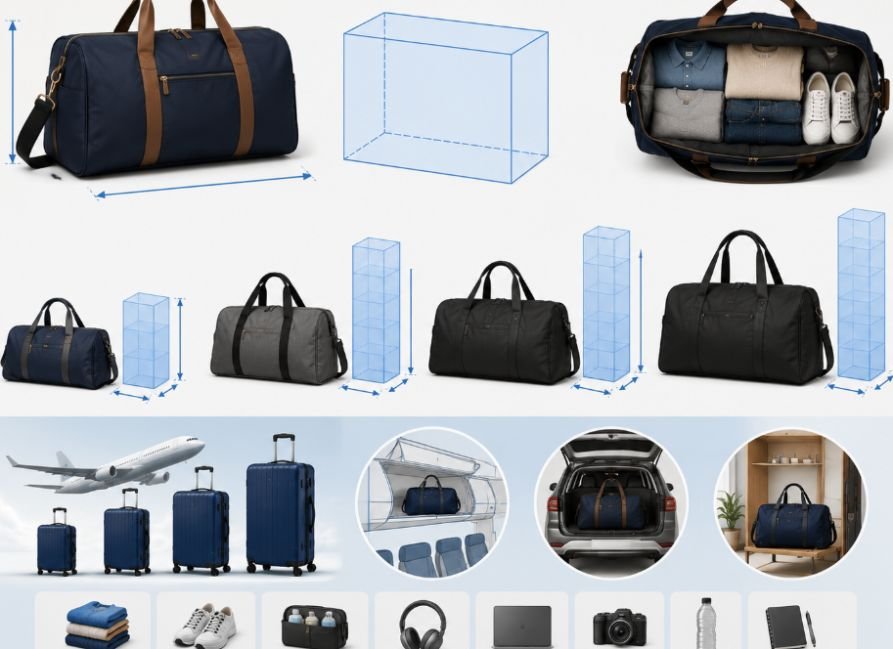
A travel bag can look surprisingly roomy in a store and still feel too small once the shoes, clothes, toiletries, and tech go in. I prefer to compare actual capacity before packing, which is why How Many Cubic Feet Is a Travel Bag? matters more than labels like “carry-on” or “large.”
Depending on the style, a travel bag can range from less than 1 cubic foot for a compact personal item to more than 4 cubic feet for a large checked suitcase. Knowing the cubic footage gives me a much clearer idea of what will fit and which bag makes sense for the length of my trip.
How Many Cubic Feet Is a Travel Bag?
When I compare luggage, I usually see liters or exterior dimensions—not cubic feet. So, How Many Cubic Feet Is a Travel Bag? Most passenger travel bags fall between about 1.0 and 4.5 cubic feet, depending on whether I am looking at a compact carry-on or a large checked suitcase. Smaller personal-item bags can dip to roughly 0.7 cubic feet.
For US travelers, cubic feet are useful because luggage dimensions are commonly shown in inches. I use a calculate cubic feet from dimensions tool to quickly compare packing space between different bags. The number helps me understand actual storage capacity instead of relying only on labels like carry-on, medium, or large.
What Are Standard Travel Bag Sizes in Cubic Feet?

These ranges give me a practical starting point:
| Luggage Type | Typical Capacity | Approx. Cubic Feet | Best Used For |
| Personal item / backpack | 20–35 L | 0.7–1.2 ft³ | Day trips, under-seat storage |
| Carry-on suitcase | 35–45 L | 1.2–1.6 ft³ | 1–4 day trips |
| Medium checked bag | 60–80 L | 2.1–2.8 ft³ | 4–7 day trips |
| Large checked bag | 90–120 L | 3.2–4.2 ft³ | 1–2 weeks |
| Rooftop cargo bag | about 420–700 L | about 15–25 ft³ | Family road trips |
I treat these as planning ranges because bag shape and construction affect usable space.
How Do I Calculate My Travel Bag’s Cubic Feet?
If I have the bag’s measurements in inches, I multiply length × width × height to get cubic inches, then divide by 1,728.
For example, a checked suitcase measuring 28 × 18 × 12 inches equals 6,048 cubic inches. Dividing by 1,728 gives 3.5 cubic feet.
The same formula works for a carry-on. A 22 × 14 × 9-inch bag equals 2,772 cubic inches, or about 1.60 cubic feet.
If the manufacturer lists liters instead, I use this conversion: 1 cubic foot equals about 28.3 liters. A 40-liter bag is about 1.41 cubic feet, while a 60-liter bag is about 2.12 cubic feet.
How Many Cubic Feet Should a US Carry-On Have?
For air travel, I never judge a carry-on by volume alone. Airlines primarily enforce exterior dimensions.
American Airlines currently limits standard carry-ons to 22 × 14 × 9 inches, including handles and wheels, and Delta publishes the same maximum dimensions. That rectangular envelope equals about 1.60 cubic feet.
Actual internal capacity is usually lower. Away’s standard Carry-On measures 21.7 × 14.4 × 9 inches externally but lists 41 liters of capacity, or roughly 1.45 cubic feet. This shows why exterior dimensions and usable packing volume are not identical.
Why Is Usable Luggage Capacity Smaller Than Exterior Volume?

When I calculate length × width × height, I am measuring a rectangular box around the luggage. Real bags lose interior room to wheels, telescoping handles, frames, curved corners, padding, laptop sleeves, dividers, and compression panels.
I use cubic feet for quick comparison but prefer the manufacturer’s internal liter capacity when available. Backpack size guides commonly use liters for comparing bags of different shapes.
What Travel Bag Size Do I Need for My Trip?
Is 0.7 to 1.2 Cubic Feet Enough for a Personal Item?
For a day trip or overnight stay, I find a 20–35-liter bag practical. That equals roughly 0.7–1.2 cubic feet and works well under the seat. I still check the airline’s personal-item dimensions.
Is 1.2 to 1.6 Cubic Feet Good for a Weekend Trip?
For a short trip, 35–45 liters is often the sweet spot. Away, for example, positions its 41-liter Carry-On for roughly three- to five-day trips.
When Should I Choose a Checked Bag?
A 60–80-liter medium checked suitcase provides about 2.1–2.8 cubic feet, while a 90–120-liter large checked bag offers roughly 3.2–4.2 cubic feet. These sizes suit longer trips and bulky gear. I also check airline weight and linear-dimension limits.
How Large Are Rooftop Cargo Bags Compared With Luggage?

Rooftop cargo bags are a separate category, but they show how quickly cubic footage scales. Soft rooftop carriers commonly appear around 15 to 25 cubic feet, or roughly 425 to 708 liters. Current products include 15-, 19-, 21-, 23-, and 25-cubic-foot options.
Some manufacturers advertise enough space for roughly four to eight suitcases. Rather than assuming every 15–25-cubic-foot carrier will hold six to ten bags, I check the carrier dimensions and the actual suitcase sizes.
Frequently Asked Questions
1. How Many Cubic Feet Is a Travel Bag?
A typical passenger travel bag is around 1.0 to 4.5 cubic feet, depending on the style. Personal items are often below 1.2 cubic feet, carry-ons are commonly around 1.2–1.6 cubic feet, and large checked luggage can exceed 4 cubic feet.
2. How many cubic feet is a 40-liter travel bag?
A 40-liter travel bag is approximately 1.41 cubic feet, a common capacity for carry-on backpacks and compact suitcases.
3. Is 2 cubic feet a large travel bag?
Two cubic feet equals about 56.6 liters. I would consider that fairly large for cabin luggage, although the bag’s exterior dimensions determine whether an airline accepts it as a carry-on.
4. How many cubic feet is a standard checked suitcase?
A medium checked suitcase often falls around 2.1 to 2.8 cubic feet, while a large checked bag can reach roughly 3.2 to 4.2 cubic feet.
Final Takeaway
I find cubic feet useful when comparing travel bags using familiar US measurements. A personal item may offer less than 1 cubic foot, a typical carry-on sits around 1.2–1.6 cubic feet, and a large checked suitcase can exceed 4 cubic feet.
I still compare liters, exterior dimensions, usable space, airline restrictions, and trip length before choosing luggage. Together, those measurements tell me whether a bag will really work for my trip.

Ryan Mitchell
Ryan Mitchell holds a degree in Civil Engineering and spent over a decade working in construction project estimation, where accurate volume and material calculations were part of his daily work — from concrete pours to landscaping material orders. He founded this site to bring that same precision to everyday calculations, helping DIYers, contractors, and students get fast, accurate cubic footage results without the guesswork. Ryan reviews every calculator and formula on this site for accuracy and writes guides based on real-world measurement scenarios he's encountered on job sites.