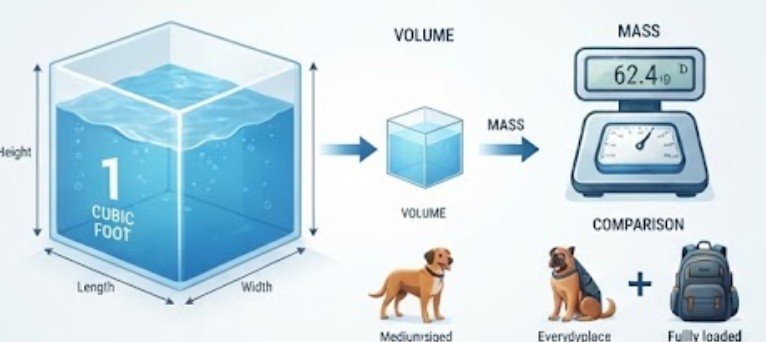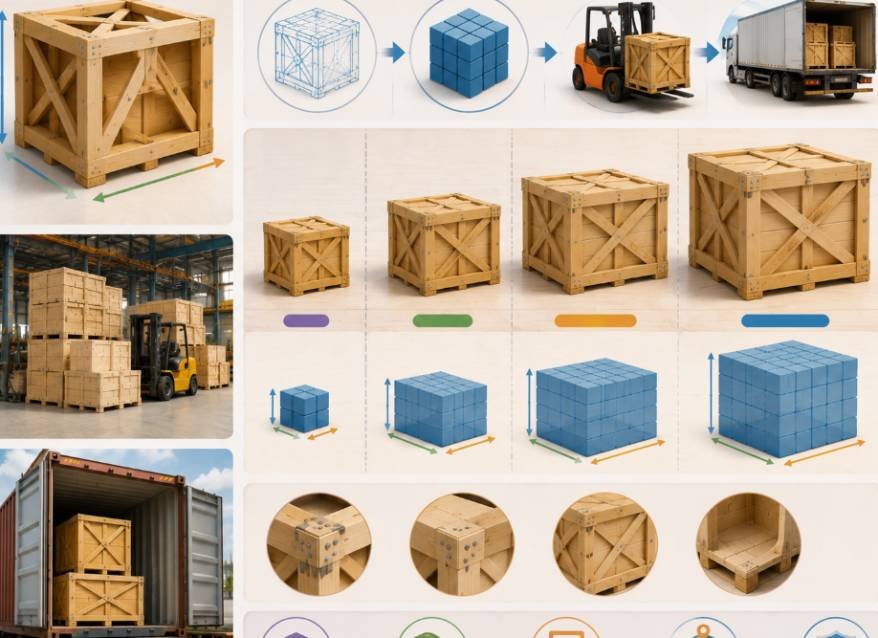
When I first tried to estimate the capacity of a wooden crate, I expected to find one standard answer. However, wooden crates vary considerably by purpose, construction, and cargo type. A small storage crate may provide only 1 cubic foot of space, while an industrial shipping crate can exceed 100 cubic feet.
The most practical answer to How Many Cubic Feet Is a Wooden Crate? is that common commercial models generally measure between 1 and 37 cubic feet. Larger moving, export, and industrial crates may offer 64, 100, 128, or even 200 cubic feet. You can find the exact volume by multiplying the crate’s length, width, and height.
What Is the Average Capacity of a Wooden Crate?
There is no universal average because manufacturers often build wooden crates around the cargo they must protect. A crate for tools or household storage will be much smaller than one designed for machinery, furniture, artwork, or international freight.
Small wooden storage crates generally occupy 1 to 4 cubic feet. Medium commercial crates commonly range from 5 to 15 cubic feet, while large pallet-mounted models may occupy 20 to 40 cubic feet. Warehouses often move these heavier models using powered industrial trucks, while custom industrial crates can be considerably larger.
One industry source describes a 4-foot-wide, 8-foot-long, and 4-foot-high wooden crate. Those measurements produce 128 cubic feet. Although that provides a useful large-crate example, it should not be treated as a universal standard.
Common Wooden Crate Sizes in Cubic Feet
A 12 × 12 × 12-inch crate has an exterior volume of exactly 1 cubic foot. An 18-inch cube occupies approximately 3.38 cubic feet, while a 24 × 20 × 20-inch model occupies about 5.56 cubic feet.
A 24-inch cube provides 8 cubic feet of gross volume. Increasing the dimensions to 32 × 24 × 24 inches produces approximately 10.67 cubic feet. Larger commercial examples include a 48 × 30 × 30-inch crate at 25 cubic feet and a 48 × 40 × 30-inch crate at approximately 33.33 cubic feet.
A 40-inch cube occupies roughly 37.04 cubic feet. Meanwhile, a 48-inch cube provides 64 cubic feet because each side measures 4 feet.
These figures represent the exterior rectangular space occupied by each crate. The actual interior storage capacity will be slightly lower.
How Do You Calculate Wooden Crate Volume?
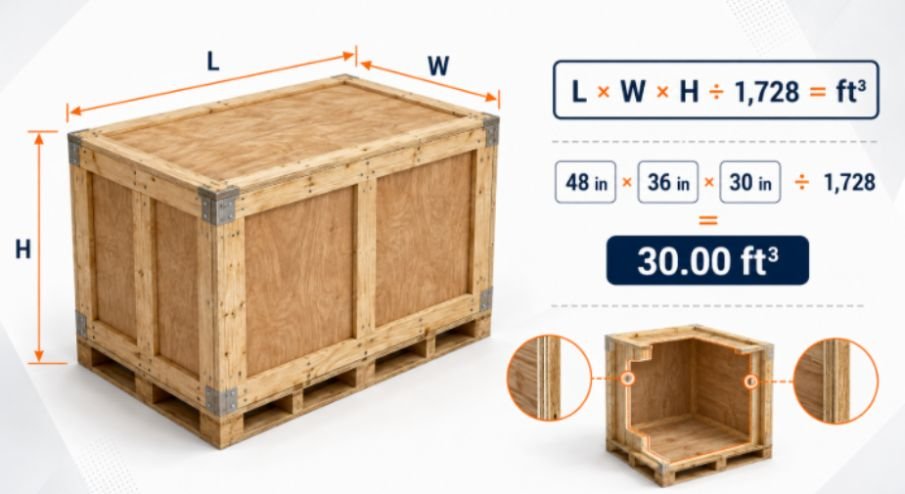
The wooden crate in cubic feet calculation depends on whether the dimensions are recorded in feet or inches.
Formula Using Feet
When every measurement is already in feet, multiply the three dimensions:
Cubic feet = Length × Width × Height
For example, a crate measuring 4 feet long, 3 feet wide, and 2 feet high occupies:
4 × 3 × 2 = 24 cubic feet
Formula Using Inches
Most American crate manufacturers publish dimensions in inches. Multiply the measurements and divide the result by 1,728, which is the number of cubic inches in one cubic foot:
Cubic feet = Length × Width × Height ÷ 1,728
A 48 × 40 × 36-inch shipping crate would therefore occupy:
48 × 40 × 36 ÷ 1,728 = 40 cubic feet
For multiple identical crates, multiply the answer by the number of crates. Five crates of 8 cubic feet each would occupy 40 cubic feet altogether.
Should You Measure the Inside or Outside?
Use interior dimensions when you want to know how much merchandise, equipment, or personal property will fit inside. Use exterior dimensions when calculating warehouse space, truck capacity, or freight charges.
This difference matters because plywood panels, timber framing, lumber cleats, skids, and attached pallets reduce the available interior space. A crate can occupy 24 cubic feet during transportation while offering considerably less usable capacity.
Interior volume is sometimes called net cubic footage. Exterior volume is commonly called gross cubic footage. This same net versus gross distinction applies to rigid storage containers of any size I go through it in my plastic container size guide, which is useful if you’re comparing crates against bins for the same cargo.
If you are ordering a custom crate, request both sets of dimensions before assuming your cargo will fit.
How Do Freight Carriers Measure a Crated Shipment?
Freight carriers usually measure the shipment at its longest exterior points. The calculation may include the crate, attached pallet, skids, handles, protective framing, and anything extending beyond the sides.
When measuring freight, place the tape at the outermost points and record the length, width, and total height in inches. Include the pallet in the height. If the cargo protrudes from the crate or requires a “Do Not Stack” cone, the additional occupied space may also affect the measurement.
Some carriers round each dimension up to the next whole inch. They may also round the final volume upward. For that reason, your billing measurement can be slightly higher than a calculation based on nominal crate dimensions.
Pallets attached to or shipped alongside crates follow the same outer-dimension rule I cover the full freight math in my pallet size guide, including how overhang and stacking height change the billed volume.
Does Cubic Footage Determine Weight Capacity?
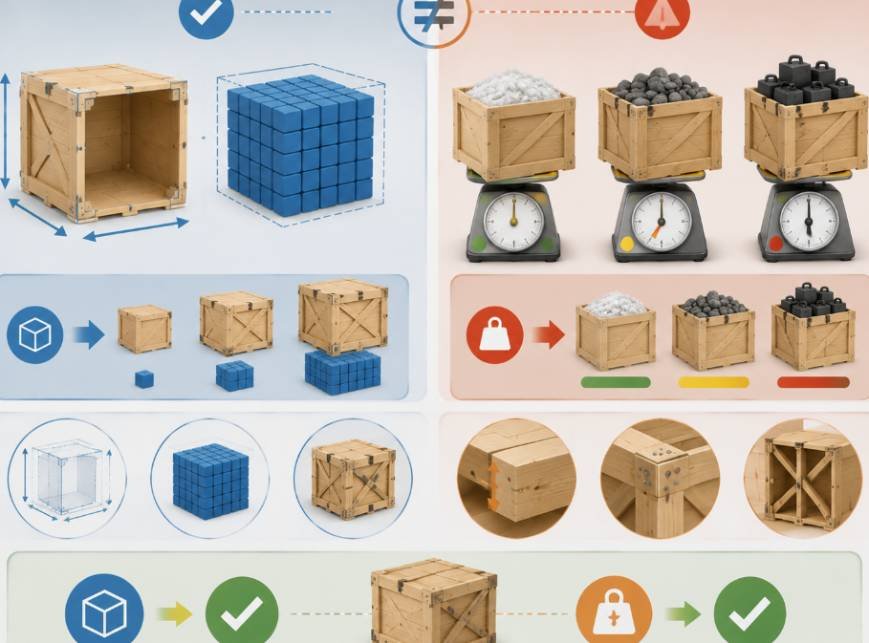
Cubic footage measures space, not strength. Two crates can have identical volume but completely different load capacities because of differences in plywood thickness, lumber framing, fasteners, bases, and internal bracing.
For example, commercially available crates may support loads ranging from a few hundred pounds to several thousand pounds. Certain pallet-mounted models are designed for approximately 3,000 pounds and substantial stacking loads. Always check the manufacturer’s weight rating instead of estimating strength from crate size.
Freight companies may use both volume and weight to calculate shipment density. Density is found by dividing the shipment’s total weight in pounds by its cubic feet. This figure can influence LTL freight classification and shipping cost.
What Else Should You Consider Before Shipping?
A crate intended for international transportation may need heat-treated and properly marked wood packaging that satisfies ISPM 15 requirements. Domestic storage crates do not necessarily carry this certification.
You should also allow room for foam, blocking, bracing, moisture protection, and shock-absorbing material. Measuring only the item and ordering a crate with identical interior dimensions can leave no space for protective packaging.
Frequently Asked Questions
1. How Many Cubic Feet Is a Wooden Crate?
A typical commercial wooden crate may occupy approximately 1 to 37 cubic feet, although custom moving and industrial crates can exceed 100 cubic feet. Multiply its exterior length, width, and height to determine gross volume.
2. How many cubic feet is a 48 × 40 × 36-inch crate?
It occupies 40 cubic feet. Multiply 48 by 40 by 36, then divide 69,120 cubic inches by 1,728.
3. How many cubic feet is a 4 × 4 × 4-foot crate?
A 4-foot cube provides a gross volume of 64 cubic feet because 4 × 4 × 4 equals 64.
4. Do I include the pallet when calculating crate volume?
Include the pallet when calculating the total shipping footprint. Exclude it when you only need the crate’s internal storage capacity.
Final Takeaways
I would never estimate crate capacity from a label such as small, medium, or large. Measuring the actual dimensions produces a far more reliable answer. Interior measurements show whether the cargo will fit, while exterior measurements help determine storage and freight requirements.
For the best result, I recommend checking both figures, leaving space for protective materials, and confirming weight limits separately. That simple approach can prevent undersized packaging, unexpected freight charges, and damage during transportation.

Ryan Mitchell
Ryan Mitchell holds a degree in Civil Engineering and spent over a decade working in construction project estimation, where accurate volume and material calculations were part of his daily work — from concrete pours to landscaping material orders. He founded this site to bring that same precision to everyday calculations, helping DIYers, contractors, and students get fast, accurate cubic footage results without the guesswork. Ryan reviews every calculator and formula on this site for accuracy and writes guides based on real-world measurement scenarios he's encountered on job sites.