

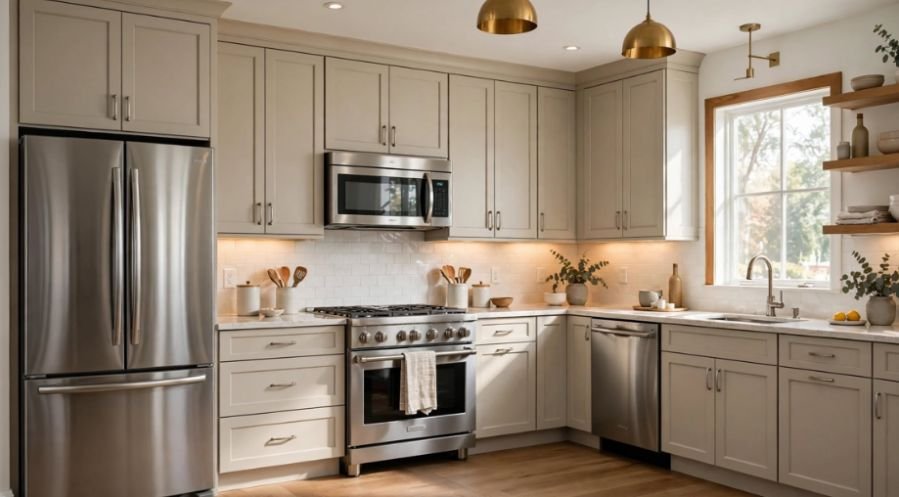
When I first compared appliance bundles, I assumed one cubic-foot figure described the entire set. It does not. If you are asking how many cubic feet is a kitchen appliance package, a standard four-piece package usually provides about 24 to 35-plus cubic feet of combined usable capacity.
That total usually includes the refrigerator, oven, and microwave. Dishwashers are normally rated by place settings instead of cubic feet. The package’s exterior moving volume is a separate and much larger measurement.
Quick Answer: Typical Kitchen Appliance Package Capacity
The answer to how many cubic feet is a kitchen appliance package depends mainly on the refrigerator. It contributes most of the usable interior space.
| Package type | Refrigerator | Oven | Microwave | Combined rated capacity* |
| Compact package | 10–18 cu. ft. | 2.5–5.0 cu. ft. | 0.9–1.6 cu. ft. | 13.4–24.6 cu. ft. |
| Standard package | 18–26 cu. ft. | 5.0–6.3 cu. ft. | 1.5–2.2 cu. ft. | 24.5–34.5 cu. ft. |
| Large package | 27–31+ cu. ft. | 5.3–6.3 cu. ft. | 1.7–2.2 cu. ft. | 34–39.5+ cu. ft. |
*Dishwasher capacity is excluded because manufacturers usually describe it through place settings.
A current four-piece GE bundle sold through Home Depot, for example, combines a 24.7-cubic-foot refrigerator with a 1.7-cubic-foot microwave, a range, and a dishwasher. This confirms why the refrigerator largely determines the package total.
Kitchen Appliance Capacity by Type
Refrigerator Capacity in a Four-Piece Bundle
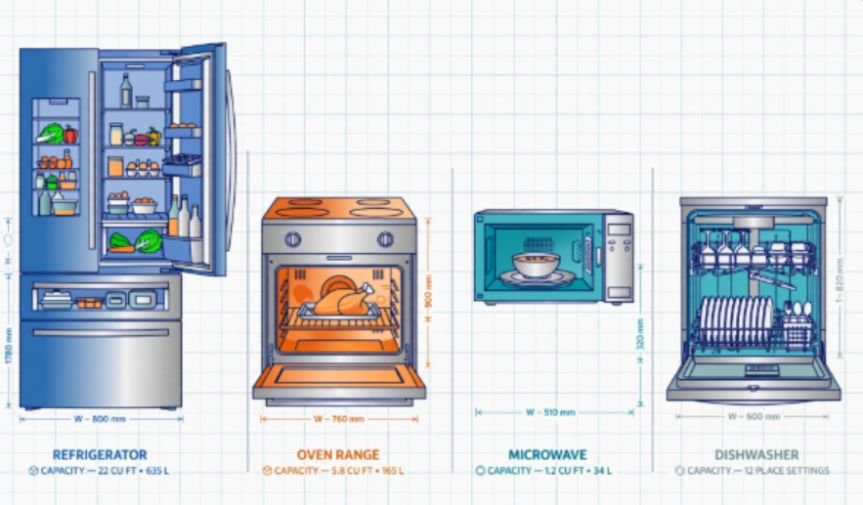
Most standard packages contain an 18-to-26-cubic-foot refrigerator. A 22-to-26-cubic-foot model often suits a household that stores several days of fresh and frozen food.
Counter-depth refrigerators may offer less capacity because their shallower cabinets align more closely with surrounding counters. Full-depth French-door models can exceed 27 cubic feet. Compact packages may use refrigerators closer to 10 or 18 cubic feet.
ENERGY STAR distinguishes compact refrigeration products as those below 7.75 cubic feet. This classification helps explain why even small apartment-package refrigerators are usually larger than true compact models.
Oven and Range Capacity
A standard 30-inch range commonly supplies about 5.0 to 6.3 cubic feet of oven space. One GE 30-inch freestanding electric range, for instance, has a rated capacity of 5.3 cubic feet.
Width alone does not determine usable capacity. Insulation, convection hardware, rack design, heating elements, and drawer placement all affect the cavity. Some professional-style ranges have wide exteriors but surprisingly modest ovens.
When estimating how many cubic feet is a kitchen appliance package, use the listed oven capacity rather than calculating the range’s exterior dimensions.
Over-the-Range Microwave Capacity
Over-the-range microwaves commonly add 1.5 to 2.2 cubic feet. GE currently groups medium models around 1.0 to 1.5 cubic feet and larger models at 1.6 cubic feet or more.
A microwave’s rated capacity describes its cooking cavity. It does not include the cabinet, door, controls, ventilation parts, or required installation clearance.
Dishwasher Place-Setting Capacity
A dishwasher should not be treated as having zero capacity. It simply uses a different rating system.
Standard 24-inch dishwashers may hold up to 16 place settings, according to Bosch’s US buying guidance. Compact 18-inch models hold less but save valuable cabinet width.
For shopping comparisons, record the dishwasher’s place settings, rack count, tub height, and width separately.
How to Calculate Combined Appliance Capacity
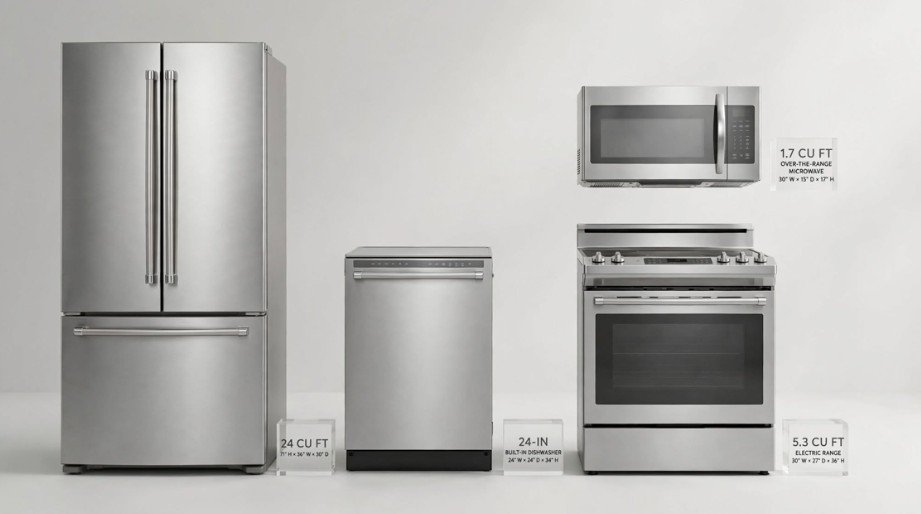
To calculate how many cubic feet is a kitchen appliance package, add every appliance with a published cubic-foot capacity:
Refrigerator + oven + microwave = combined rated capacity
Suppose a package contains:
| Appliance | Rated capacity |
| Refrigerator | 24.7 cu. ft. |
| Oven | 5.3 cu. ft. |
| Microwave | 1.7 cu. ft. |
| Dishwasher | 16 place settings |
The calculation is:
24.7 + 5.3 + 1.7 = 31.7 cubic feet
This package therefore provides 31.7 cubic feet of combined rated cavity space. The dishwasher remains listed separately at 16 place settings.
My preferred comparison method also calculates each appliance’s percentage of the total. In this example, the refrigerator supplies about 78% of the combined rated volume. That original percentage is more useful than the total alone because it reveals where the package’s practical storage capacity sits.
Interior Capacity Versus Moving Volume
The biggest mistake I see is using 31.7 cubic feet to reserve a moving van. That number measures usable cavities, not the space occupied by the appliance bodies.
If you are planning a complete move, compare this figure with the space required for a furniture moving package to get a more realistic estimate of your total moving volume.
For moving purposes, measure each appliance’s packed exterior:
Length × width × height ÷ 1,728 = exterior cubic feet
NIST confirms that one cubic foot contains exactly 1,728 cubic inches.
For example, a packaged refrigerator measuring 38 × 36 × 72 inches occupies:
38 × 36 × 72 ÷ 1,728 = 57 cubic feet
The refrigerator alone can therefore occupy more moving space than the entire package’s rated interior capacity. Apply the same formula to the range, dishwasher, and microwave. Then add every result.
How Much Moving Space Does the Package Need?
A standard unpacked four-piece kitchen set may occupy roughly 125 to 160 cubic feet when treated as separate exterior boxes. Protective cartons, foam, pallets, hoses, and unstackable gaps can increase the practical requirement.
| Appliance | Example exterior dimensions | Approximate volume |
| Refrigerator | 36 × 34 × 70 in. | 49.6 cu. ft. |
| Range | 30 × 28 × 47 in. | 22.8 cu. ft. |
| Dishwasher | 24 × 25 × 35 in. | 12.2 cu. ft. |
| Microwave | 30 × 16 × 17 in. | 4.7 cu. ft. |
| Unpacked total | — | 89.3 cu. ft. |
This geometric total is only a starting point. A safe moving estimate may require 20% to 40% more room for cartons, appliance protrusions, safe loading, and unusable gaps.Those replacing appliances across several rooms may also need the broader calculations for a household appliance set.
Choosing the Right Kitchen Appliance Package Size
When deciding how many cubic feet is a kitchen appliance package for your home, prioritize usable capacity rather than the highest total.
Check the refrigerator’s shelf layout, freezer division, and door-bin depth. Confirm that the oven fits your largest cookware. Measure microwave clearance and ventilation needs. Review dishwasher rack design instead of relying only on place-setting claims.
Also measure doors, hallways, counters, islands, and turning points. A refrigerator may fit its finished opening yet fail to pass through the kitchen doorway.
Frequently Asked Questions
1. How many cubic feet is a four-piece kitchen appliance package?
A typical four-piece package offers about 24 to 35-plus cubic feet of combined refrigerator, oven, and microwave capacity.
2. Does the dishwasher count toward the total cubic feet?
Usually not, because dishwasher capacity is commonly expressed through place settings and rack configuration.
3. Is appliance capacity the same as shipping volume?
No. Capacity measures usable interior space, while shipping volume uses the appliance’s packed exterior dimensions.
4. How many cubic feet is a kitchen appliance package for moving?
Many four-piece sets need roughly 125 to 160 cubic feet after allowing for packaging and safe loading gaps.
The Final Measure: Capacity Sorted, Surprises Avoided
I would use two totals before buying or moving a package. First, add the listed refrigerator, oven, and microwave capacities. Second, calculate each appliance’s exterior volume.
That approach answers how many cubic feet is a kitchen appliance package without confusing food-storage capacity with truck space. Measure every doorway next, then confirm the manufacturer’s installation clearances before ordering.

Ryan Mitchell
Ryan Mitchell holds a degree in Civil Engineering and spent over a decade working in construction project estimation, where accurate volume and material calculations were part of his daily work — from concrete pours to landscaping material orders. He founded this site to bring that same precision to everyday calculations, helping DIYers, contractors, and students get fast, accurate cubic footage results without the guesswork. Ryan reviews every calculator and formula on this site for accuracy and writes guides based on real-world measurement scenarios he's encountered on job sites.


