

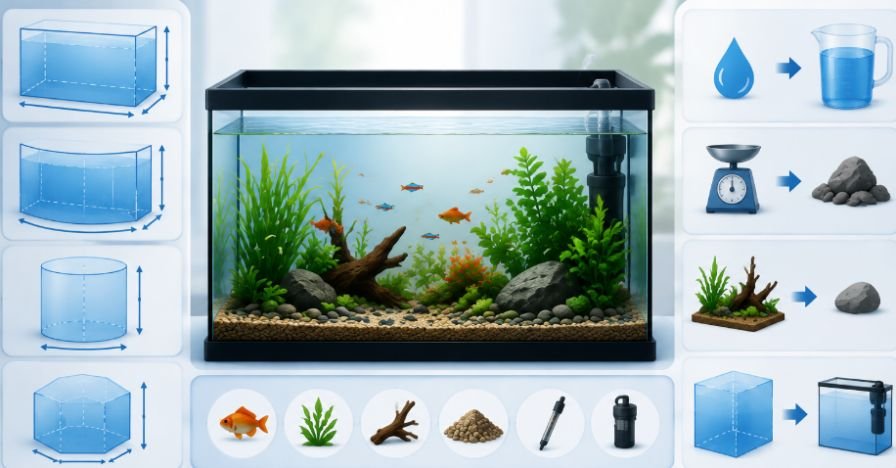
When I look at an aquarium, I naturally think about gallons. However, gallons only describe liquid capacity. Cubic feet can reveal how much three-dimensional space the aquarium occupies, how much water it may hold, and whether it will fit comfortably in a room, moving vehicle, or storage area.
The quick answer to How Many Cubic Feet Is a Fish Tank? is that every 7.48 US gallons equals approximately one cubic foot. A 10-gallon aquarium therefore holds about 1.34 cubic feet, while a 55-gallon model represents roughly 7.35 cubic feet. These figures describe theoretical water capacity; the tank’s exterior occupied volume and usable water volume can differ.
Quick Fish Tank Cubic Feet Estimates
Common aquarium capacities convert to cubic feet as follows. A 5-gallon tank equals approximately 0.67 cubic feet. A 10-gallon tank equals 1.34 cubic feet, while a 20-gallon aquarium equals 2.67 cubic feet.
A 29-gallon tank represents approximately 3.88 cubic feet. A 40-gallon model equals 5.35 cubic feet, and a 55-gallon aquarium equals 7.35 cubic feet. Larger 75-, 100-, and 125-gallon tanks equal approximately 10.03, 13.37, and 16.71 cubic feet respectively.
These are capacity conversions. They should not automatically be treated as the exterior space occupied by the aquarium.
How to Convert Fish Tank Gallons to Cubic Feet
One cubic foot contains approximately 7.4805 US gallons. To convert an aquarium’s advertised capacity, divide the number of gallons by 7.4805.
The formula is:
Cubic feet = US gallons ÷ 7.4805
For example, a 55-gallon aquarium produces this calculation:
55 ÷ 7.4805 = 7.35 cubic feet
To reverse the calculation, multiply cubic feet by 7.4805. An aquarium with a three-cubic-foot internal volume would theoretically contain approximately 22.44 US gallons. The same volume-conversion principle is commonly applied when measuring water, oil and petroleum products, although liquid density and industry standards may differ.
Imperial gallons are different from US gallons, so confirm which measurement a manufacturer uses. When working in liters, one cubic foot equals approximately 28.32 liters.
How to Calculate Cubic Feet From Tank Dimensions
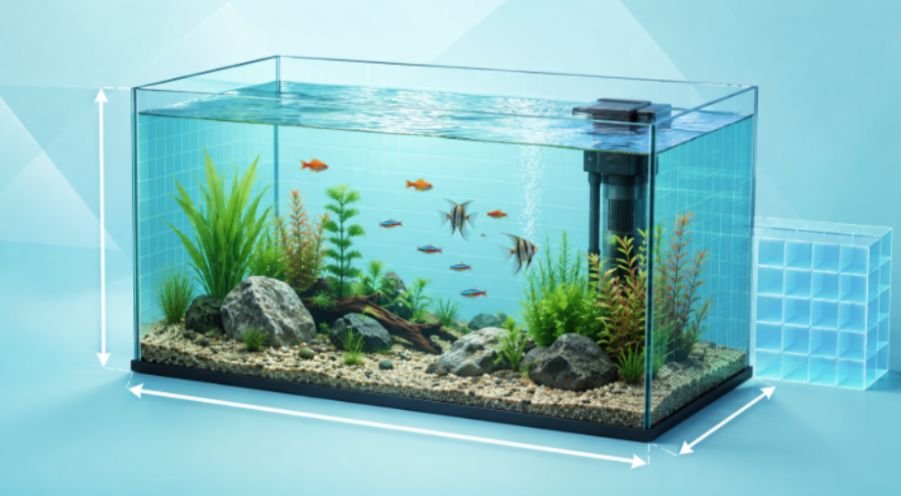
The gallon rating is not always available, particularly with second-hand, homemade, custom, or unlabelled aquariums. In that situation, calculate volume from the tank’s measurements.
Rectangular Fish Tanks
For a rectangular aquarium measured in inches, multiply the length by the width and height. Divide the result by 1,728, the number of cubic inches in one cubic foot.
The formula is:
Cubic feet = length × width × height ÷ 1,728
Consider a tank measuring 48 inches long, 13 inches wide, and 21 inches high. Multiplying these measurements gives 13,104 cubic inches. Dividing by 1,728 produces approximately 7.58 cubic feet.
That figure is the geometric exterior volume when exterior measurements are used. It is not necessarily the tank’s actual water capacity.
Cube and Cylindrical Aquariums
For a cube, multiply the length of one side by itself three times. A 24-inch cube occupies 13,824 cubic inches, or eight cubic feet.
A cylindrical tank requires a different formula:
Volume = π × radius² × height
Use the interior radius and actual water height when calculating usable water. Bow-front, hexagonal, corner, spherical, and L-shaped aquariums require formulas matching their geometry. Dividing an unusual tank into several simple shapes can make the calculation easier, especially when you plan to set up a freshwater aquarium and need an accurate estimate for equipment, treatments, and water changes.
Advertised Capacity Versus Actual Water Volume
A tank labelled “55 gallons” may not contain exactly 55 gallons when installed. Manufacturers may use nominal capacity, rounded figures, or exterior dimensions. Glass or acrylic thickness reduces the interior space, while the frame and trim add to the external measurements.
Consequently, net water volume may be around 10% to 15% below rated capacity in many setups.
Heavily decorated aquariums may lose even more. Measure the internal length and width together with the actual water depth when accurate treatment or additive dosing is important.
Water Capacity Versus Occupied Space
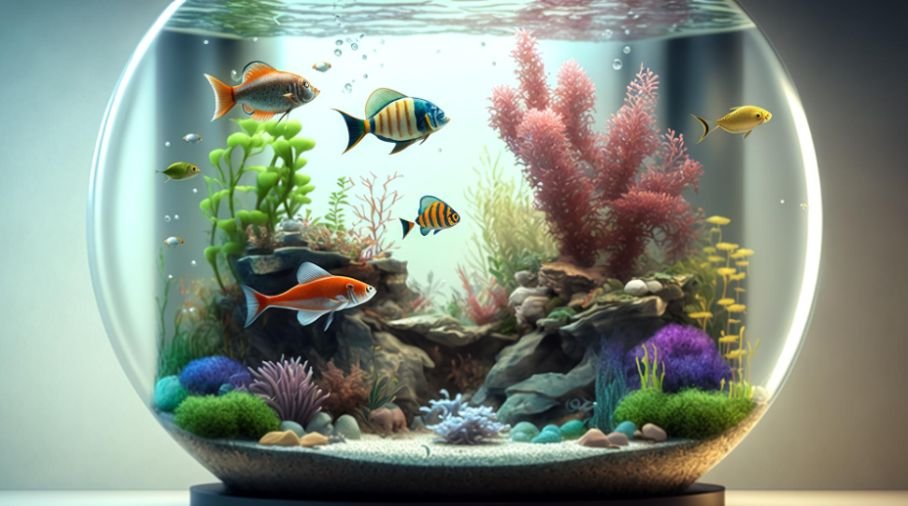
The answer to How Many Cubic Feet Is a Fish Tank? changes according to what is being measured. Water capacity describes the liquid contained inside the aquarium. Exterior cubic footage describes the physical space enclosed by its outer length, width, and height.
Neither measurement includes the complete installation. A hood, light, external filter, pipes, cables, air pump, sump, cabinet, and maintenance clearance can substantially increase the space required.
Floor footprint is another separate measurement. Multiply only the exterior length by the width to calculate square feet. Do not multiply by height unless cubic volume is needed.
Why Cubic Footage Matters
Cubic footage is useful when planning where an aquarium will stand. It helps determine whether the tank can pass through doors, fit against a wall, travel in a vehicle, or occupy a designated storage area.
It also affects equipment selection. Heaters, filters, pumps, treatments, conditioners, and salt mixes are normally chosen or dosed according to water capacity. Using nominal capacity instead of net water volume may produce an inaccurate result.
Cubic footage can also help estimate water weight. One cubic foot of freshwater weighs approximately 62.4 pounds. Saltwater is slightly heavier because of the dissolved salt. The completed setup will weigh more after adding the empty tank, stand, substrate, rocks, decorations, hood, and equipment.
The same volume-to-weight jump applies to other large appliances sitting on a floor my chest freezer size guide covers how cubic footage relates to loaded weight and floor support needs.
A large aquarium therefore needs a level, purpose-built support that accommodates its entire footprint. Cubic volume alone does not confirm whether a stand or floor is structurally suitable.
Does Tank Shape Affect Fish Capacity?
Two aquariums can contain the same water volume but offer different living environments. A tall, narrow aquarium may hold as much water as a long, shallow model, yet provide less horizontal swimming room and a smaller water surface.
Surface area affects gas exchange, while tank length can matter for active species. Filtration, adult fish size, behaviour, waste production, temperature, planting, and maintenance practices also influence responsible stocking.
For that reason, cubic footage should not be used as a stand-alone rule for deciding how many fish to keep. Simple fish-per-gallon formulas are rough starting points rather than universal stocking standards.
Frequently Asked Questions
1. How many cubic feet is a 10-gallon fish tank?
A 10-gallon aquarium has a theoretical water capacity of approximately 1.34 cubic feet. Its exterior occupied volume can be slightly different because of its frame, glass thickness, trim, and precise dimensions.
2. How Many Cubic Feet Is a Fish Tank?
Divide its US gallon capacity by 7.4805. Alternatively, multiply its length, width, and height in inches and divide the result by 1,728. Interior measurements provide a better estimate of water capacity, while exterior measurements show occupied volume.
3. How many gallons fit in one cubic foot?
One cubic foot holds approximately 7.48 US gallons, 6.23 Imperial gallons, or 28.32 liters.
4. Does gravel reduce aquarium water capacity?
Yes. Gravel, rocks, wood, ornaments, plants, internal equipment, and the unfilled area below the rim reduce net water volume. The tank may therefore contain less water than its advertised capacity suggests.
Final Thoughts
When I calculate aquarium size, I separate rated capacity, net water volume, exterior cubic footage, and floor footprint. Each number answers a different question. Gallon capacity helps with general product comparisons, while interior volume is more relevant for water treatments and equipment.
Exterior dimensions are more useful for placement, transportation, and storage. I also account for the stand, filter, lighting, service clearance, substrate, decorations, and total loaded weight before deciding whether a space is suitable. That broader calculation gives me a far more realistic answer than relying on the label alone.

Ryan Mitchell
Ryan Mitchell holds a degree in Civil Engineering and spent over a decade working in construction project estimation, where accurate volume and material calculations were part of his daily work — from concrete pours to landscaping material orders. He founded this site to bring that same precision to everyday calculations, helping DIYers, contractors, and students get fast, accurate cubic footage results without the guesswork. Ryan reviews every calculator and formula on this site for accuracy and writes guides based on real-world measurement scenarios he's encountered on job sites.


