

The moment I open the rear hatch of a car, I can usually tell whether it was designed for real life or just to look practical on paper. A few extra inches of height, a wider cargo opening, or seats that fold completely flat can change how much I can actually carry. This is why hatchbacks continue to attract drivers who want everyday convenience without moving up to a larger SUV.
How Many Cubic Feet Is a Hatchback Cargo Space depends on more than the vehicle’s size. From compact city hatchbacks to larger fastback-style models, cargo capacity can range from about 9 cubic feet to nearly 60 cubic feet when the rear seats are folded. The difference comes down to design, vehicle class, and how manufacturers measure usable storage.
For drivers in the US, knowing the real hatchback cargo capacity helps when choosing a vehicle for commuting, weekend trips, family errands, and carrying bulky items. Instead of focusing only on the number listed in a specification sheet, understanding how that space works in everyday situations gives a clearer picture of what a hatchback can truly handle.
What Is the Average Hatchback Cargo Space in Cubic Feet?
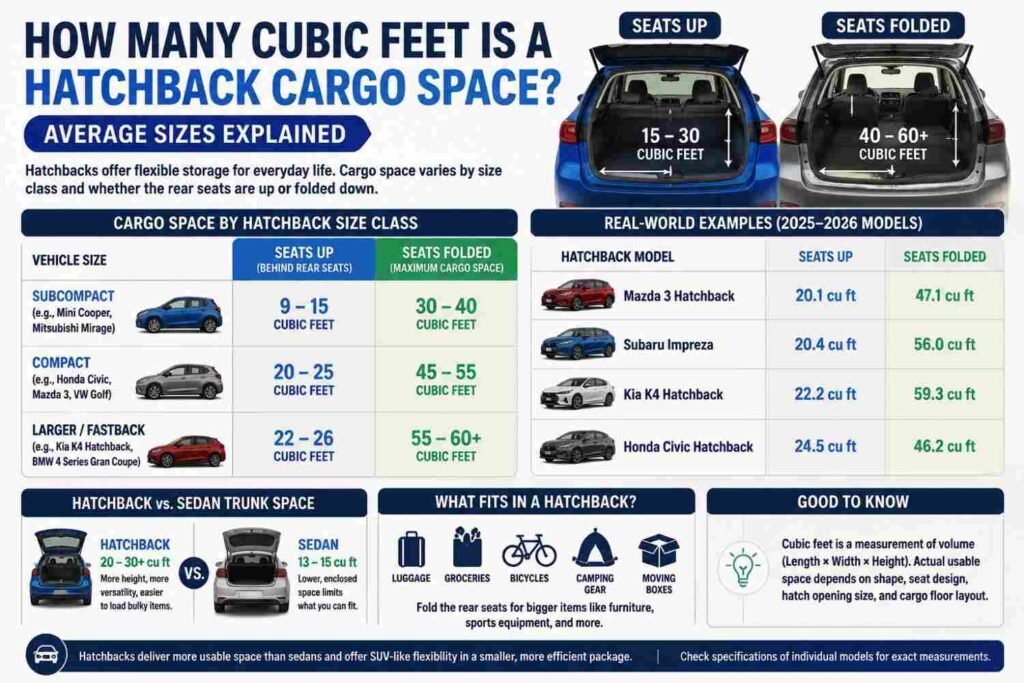
The average hatchback cargo area varies significantly because the category includes everything from small city cars to larger performance-oriented models.
A typical breakdown looks like this:
| Hatchback Type | Cargo Space Behind Seats | Maximum Cargo Space |
| Subcompact hatchback | 9–15 cubic feet | 30–40 cubic feet |
| Compact hatchback | 20–25 cubic feet | 45–55 cubic feet |
| Larger hatchback/fastback models | 22–30 cubic feet | 55–60+ cubic feet |
Subcompact models focus on efficiency and easy parking, so they usually have smaller cargo areas. Compact hatchbacks offer the best balance between passenger comfort and storage capacity, making them popular among US drivers.
When comparing storage needs, understanding measurements such as the size of a plastic container can also help visualize how much usable space different cargo areas provide.
Larger hatchbacks and fastback-style vehicles provide additional room by extending the cargo area and maximizing the available cabin height. This added flexibility allows them to accommodate larger items while maintaining a practical design for everyday driving.
How Much Cargo Space Does a Hatchback Have With Seats Up?
The seats-up measurement represents the storage space available during normal driving when passengers are using the rear seats. This is the number I consider most important for everyday use.
A small hatchback with around 10 to 15 cubic feet can usually handle:
- Grocery bags
- Backpacks
- Small luggage
- Daily shopping items
A compact hatchback with 20 to 25 cubic feet provides much more flexibility. It can accommodate multiple suitcases, camping equipment, and larger shopping loads without requiring frequent seat adjustments.
For example, the Honda Civic Hatchback provides approximately 24.5 cubic feet behind the second row, while the Subaru Impreza offers around 20.4 cubic feet of cargo volume behind the rear seats.
How Much Space Does a Hatchback Have With Seats Folded?
One of the biggest advantages of hatchbacks is their expandable cargo capacity. Folding the rear seats transforms the vehicle into a much larger storage area.
Many hatchbacks reach:
- 40–50 cubic feet of cargo space
- More than 55 cubic feet in larger models
This extra room allows me to carry items that would normally require an SUV, including:
- Large boxes
- Camping equipment
- Bicycles
- Furniture pieces
- Oversized luggage
The Kia K4 Hatchback, for example, offers around 59.3 cubic feet of maximum cargo space, placing it among the roomiest hatchback options available.
How Do Popular Hatchback Models Compare for Cargo Space?

Looking at real-world vehicles makes it easier to understand how much storage hatchbacks actually provide.
| Hatchback Model | Seats Up Cargo Space | Seats Folded Cargo Space |
| Honda Civic Hatchback | 24.5 cu ft | Around 46 cu ft |
| Mazda3 Hatchback | Around 20 cu ft | Around 47 cu ft |
| Subaru Impreza | 20.4 cu ft | Around 56 cu ft |
| Kia K4 Hatchback | 22.2 cu ft | Around 59.3 cu ft |
The Honda Civic Hatchback is one of the strongest compact options because it combines a large cargo opening with impressive passenger space. The Mazda3 Hatchback offers a premium interior experience, while the Subaru Impreza provides excellent maximum storage capacity.
Hatchback vs Sedan Trunk Space: Which Holds More?
When I compare hatchbacks and sedans, the biggest difference is not always the total number of cubic feet. The shape of the cargo area matters just as much.
A sedan has a separate trunk compartment, which limits vertical storage. A hatchback extends the cargo area upward to the roof, allowing taller and bulkier items to fit.
For example, the Honda Civic sedan provides about 14.8 cubic feet of trunk space, while the Civic Hatchback offers approximately 24.5 cubic feet behind the rear seats.
This difference makes hatchbacks better suited for:
- Road trips
- Outdoor gear
- Moving boxes
- Pet supplies
- Large shopping trips
However, usable cargo space depends on more than the official measurement. A vehicle with a sloped roof, narrow hatch opening, or wheel-well intrusion may feel smaller than the advertised volume.
How Is Hatchback Cargo Volume Measured?
Manufacturers calculate cargo volume by measuring the three-dimensional space available inside the vehicle.
The basic formula is:
Length × Width × Height = Cubic Feet
However, vehicle cargo measurements are not always equal to real-world usability. Factors such as seat position, floor design, roof shape, and cargo opening size influence how easy it is to load items. Just like comparing storage locker size, the available dimensions and layout often matter as much as the total volume.
A hatchback with fewer cubic feet may sometimes feel more practical because it has a wider opening and a flatter cargo floor, making it easier to organize and access items in everyday situations.
What Should I Consider Before Choosing a Hatchback?

When I evaluate hatchback storage capacity, I look beyond the advertised number. The most important factors include:
Cargo Opening Size
A wide hatch opening makes loading large objects easier. Even a spacious cargo area becomes less useful if the opening is too small.
Rear Seat Folding Design
Seats that fold flat create a smoother loading surface and maximize available storage.
Cargo Floor Height
A low cargo floor makes it easier to load heavy items and improves everyday usability.
Vehicle Length and Shape
Longer hatchbacks usually provide more room, but compact models may be easier to park and maneuver in crowded US cities.
Frequently Asked Questions (FAQs)
1. How many cubic feet is an average hatchback cargo space?
Most hatchbacks offer between 15 and 30 cubic feet behind the rear seats. When the seats are folded, many models provide 40 to 60 cubic feet or more.
2. Is 20 cubic feet enough cargo space for a hatchback?
Yes. Around 20 cubic feet is enough for most daily activities, including grocery shopping, commuting, carrying luggage, and weekend trips.
3. Which hatchback has the most cargo space?
Some of the largest hatchbacks include models like the Kia K4 Hatchback, which can provide nearly 60 cubic feet of maximum cargo capacity with the seats folded.
4. Are hatchbacks better than sedans for cargo?
For most people, yes. Hatchbacks usually provide more flexible storage because they offer additional height and easier access through the rear door.
Conclusion
I have found that cargo space is one of the most overlooked factors when choosing a vehicle. A hatchback may look compact from the outside, but its flexible design can provide impressive storage for everyday needs.
How Many Cubic Feet Is a Hatchback Cargo Space depends on the vehicle category, but most models offer enough room for daily errands, travel, and occasional hauling. Compact hatchbacks usually provide the best balance, while larger models can compete with small SUVs in maximum cargo capacity.
By understanding cargo volume, seat configurations, and real-world usability, I can choose a hatchback that fits my lifestyle instead of relying only on a number listed on a specification sheet. When comparing different vehicles, a cargo volume calculator can help estimate storage capacity and make it easier to understand the actual space available.

Ryan Mitchell
Ryan Mitchell holds a degree in Civil Engineering and spent over a decade working in construction project estimation, where accurate volume and material calculations were part of his daily work — from concrete pours to landscaping material orders. He founded this site to bring that same precision to everyday calculations, helping DIYers, contractors, and students get fast, accurate cubic footage results without the guesswork. Ryan reviews every calculator and formula on this site for accuracy and writes guides based on real-world measurement scenarios he's encountered on job sites.