

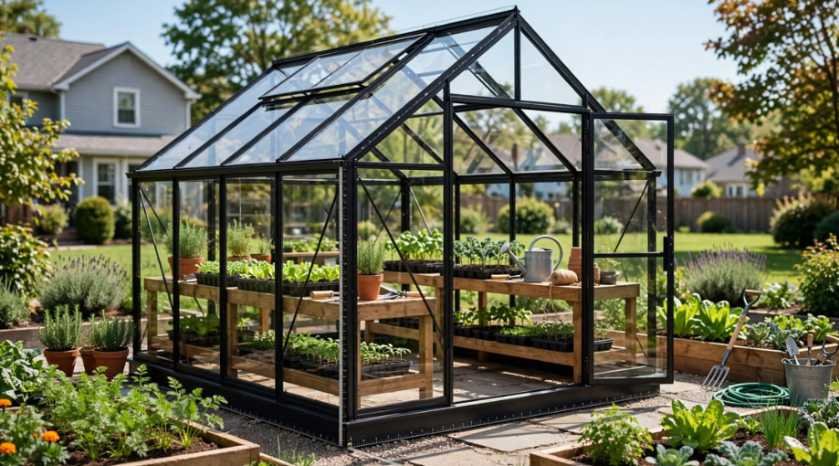
The answer can range from under 400 cubic feet to hundreds of thousands. When someone asks me how many cubic feet is a greenhouse, I never rely on floor dimensions alone. The roof shape and interior height can change the result significantly.
A simple 8-by-10-foot greenhouse may hold about 560 to 720 cubic feet. A 12-by-24-foot hobby model can exceed 2,000 cubic feet. Large commercial houses may contain 30,000 cubic feet or more.
The Quick Answer
Greenhouse volume is the amount of three-dimensional space enclosed by the floor, walls, and roof. For a rough estimate, use:
Greenhouse volume = length × width × average height
All three measurements must be in feet. The answer will be in cubic feet.
For example, a structure measuring 10 feet long and 8 feet wide, with an average height of 7 feet, contains:
10 × 8 × 7 = 560 cubic feet
This shortcut works well for early planning. However, a roof-specific formula gives a more reliable answer for heating and ventilation.
Greenhouse Cubic Feet by Common Size
The following figures assume the stated average interior height. Actual volume will vary with the wall height, roof pitch, framing, and greenhouse design.
| Greenhouse dimensions | Average height | Approximate volume |
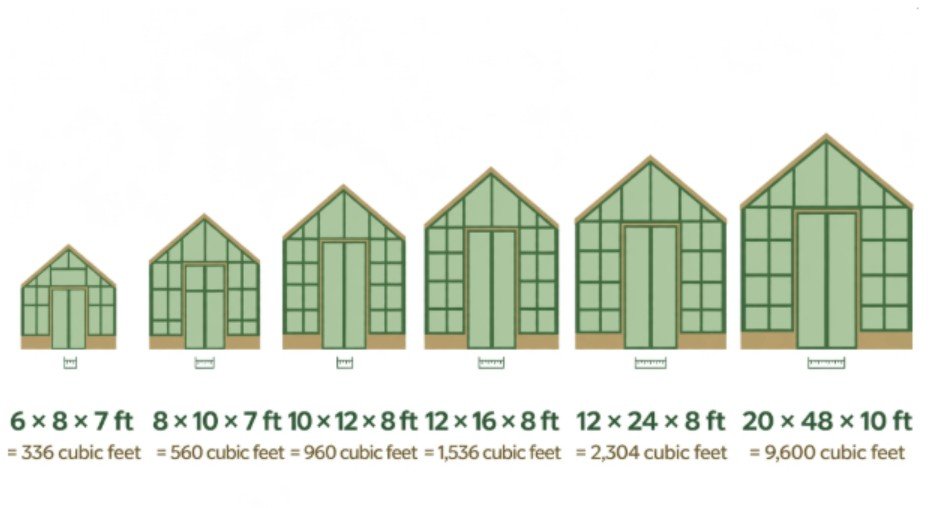
| 6 × 8 feet | 7 feet | 336 cubic feet |
| 8 × 10 feet | 7 feet | 560 cubic feet |
| 10 × 12 feet | 8 feet | 960 cubic feet |
| 12 × 16 feet | 8 feet | 1,536 cubic feet |
| 12 × 24 feet | 8 feet | 2,304 cubic feet |
| 20 × 48 feet | 10 feet | 9,600 cubic feet |
| 30 × 100 feet | Varies by roof | About 30,000 cubic feet |
These are planning estimates, not universal capacities. Two greenhouses with identical floor areas can have different volumes because their roofs rise to different heights.
How to Calculate Greenhouse Volume
The right formula depends on the cross-sectional shape. I measure the interior dimensions because exterior measurements can include frames, panels, and foundations that do not represent usable airspace.
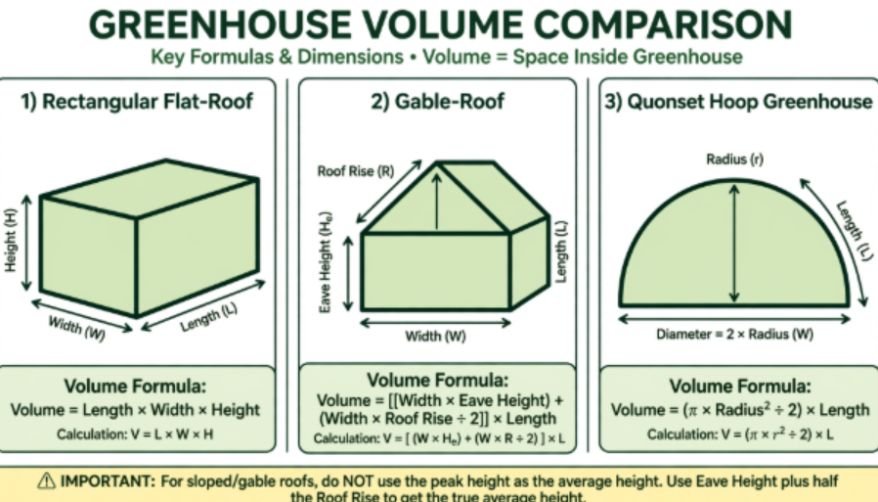
Rectangular or Flat-Roof Greenhouse
Use the standard rectangular-volume formula:
Volume = length × width × height
A 10-by-12-foot greenhouse with an 8-foot flat roof contains:
10 × 12 × 8 = 960 cubic feet
This method also works for a lean-to structure when the roof height remains consistent. For a sloped lean-to, calculate its average height first.
Gable-Roof Greenhouse
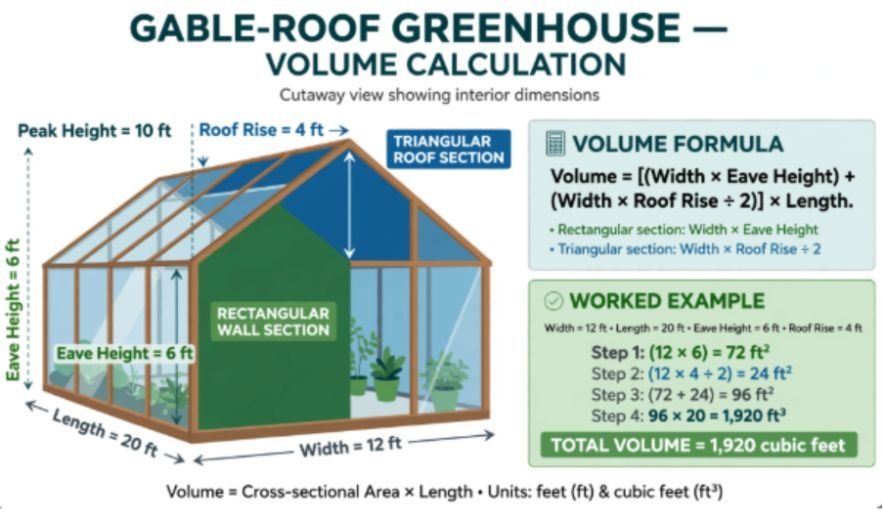
A gable greenhouse consists of a rectangular lower section and a triangular roof section. The University of Georgia provides a dedicated formula for even-span greenhouses:
Volume = [(width × eave height) + (width × roof-rise height ÷ 2)] × length
This method measures the wall section and roof section separately. It is more accurate than treating the entire building as a full-height rectangle. The University of Georgia’s horticultural formula guide also provides formulas for uneven-span and Quonset structures.
If you only need a quick estimate, calculate average height as:
Average height = eave height + (roof rise ÷ 2)
Then multiply that figure by the length and width.
Quonset or Hoop Greenhouse
An arched greenhouse requires a curved-roof calculation.Hoop-style structures also overlap with agricultural high tunnels. The USDA Natural Resources Conservation Service publishes high tunnel system standards covering their construction and structural characteristics.
UGA recommends this formula when the structure has straight sidewalls beneath a semicircular roof:
Volume = [(width × eave height) + (3.14 × roof-rise² ÷ 2)] × length
If the structure forms a true half-cylinder from ground level, use:
Volume = π × radius² × length ÷ 2
Do not use the full peak height as the average height. That approach treats empty space outside the curved roof as part of the greenhouse.
A Worked Greenhouse Volume Example
Suppose I measure a gable greenhouse that is 12 feet wide and 20 feet long. Its sidewalls reach 6 feet, while its peak reaches 10 feet.
The roof rises 4 feet above the sidewalls. I first calculate the rectangular section:
12 × 6 = 72 square feet
Next, I calculate the triangular roof section:
12 × 4 ÷ 2 = 24 square feet
The total cross-sectional area is 96 square feet. I then multiply it by the 20-foot length:
96 × 20 = 1,920 cubic feet
The average-height shortcut gives the same result:
6 + (4 ÷ 2) = 8 feet
12 × 20 × 8 = 1,920 cubic feet
Using the average of the sidewall and peak heights would produce 1,920 cubic feet here only because the correct calculation is 6 + half the roof rise. A common mistake is using 8 feet without understanding why it works.
More importantly, multiplying by the full 10-foot peak would produce 2,400 cubic feet. That is a 25% overestimate and could lead to oversized equipment.
Why Greenhouse Cubic Footage Matters
Knowing how many cubic feet is a greenhouse answers more than a geometry question. The result affects air exchange, heat loss, equipment capacity, and operating costs.
Ventilation and Fan Capacity
Fans are rated in cubic feet per minute, or CFM. Oklahoma State University advises sizing hobby-greenhouse exhaust capacity to change the air about once per minute. Under that guideline, a 1,920-cubic-foot greenhouse needs roughly 1,920 CFM at the specified static pressure.
This is a starting point, not a universal purchase specification. Screens, louvers, cooling pads, local heat, and fan resistance affect performance.
Purdue Extension’s greenhouse ventilation guidance uses a summer-design approach based on floor area, recommending approximately 8–10 CFM per square foot when attempting to keep greenhouse air close to the outside temperature.
Check the fan’s rated airflow under operating resistance. Do not choose equipment from diameter alone.
Heating and Energy Use
Volume affects infiltration heat loss because every air exchange replaces warm interior air with colder outside air. UGA includes greenhouse volume directly in its infiltration heat-loss equation. Its published 30-by-100-foot example contains 30,928 cubic feet after accounting for its walls and roof.
Volume alone cannot size a heater. Glazing type, surface area, insulation, air leakage, wind, target temperature, and local winter design temperature also matter.
A tall greenhouse may have the same floor area as a short model but require more energy to manage. Warm air also collects near the roof, so circulation affects temperature uniformity.
Growing Space and Storage
Cubic footage describes enclosed airspace, not plant capacity. Bench layout, aisle width, hanging baskets, and crop height determine how much growing area you can use.
I plan the soil by calculating proper planter box size helps estimate growing-medium needs.
Common Measurement Mistakes
The most frequent error is multiplying floor area by peak height. That creates an imaginary rectangular roof and inflates the result.
Another mistake is confusing square feet with cubic feet. Square footage measures the floor. Cubic footage measures the entire enclosed space.
Measure in one unit before calculating. Convert inches to feet by dividing by 12. For example, 18 inches equals 1.5 feet.
Do not reduce the volume for benches, trays, tools, or plants during ordinary fan planning. Those objects occupy some space, but their irregular shapes make a net-volume calculation impractical. Use the gross interior volume unless your equipment designer says otherwise.
Finally, avoid applying a generic seven-foot average height to every structure. Oklahoma State uses floor area multiplied by seven as an approximate hobby-greenhouse method, but an actual roof-shape calculation is better when dimensions are available.
I also plan waste-handling areas separately. Measuring a compost tumbler size helps reserve enough working clearance. Neither measurement should be subtracted from greenhouse air volume when sizing ventilation unless an engineer specifically requires net volume.
Frequently Asked Questions
1. How many cubic feet is an 8-by-10 greenhouse?
At a seven-foot average height, an 8-by-10 greenhouse contains approximately 560 cubic feet.
2. How do I calculate greenhouse cubic feet with a peaked roof?
Add the rectangular wall volume to the triangular roof volume, or multiply floor area by the eave height plus half the roof rise.
3. Is greenhouse size measured in square feet or cubic feet?
Floor and growing areas use square feet, while heating and air-volume calculations often require cubic feet.
4. How much ventilation does a greenhouse need?
Some hobby-greenhouse guidance targets one air change per minute, but climate, resistance, cooling equipment, and greenhouse design can alter the required CFM.
Measure Once, Grow Without the Guesswork
I treat greenhouse volume as the bridge between the structure and the equipment supporting it. A careful roof-shape calculation takes only a few minutes, yet it can prevent a costly fan or heater mismatch.
Measure the interior length, width, eave height, and peak height. Choose the formula that matches the roof, calculate the gross volume, and keep that number with the greenhouse records. The next time equipment needs replacing, you will have a dependable figure instead of an estimate pulled from thin air.

Ryan Mitchell
Ryan Mitchell holds a degree in Civil Engineering and spent over a decade working in construction project estimation, where accurate volume and material calculations were part of his daily work — from concrete pours to landscaping material orders. He founded this site to bring that same precision to everyday calculations, helping DIYers, contractors, and students get fast, accurate cubic footage results without the guesswork. Ryan reviews every calculator and formula on this site for accuracy and writes guides based on real-world measurement scenarios he's encountered on job sites.


