

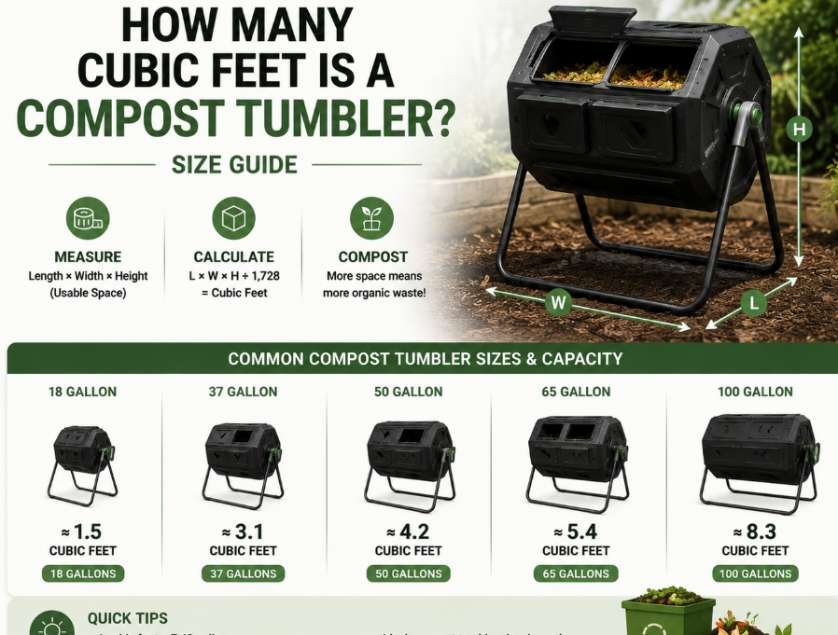
The label says 43 gallons, but what does that mean for your food scraps and yard waste? If you are asking how many cubic feet is a compost tumbler, most residential models hold 4 to 15 cubic feet. Compact designs may hold about 2 cubic feet, while specialized gear-driven units can exceed that common range.
I never judge a tumbler by its exterior dimensions alone. The frame, airspace, divider, and curved drum can make its useful capacity smaller than expected.
How Many Cubic Feet Is a Compost Tumbler on Average?
A standard residential model usually provides 4.5 to 7 cubic feet. That range suits many households processing kitchen scraps with moderate amounts of dry leaves or shredded cardboard.
Small balcony models often hold 2 to 3.5 cubic feet. Large backyard drums usually offer 8 to 12 cubic feet. Eartheasy places the general capacity range for compost tumblers at 4 to 15 cubic feet.
Capacity can vary beyond that range. For example, Mantis lists a gear-driven dual-drum model at 24.8 cubic feet. Such equipment is much larger and heavier than an ordinary backyard tumbler.
The right capacity also depends on where the finished compost will go. A gardener filling a large planter box may need more compost than someone feeding two patio plants.
Compost Tumbler Size Chart
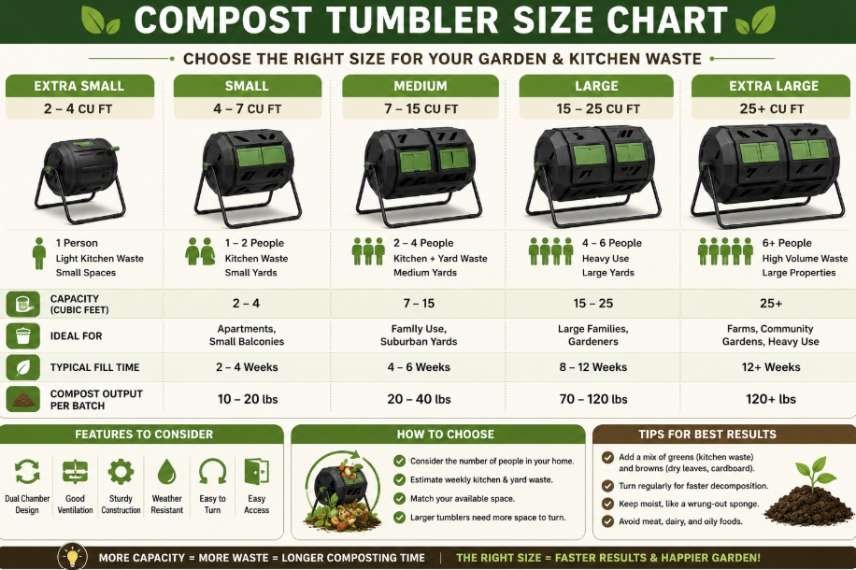
Use this table as a quick reference. The gallon figures are approximate because manufacturers may round their labels.
| Size category | Approximate gallons | Cubic feet | Best suited to |
| Compact | 15–25 | 2–3.3 | One person or limited space |
| Standard | 35–50 | 4.7–6.7 | Average household |
| Large | 60–80 | 8–10.7 | Large family or mixed yard waste |
| Extra-large | 90–112 | 12–15 | High-volume garden use |
A 4.5-cubic-foot Jora model, for example, holds 33 gallons and has a stated operating capacity of 2 to 4 gallons of material per week. This distinction between total volume and weekly input is useful when comparing models.
How to Convert Compost Tumbler Gallons to Cubic Feet
US retailers often list tumbler capacity in gallons. One cubic foot equals approximately 7.48052 US gallons.
Use this formula:
Cubic feet = gallons ÷ 7.48052
To convert cubic feet back into gallons, multiply by 7.48052. This calculation answers how many cubic feet is a compost tumbler when its label only provides gallons.
Worked 43-Gallon Compost Tumbler Example
For a 43-gallon tumbler:
43 ÷ 7.48052 = 5.75 cubic feet
The advertised drum therefore holds about 5.75 cubic feet. A manufacturer listing for a 43-gallon dual-batch model rounds that figure to 5.7 cubic feet.
That number represents total capacity. It does not necessarily mean you should pack 5.75 cubic feet of dense material into the drum.
Single-Chamber vs. Dual-Chamber Tumbler Capacity
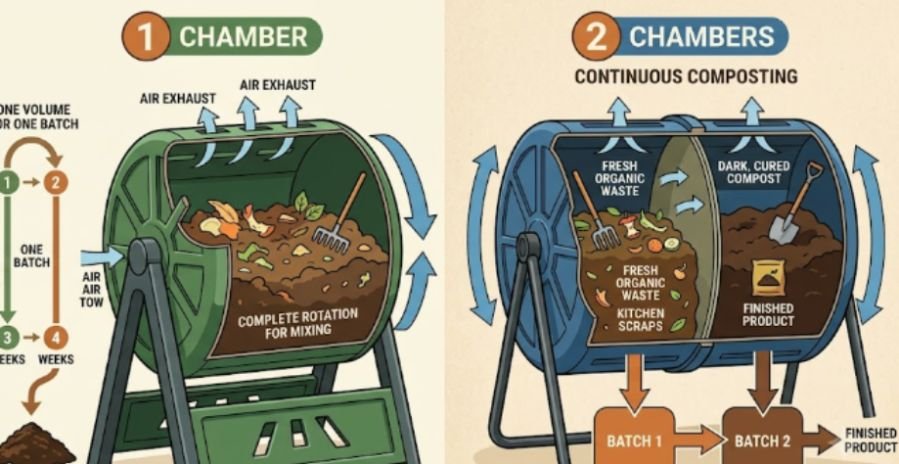
A single-chamber unit provides one continuous drum. It accepts larger batches, but fresh scraps can restart the decomposition clock when mixed with nearly finished compost.
A dual-chamber tumbler divides the total volume. One side can cure while the other receives fresh waste. This feature supports continuous processing, but each batch gets less space.
If a 43-gallon dual-chamber model divides its capacity equally, each side holds about:
5.75 ÷ 2 = 2.88 cubic feet
That is the article’s most useful buying insight: a “5.75-cubic-foot tumbler” may function like two separate 2.88-cubic-foot bins. Check whether the listed capacity applies to the complete unit or each chamber.
A dual design can still suit a small garden or a compact flower pot with limited soil capacity, where compost demand remains modest.
Advertised Capacity Is Not Working Capacity
A tumbler needs free space for material to lift, fall, mix, and receive oxygen. Filling the drum to its physical limit can make rotation difficult. Dense contents may also compress the mixture and restrict airflow.
I treat the stated figure as storage capacity, not an instruction to fill every inch. A practical planning allowance is roughly 70% to 80% of the drum’s listed volume. This is a sizing estimate rather than a universal manufacturer rule.
Using a 75% allowance, a 5.75-cubic-foot drum offers about:
5.75 × 0.75 = 4.31 cubic feet of planning capacity
For an evenly divided dual model, that becomes about 2.16 cubic feet per chamber. This original calculation gives a more realistic shopping comparison than the headline gallon number.
The EPA explains that successful composting requires suitable carbon-rich and nitrogen-rich materials, plus adequate oxygen, moisture, particle size, and temperature. Extra empty space supports mixing, but good ingredients and moisture control remain essential.
What Size Compost Tumbler Do I Need?
Choose capacity by measuring your organic waste, not by counting household members alone. Two people with a large yard may create more compostable material than a family with no lawn.
Estimate Your Weekly Compost Volume
Collect normal compostable waste for seven days in a known-size container. Include fruit and vegetable scraps, coffee grounds, dry leaves, and the brown material needed to balance wet scraps.
Multiply that weekly amount by the number of weeks you expect to fill one batch. Add some room for mixing. If you generate one cubic foot weekly and fill a chamber for four weeks, a chamber near 5 cubic feet gives more breathing room than a 3-cubic-foot compartment.
Do not include meat, dairy products, fats, pet waste, or treated wood unless your system’s instructions specifically permit them. The EPA’s home-composting guidance provides a useful list of suitable household materials.
Consider Finished-Compost Demand
A small tumbler may serve patio gardeners well. A household amending a raised garden bed will likely need a larger drum or several batches.
Compare output needs with input volume. Compost shrinks during decomposition, so one cubic foot of scraps does not produce one cubic foot of finished compost.
Does a Larger Compost Tumbler Work Better?
Bigger is not automatically better. Large drums become heavy when they contain damp food scraps, leaves, and partially decomposed material. Manual rotation can become unpleasant long before the drum reaches its stated limit.
A smaller tumbler is easier to turn and manage, but it fills quickly. Very small batches may also struggle to retain heat. Large gear-driven models reduce turning effort, although they cost more and occupy more space.
When deciding how many cubic feet is a compost tumbler should hold for your home, balance capacity against reach, handle design, frame strength, drainage, and turning effort.
Measure an Unlabeled Compost Tumbler
Measuring a curved barrel as a rectangular box overstates its volume. If the drum is roughly cylindrical, measure its interior diameter and usable interior length.
Use:
Volume = 3.1416 × radius² × length
Keep all measurements in feet to get cubic feet. If you measure in inches, divide the final result by 1,728.
For irregular drums, the safest option is to find the manufacturer’s model number. Product documentation usually provides a more reliable capacity than an exterior measurement.
Frequently Asked Questions
1. How many gallons are in a cubic foot of compost tumbler space?
One cubic foot equals approximately 7.48 US gallons.
2. Is a 43-gallon compost tumbler large enough for a family?
Its 5.75-cubic-foot total capacity can suit a moderate waste stream, but dual chambers provide only about 2.88 cubic feet each.
3. What is the best compost tumbler size for two people?
A model between 3 and 5 cubic feet often works, although actual weekly food and yard waste offers a better guide.
4. How many cubic feet is a compost tumbler with a 50-gallon label?
A 50-gallon compost tumbler holds approximately 6.68 cubic feet before allowing space for effective mixing.
Pick the Drum You Can Actually Keep Turning
A huge capacity label looks impressive until a wet, overloaded drum refuses to rotate. I would choose a tumbler based on measured weekly waste, usable chamber space, and comfortable turning effort.
For many homes, 4.5 to 7 cubic feet is the practical sweet spot. Before buying, convert gallons, check how the chambers divide, and reserve mixing space. Your arms—and your compost—will appreciate the honesty.

Ryan Mitchell
Ryan Mitchell holds a degree in Civil Engineering and spent over a decade working in construction project estimation, where accurate volume and material calculations were part of his daily work — from concrete pours to landscaping material orders. He founded this site to bring that same precision to everyday calculations, helping DIYers, contractors, and students get fast, accurate cubic footage results without the guesswork. Ryan reviews every calculator and formula on this site for accuracy and writes guides based on real-world measurement scenarios he's encountered on job sites.


