

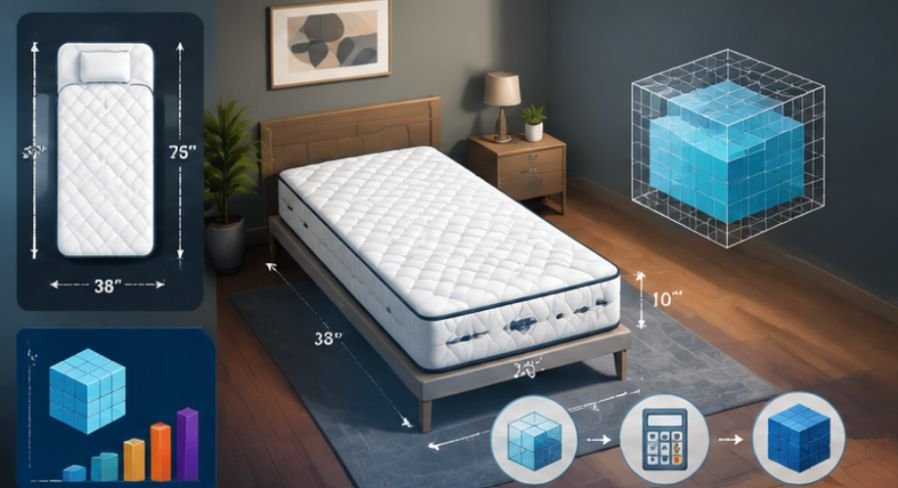
A standard queen-size mattress occupies roughly 33 to 35 cubic feet of space, yet moving company data suggests that DIY movers routinely rent trucks 30% larger than necessary simply because they miscalculate bulk item volume.
When you are starting out, moving into a first apartment, or paring down expenses, every square foot of rental space counts. Spending extra on a 15-foot box truck when a 10-foot truck would have done the job is a fast way to blow a tight moving budget.
Understanding how many cubic feet is a mattress allows you to accurately budget your moving truck, container, or storage unit footprint before spending a single dollar.
The Math Behind Mattress Volume
Calculating volume is straightforward: length multiplied by width multiplied by height (profile thickness), divided by 1,728 to convert cubic inches into cubic feet.
$$\text{Cubic Feet} = \frac{\text{Length (in)} \times \text{Width (in)} \times \text{Height (in)}}{1728}$$
However, real-world packing is rarely a clean math problem. Mattress profiles vary from basic 8-inch foam slabs to 16-inch pillow-top hybrid monsters.
Furthermore, memory foam mattresses compress into dense cylinders, whereas thick innersprings remain rigid 3D rectangles that cannot be squeezed.
Mattress Volume Breakdown by Standard Sizes
To simplify your packing estimates, standard mattress sizes translate to specific volume requirements based on an average 10-to-12-inch profile.
| Mattress Size | Dimensions (in) | Avg. Thickness | Volume (Cu. Ft.) |
| Twin / Single | 38″ × 75″ | 10″ | ~16–22 cu ft |
| Twin XL | 38″ × 80″ | 10″ | ~18–23 cu ft |
| Full / Double | 54″ × 75″ | 10″–12″ | ~23–32 cu ft |
| Queen | 60″ × 80″ | 10″–12″ | ~33–35 cu ft |
| King | 76″ × 80″ | 10″–12″ | ~35–42 cu ft |
| California King | 72″ × 84″ | 10″–12″ | ~35–42 cu ft |
Note: If you use a matching box spring or foundation, double your calculated volume. A standard foundation has identical length and width dimensions, adding roughly equal cubic footage to your load.
The Invisible Space Stealers: What Most Budget Movers Miss
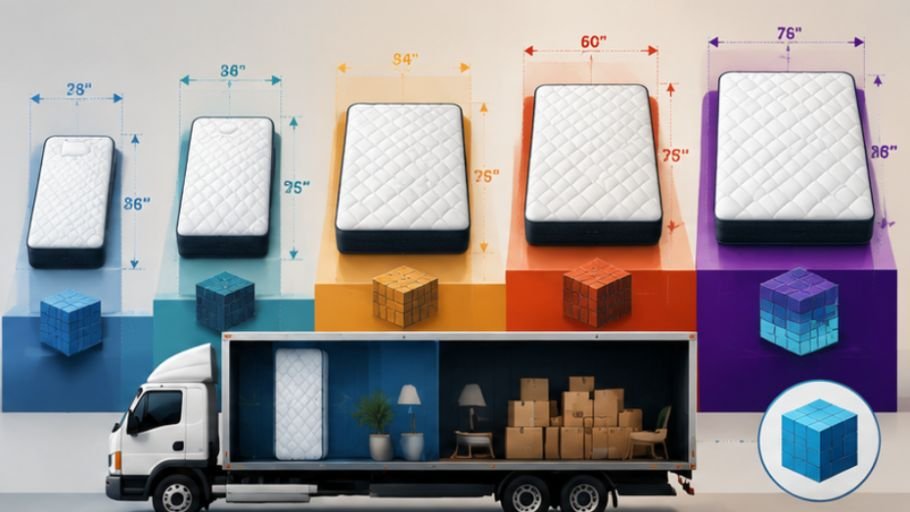
Understanding bare mattress dimensions is only half the battle. When packing tight quarters, several factors expand your mattress’s real-world footprint:
- Pillow Tops & European Tops: Adding 3 to 4 inches of plush topper increases a Queen mattress’s volume from 33 cubic feet up to nearly 42 cubic feet.
- Heavy-Duty Mattress Covers: A thick, padded transport bag adds bulk and prevents the mattress from sliding flush against truck walls.
- The “V-Shape” Sag: Traditional innerspring mattresses sag slightly when carried vertically, requiring extra horizontal clearance unless secured flat with cargo straps.
If you are packing multiple household items alongside your bed, calculating container space gets tricky fast. You might stack plastic bins, luggage, and backpacks around the frame to max out your truck interior.
To plan your layout down to the inch, check out our guide on the cubic feet is a plastic container to pair your mattress load with standard storage totes efficiently.
How to Calculate Your Real Space Needs: A Step-by-Step Test
Before renting a vehicle, perform this 3-step audit at home to prevent overspending.
- Measure the True Height: Don’t rely on the manufacturer’s label. Measure from the lowest seam to the crown of the mattress top.
- Account for the Foundation: Measure your box spring separately. Standard box springs are 9 inches high, while low-profile options run 5 inches.
- Calculate the Total Block: Multiply total length $\times$ width $\times$ combined height, then divide by 1,728.
When estimating the remaining cargo, remember to account for soft household items as well. Knowing the space blankets may occupy when packed can help you avoid underestimating the total volume needed for your move.
Budget Tip: Transporting an all-foam mattress? Renting a vacuum-compression bag costs under $20 and can shrink an all-foam Queen mattress by up to 70% of its volume, reducing its cargo footprint to less than 10 cubic feet.
Federal Safety & Logistics Standards
When hauling cargo on public highways, weight distribution and securement matter just as much as cubic volume. The Federal Motor Carrier Safety Administration (FMCSA) sets strict cargo securement rules under 49 CFR 393.100.
While these rules primarily regulate commercial transport, the underlying physics applies directly to consumer rental trucks.
Unsecured mattresses can shift, block rear visibility, or cause unstable load distribution. Always position your mattress vertically against the side wall of the truck, securing it with ratchet straps attached to the tie-down rails.
TRUCK WALL
|————-|
| MATTRESS | <– Secured vertically flat against side wall
| (Vertical) |
|————-|
| [BOX SPRING]| <– Placed directly alongside or beneath
|————-|
Research from the American Furniture Manufacturers Association emphasizes that standing an innerspring mattress on its side for short transit windows (under 48 hours) does not cause structural coil damage, provided it remains flat against a rigid surface rather than slumped.
Budgeting Strategy: Truck Sizing vs. Mattress Footprint
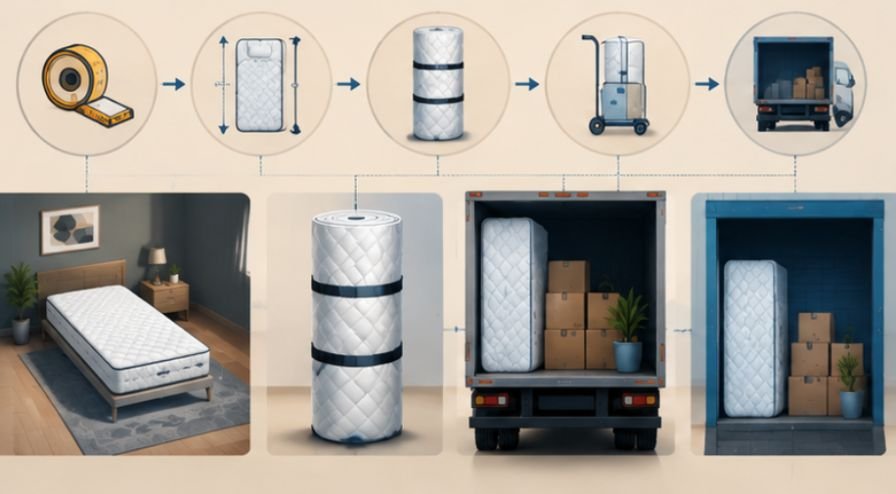
A typical 10-foot rental truck offers roughly 400 cubic feet of cargo space. A Queen bed setup (mattress plus box spring) takes up roughly 70 cubic feet combined.
That means your bed alone will consume nearly 18% of a small truck’s total usable volume.
10-Foot Cargo Truck Space Allocation (~400 cu ft total)
[███████░░░░░░░░░░░░░░░░░░░░░░░░░░░░░░░░]
18% = Queen Mattress + Box Spring (~70 cu ft)
If you are moving on a tight budget, place the mattress along the long wall first. Use the space in front of the mattress to wedge low-profile items like suitcases, packed duffels, and utility boxes.
Limitations and Exceptions
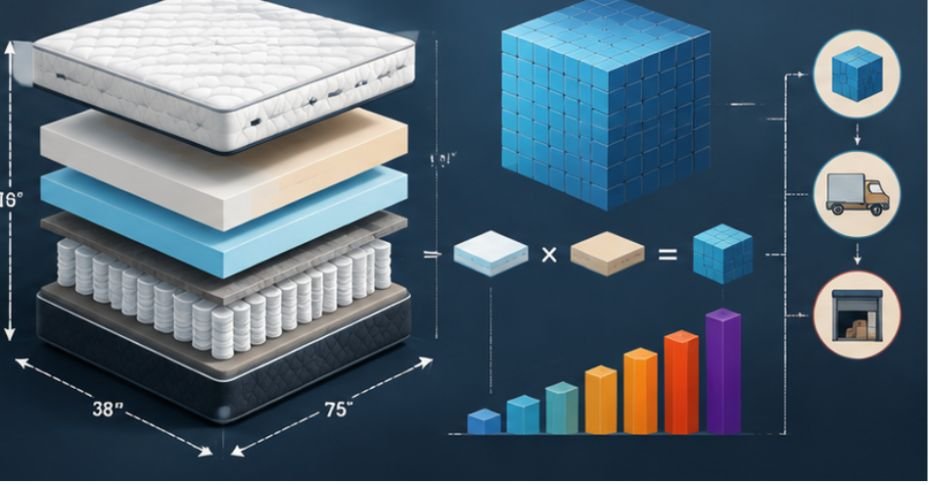
Calculating cubic volume using strict geometric formulas isn’t always foolproof. Keep these real-world exceptions in mind:
- Rigid Innersprings Cannot Compress: Unlike memory foam mattress beds, traditional coil beds cannot be folded or squished into odd corners. Their cubic footprint is absolute.
- Irregular Truck Wheel Wells: A 10-foot truck may offer 400 total cubic feet, but wheel wells reduce floor width, preventing wide mattresses from laying flat on the truck bed floor.
- Split Foundations: King-size beds almost always use two Twin XL box springs (split foundations). Make sure to account for two separate base units in your volume math.
Frequently Asked Questions
1. How many cubic feet is a full mattress?
A standard Full (Double) mattress with a 10- to 12-inch profile occupies approximately 23 to 35 cubic feet of space, depending on mattress thickness.
2. How many cubic feet is a twin bed?
A standard Twin mattress generally occupies about 16 to 22 cubic feet, while thicker 10-inch models reach up to 25 to 30 cubic feet.
3. What is the standard size of a mattress?
The most common standard mattress size in the US is a Queen, measuring 60 inches wide by 80 inches long with varying profile depths.
4. How many cubic feet is a queen mattress?
A standard Queen mattress measures 60″ $\times$ 80″ and occupies between 33 and 35 cubic feet for typical 10- to 12-inch profile depths.
Summary & Key Takeaways
Knowing how many cubic feet is a mattress stops you from overpaying for oversized moving trucks or underestimating storage unit space.
By measuring your mattress profile depth, accounting for your box spring, and factoring in real-world clearance loss, you can accurately budget your space down to the cubic foot.
Lock in your measurements before reserving your moving equipment, use vertical loading strategies, and keep your hard-earned cash where it belongs—in your bank account.

Ryan Mitchell
Ryan Mitchell holds a degree in Civil Engineering and spent over a decade working in construction project estimation, where accurate volume and material calculations were part of his daily work — from concrete pours to landscaping material orders. He founded this site to bring that same precision to everyday calculations, helping DIYers, contractors, and students get fast, accurate cubic footage results without the guesswork. Ryan reviews every calculator and formula on this site for accuracy and writes guides based on real-world measurement scenarios he's encountered on job sites.


