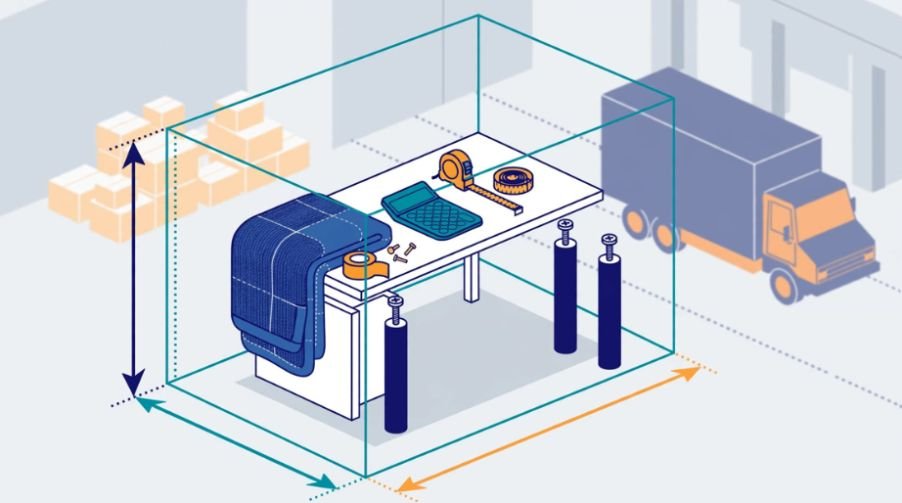
When I estimate furniture for a move, desks often take more room than expected. So, how many cubic feet is an office desk? A typical desk occupies about 20 to 45 cubic feet when measured by its outer dimensions.
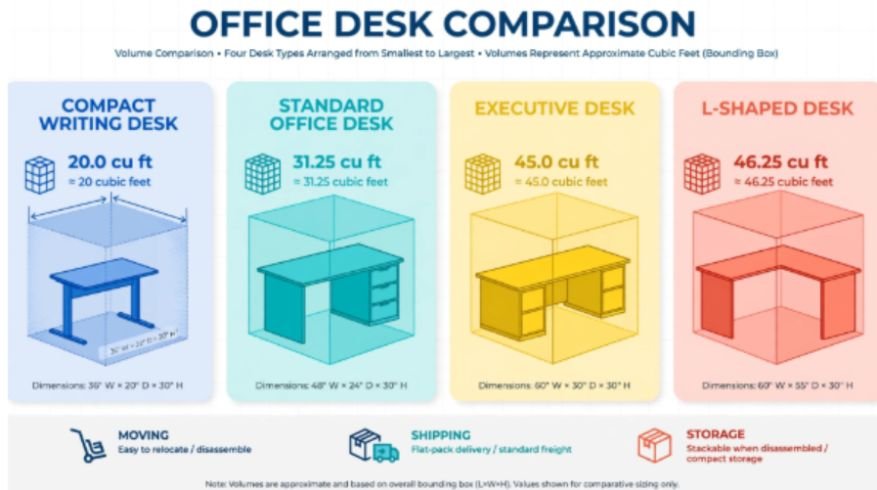
Small writing desks may use around 20 cubic feet. A medium office desk often reaches 25 to 32 cubic feet. Large executive models can occupy 40 cubic feet or more. The final figure depends on the desk’s length, depth, height, shape, and packing method.
Quick Office Desk Cubic Feet Estimates
Movers often use standard inventory values when an exact measurement is unavailable. For example, the Washington Utilities and Transportation Commission assigns 22 cubic feet to a small or Winthrop desk on its completed cube sheet.
The following estimates use a 30-inch desk height and the full rectangular footprint.
| Desk category | Typical dimensions | Estimated volume |
| Compact writing desk | 48 × 24 × 30 inches | 20.00 cu. ft. |
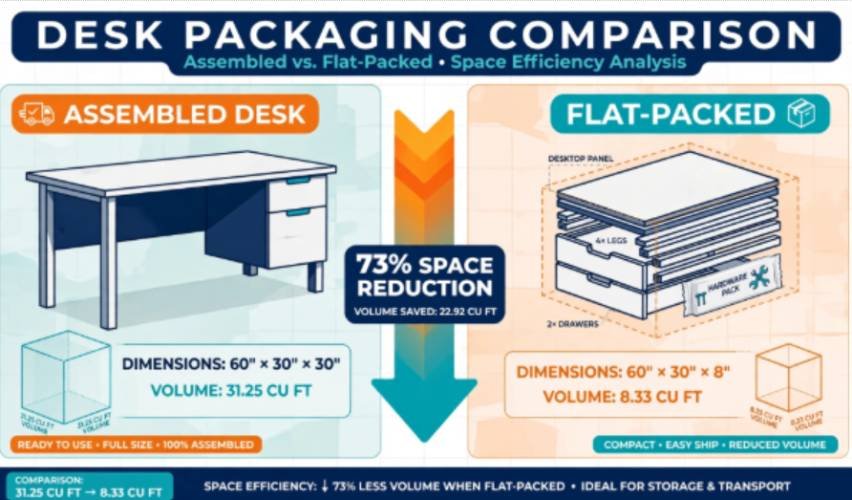
| Standard office desk | 60 × 30 × 30 inches | 31.25 cu. ft. |
| Large executive desk | 72 × 36 × 30 inches | 45.00 cu. ft. |
| Narrow computer desk | 48 × 20 × 30 inches | 16.67 cu. ft. |
| Standing desk | 60 × 30 × 48 inches | 50.00 cu. ft.* |
*The standing-desk figure assumes the frame remains extended. Lowering or removing the legs can substantially reduce its packed volume.
These figures explain why there is no single answer to how many cubic feet is an office desk. Even desks with the same length can have different depths, pedestals, shelves, or adjustable frames.
How to Calculate Office Desk Volume
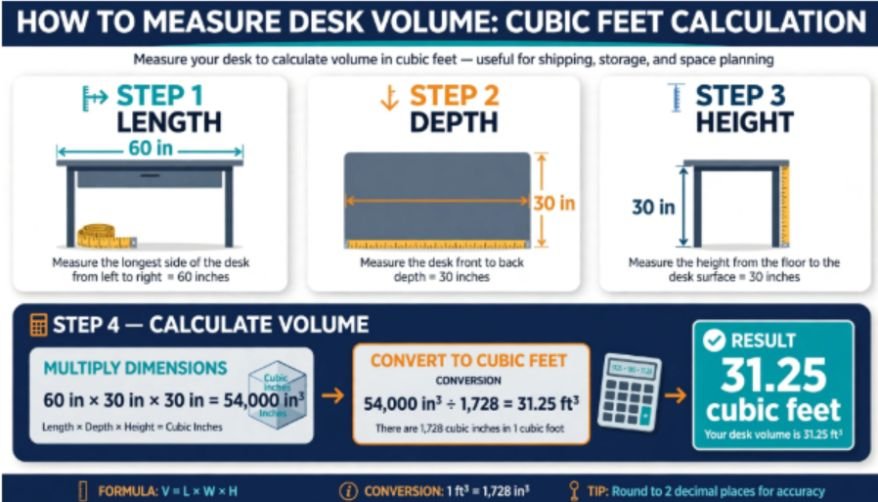
The calculation is simple when the desk has a rectangular outline:
Cubic feet = Length × Width × Height in inches ÷ 1,728
The divisor is 1,728 because one cubic foot contains exactly 1,728 cubic inches, according to the National Institute of Standards and Technology.
Measuring a Rectangular Desk
Measure the widest points, including drawers, trim, cable trays, and attached shelves. Do not measure only the desktop surface.
Suppose I measure a desk at 60 inches long, 30 inches deep, and 30 inches high:
60 × 30 × 30 = 54,000 cubic inches
54,000 ÷ 1,728 = 31.25 cubic feet
Therefore, the desk’s rectangular moving footprint is 31.25 cubic feet. This figure represents the surrounding box-shaped space, not the amount of wood or metal in the desk.
Calculating an L-Shaped Desk
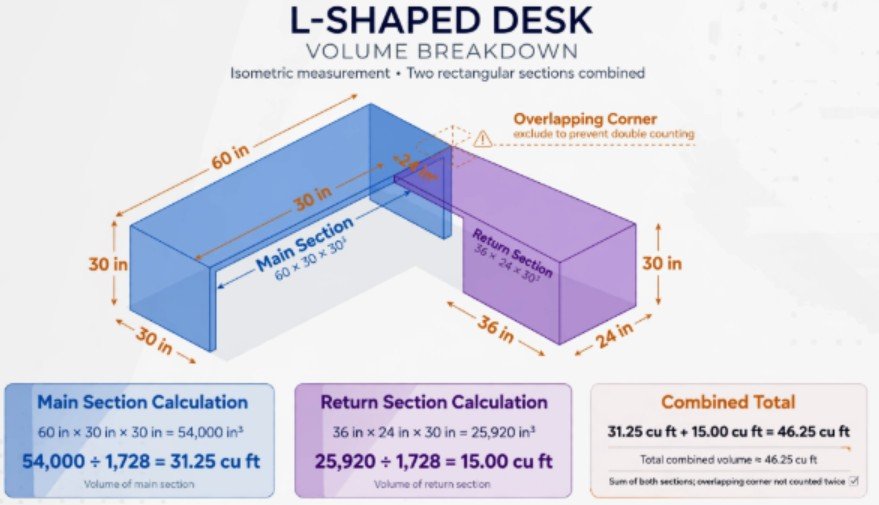
Treating an L-shaped desk as one large rectangle often exaggerates its volume. I get a better estimate by dividing it into two rectangular sections.
Consider these sections:
| Section | Dimensions | Volume |
| Main desktop | 60 × 30 × 30 inches | 31.25 cu. ft. |
| Return section | 36 × 24 × 30 inches | 15.00 cu. ft. |
| Combined estimate | — | 46.25 cu. ft. |
This method gives 46.25 cubic feet before accounting for any overlap between the two sections. If the return overlaps the main desktop, subtract the shared volume once.
Moving Footprint Versus Actual Material Volume
The answer to how many cubic feet is an office desk usually refers to its moving footprint. This is the smallest rectangular space that contains the assembled desk.
A 60-inch desk may occupy 31.25 cubic feet despite having open space beneath its surface. Movers use this outer footprint because other boxes cannot always fill that space safely.
Material volume is different. It measures only the solid wood, glass, or metal. That number has little value when choosing a truck or storage unit.
Packed volume can also differ from both figures. Removed legs may fit beneath the desktop, while drawers and hardware can travel in separate cartons. Protective blankets may add a few inches to each outer dimension.
How Desk Type Changes Cubic Footage
A simple writing desk usually has the smallest footprint. It has a narrow surface and few permanent storage components.
A pedestal desk needs more room because its drawer units fill the area below the desktop. An executive desk may also have a deep work surface, thick panels, and decorative overhangs.
An L-shaped workstation often falls between 40 and 70 cubic feet. Large corner systems can exceed that range. Hutch desks require extra height and may occupy 50 to 80 cubic feet when moved intact.
Sit-stand models create another challenge. Their normal working height should not automatically become the shipping height. Lower the frame before measuring whenever the manufacturer permits it.
Desk dimensions also matter after the move. OSHA recommends arranging workstation components so users can maintain neutral positions and reach frequently used items easily. Its computer workstation guidance can help when choosing the desk’s new location.
How Much Moving Space Should You Reserve?
For quick planning, reserve about 25 to 30 cubic feet for a normal office desk. Use the measured figure when space or cost is tight.
A 100-cubic-foot moving allocation could theoretically hold three medium desks at 31.25 cubic feet each. In practice, padding, uneven shapes, and loading gaps reduce that capacity.
When estimating an entire home, calculate bulky categories separately. A desk may appear small beside a household appliance set, yet several office pieces can consume significant truck space.
Add the desk, chair, filing cabinets, bookcases, cartons, and electronics to create a furniture moving package estimate. This produces a more useful total than calculating the desk alone.
Ways to Reduce a Desk’s Shipping Volume
Disassembly usually creates the greatest saving. Remove detachable legs, hutches, return sections, keyboard trays, and modesty panels. Place labeled hardware in a sealed bag and attach it securely.
Remove drawers before lifting the desk. Transporting them separately reduces weight, although it does not always reduce total cubic footage.
Nest narrow parts beneath or against the desktop when safe. Protect glass, finished edges, and motorized standing-desk components with suitable packing materials.
Measure the disassembled stack again. This second calculation answers how many cubic feet is an office desk after preparation, which may be far lower than its assembled footprint.
My practical finding is revealing: reducing a 60 × 30 × 30-inch desk to a 60 × 30 × 8-inch packed stack cuts its theoretical footprint from 31.25 to 8.33 cubic feet. That is a reduction of about 73%.
Reference Sources
| Authority | Information used | External reference |
| Washington UTC | Moving-industry cube-sheet estimate | Completed Cube Sheet |
| NIST | Cubic-inch and cubic-foot conversion | General Tables of Units |
| OSHA | Computer workstation arrangement | Workstation Components |
| IRS | Office furniture classification reference | Publication 584-B |
Frequently Asked Questions
1. How many cubic feet is a standard 60-inch office desk?
A 60 × 30 × 30-inch desk occupies approximately 31.25 cubic feet when measured as a rectangular footprint.
2. How many cubic feet is an office desk after disassembly?
A desk packed flat may occupy 8 to 15 cubic feet, depending on its desktop thickness, legs, drawers, and padding.
3. How much space does an L-shaped desk need in a moving truck?
Many L-shaped desks require 40 to 70 cubic feet when assembled, but separating the return can reduce wasted loading space.
4. Should I include the office chair in the desk calculation?
No. Measure the chair separately because its arms, base, and back create an independent moving footprint.
Final Verdict: Measure It Before It Steals the Truck
I use 25 to 30 cubic feet as a fast estimate for an ordinary office desk. For an accurate moving quote, I measure the widest length, depth, and height before dividing the result by 1,728.
Do not let empty legroom fool you. An assembled desk can claim a large block of truck space. Measure it again after disassembly, label every part, and use the smaller packed figure for final planning.

Ryan Mitchell
Ryan Mitchell holds a degree in Civil Engineering and spent over a decade working in construction project estimation, where accurate volume and material calculations were part of his daily work — from concrete pours to landscaping material orders. He founded this site to bring that same precision to everyday calculations, helping DIYers, contractors, and students get fast, accurate cubic footage results without the guesswork. Ryan reviews every calculator and formula on this site for accuracy and writes guides based on real-world measurement scenarios he's encountered on job sites.