

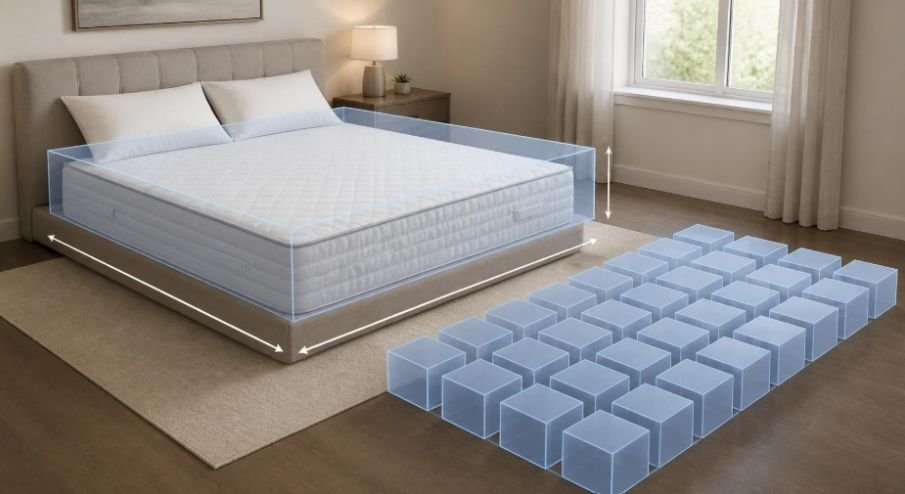
A standard queen mattress occupies significantly more room in a moving truck or storage unit than most people expect, typically claiming anywhere from 22 to 39 cubic feet of spatial volume. While two-dimensional measurements tell you if a bed fits your frame, three-dimensional volume dictates your shipping costs, storage unit rental size, and truck loading strategy.
Planning a move without calculating exact spatial volume often leads to rented trucks that fill up too quickly or storage lockers packed past safety limits. Understanding exact mattress dimensions in three dimensions saves money, time, and heavy lifting.
Why Mattress Volume Matters More Than Floor Dimensions
Measuring a bed in square feet only gives you two dimensions: length and width. A standard queen mattress covers 33.3 square feet of floor space, measuring 60 inches wide by 80 inches long (5 feet by 6.7 feet).
However, total space consumption depends heavily on thickness. Mattress height varies wildly across modern brands, ranging from slim 8-inch profiles to plush 14-inch hybrid models.
When loading a cargo container or freight vehicle, height translates directly into lost or utilized cargo capacity. The U.S. Department of Transportation sets strict volume and weight limits for commercial transport, making exact spatial density a core factor in freight estimates and personal moving logistics.
Calculating Queen Mattress Volume Step-by-Step
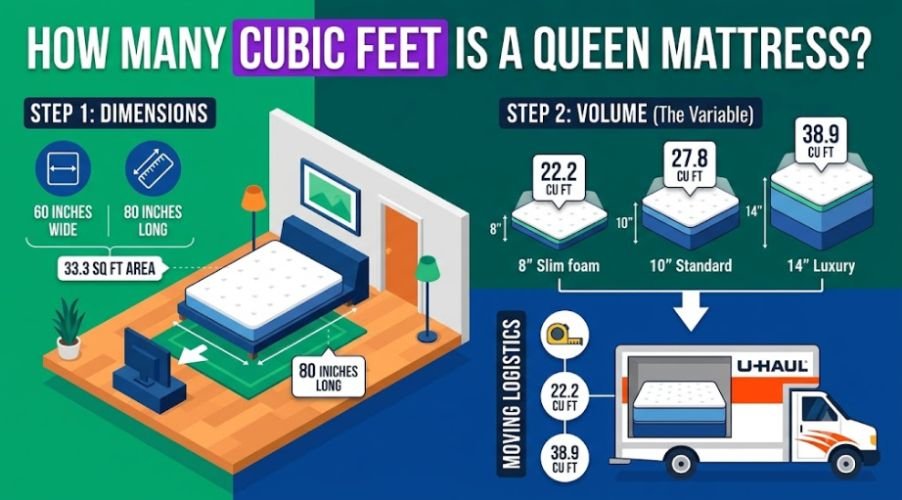
Finding the exact cubic footage of your bed requires simple three-dimensional math: Length × Width × Height (in inches) ÷ 1,728.
Because a foot contains 12 inches, one cubic foot equals 1,728 cubic inches (12 × 12 × 12).
Here is the straightforward formula applied to standard mattress heights:
- Measure Width: 60 inches
- Measure Length: 80 inches
- Multiply Base Area: 60 × 80 = 4,800 square inches
- Multiply by Height: 4,800 × Thickness (in inches)
- Convert to Cubic Feet: Divide total cubic inches by 1,728
For example, a standard 10-inch queen mattress calculation looks like this:
4,800 × 10 = 48,000 cubic inches
48,000 ÷ 1,728 = 27.77 cubic feet
Queen Mattress Cubic Feet Comparison Table
Thickness varies dramatically based on material layers like high-density foam, inner coils, and pillow-top covers. Use this breakdown to estimate your specific model:
| Mattress Type | Height (Inches) | Base Area (Sq Ft) | Volume (Cubic Feet) |
| Slim / RV Queen | 8 inches | 33.3 sq ft | 22.2 cu ft |
| Standard Foam | 10 inches | 33.3 sq ft | 27.8 cu ft |
| Medium Hybrid | 12 inches | 33.3 sq ft | 33.3 cu ft |
| Luxury Pillow-Top | 14 inches | 33.3 sq ft | 38.9 cu ft |
If you are planning a broader household relocation, calculating space for other bedroom items is just as vital. You can calculate precise storage needs using an online appliance and household cubic feet calculator to prevent underestimating truck sizes.
How Queen Mattress Volume Compares to Other Sizes
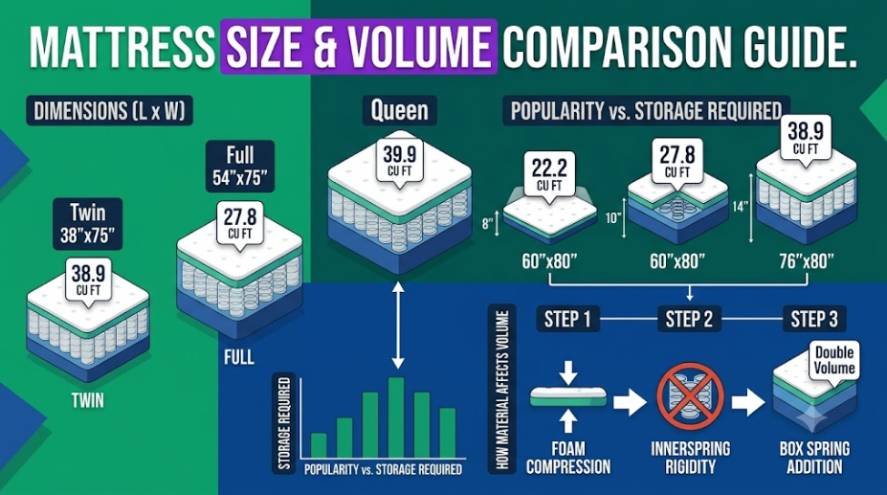
Queen beds remain the most popular mattress size in North America, accounting for nearly half of all adult mattress purchases. Yet, switching to a different bed size alters your cargo capacity requirements substantially.
- Twin Mattress: A standard twin measures 38 × 75 inches. At a 10-inch height, it takes up roughly 16.5 cubic feet. Reviewing a detailed breakdown of twin mattress spatial dimensions helps when packing smaller bedrooms.
- Full (Double) Mattress: Measuring 54 × 75 inches, a 10-inch full mattress occupies about 23.4 cubic feet.
- King Mattress: Measuring 76 × 80 inches, a 10-inch king mattress jumps to roughly 35.2 cubic feet, expanding to over 49 cubic feet for 14-inch models.
Understanding these ratios ensures you do not waste rental space when upgrading or downsizing your furniture collection.
Moving and Storage Logistics: Practical Real-World Impact
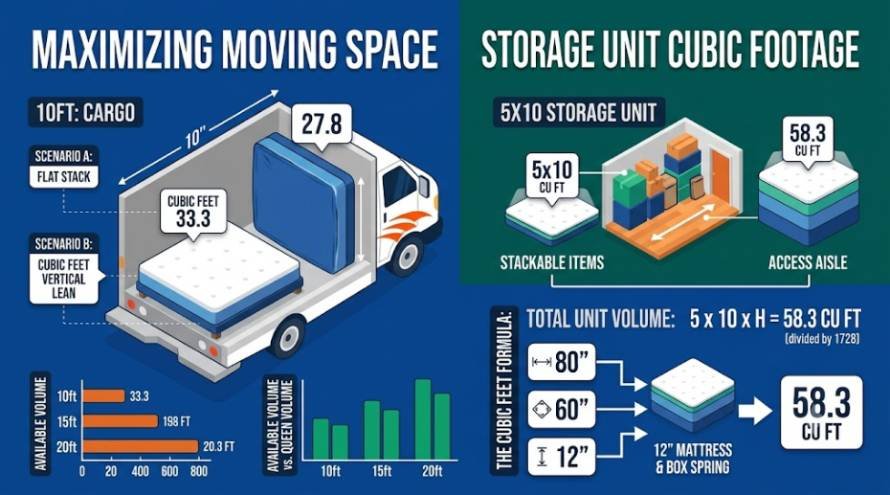
Knowing your bed takes up 28 to 33 cubic feet is only half the battle. Real-world packing introduces clearance variables, protective wrapping, and box springs.
Storage Unit Planning
The Small Business Administration highlights logistics management as a crucial factor in operational efficiency—a principle that applies directly to home moves. In a standard 5×10 storage unit (which offers 400 total cubic feet of space assuming 8-foot ceilings), a single 12-inch queen mattress consumes roughly 8.3% of total available room.
Box Springs and Bed Frames
Never forget to double your spatial estimates if moving a traditional box spring. Box springs do not compress and share the exact footprint of the mattress (60 × 80 inches). A standard 9-inch box spring adds another 25 cubic feet of solid volume to your load.
Compression Bags vs. Traditional Packing
Vacuum-sealing all-foam beds (like memory foam) can compress their total volume by up to 60%, drastically reducing spatial footprint during travel.
For other soft household items, you can also estimate blanket size and volume when planning how much space your packed bedding will require.
However, the Innerspring Manufacturers Association warns against compressing traditional innerspring or hybrid models, as bending steel coils permanently ruins internal structural integrity.
Step-by-Step Checklist for Moving a Queen Mattress
Follow this step-by-step checklist to transport your mattress safely without damaging internal layers:
- Step 1: Verify Mattress Type
Determine if your bed contains inner coils or 100% memory foam to evaluate compression safety. - Step 2: Take Accurate Height Measurements
Measure from the lowest base seam to the highest crown point to calculate exact cubic feet. - Step 3: Bag and Seal
Encase the mattress in a heavy-duty 4-mil polyethylene mattress bag to protect against dust and moisture. - Step 4: Secure Vertical Placement
Store and transport mattresses on their long edge to maximize truck floor space, but secure them flat once in long-term storage to prevent internal fill sagging.
Common Misconceptions and Spatial Exceptions
Several widespread myths cause people to miscalculate cargo space during home relocations:
- Myth: All Queen Beds Are 60 × 80 Inches
Reality: Olympic Queens measure 66 × 80 inches (adding ~10% more volume), while California Queens measure 60 × 84 inches. Always measure before calculating cubic space. - Myth: You Can Turn Box Springs Around Tight Corners
Reality: Standard queen box springs are rigid. If stairwells feature sharp turns, split-queen box springs (two 30 × 80-inch units) are required. - Myth: Stacking Heavy Boxes on Stored Mattresses Saves Space
Reality: Long-term weight pressure causes permanent foam indentation and broken coil springs, destroying structural support.
Frequently Asked Questions
1. What size moving truck do I need for a queen mattress?
A cargo van or a 10-foot moving truck easily fits a queen mattress. The mattress takes up roughly 28 to 33 cubic feet, leaving plenty of room for additional furniture and boxes.
2. Can a queen mattress fit in an SUV?
Most standard SUVs cannot fit a queen mattress inside with the hatch closed. A queen mattress requires 60 inches of flat width and 80 inches of length, which exceeds most cargo areas.
3. How much does a queen mattress weigh?
A standard queen mattress weighs between 60 and 150 pounds. All-foam models lean lighter, while heavy hybrid and latex mattresses with dense coil layers reach the higher end of the range.
4. Can you fold a queen mattress to save cubic space?
You can temporarily bend memory foam and latex mattresses in half for brief transport. Never fold innerspring or hybrid mattresses, as doing so permanently snaps the border wire and ruins internal coils.
Final Takeaway
Calculating spatial volume moves you beyond simple floor dimensions, revealing that a queen mattress requires 22 to 39 cubic feet depending on its height. Factoring in total volume, box spring additions, and material limitations ensures you rent the right truck size, choose the correct storage unit, and protect your sleep investment during any move.

Ryan Mitchell
Ryan Mitchell holds a degree in Civil Engineering and spent over a decade working in construction project estimation, where accurate volume and material calculations were part of his daily work — from concrete pours to landscaping material orders. He founded this site to bring that same precision to everyday calculations, helping DIYers, contractors, and students get fast, accurate cubic footage results without the guesswork. Ryan reviews every calculator and formula on this site for accuracy and writes guides based on real-world measurement scenarios he's encountered on job sites.


