

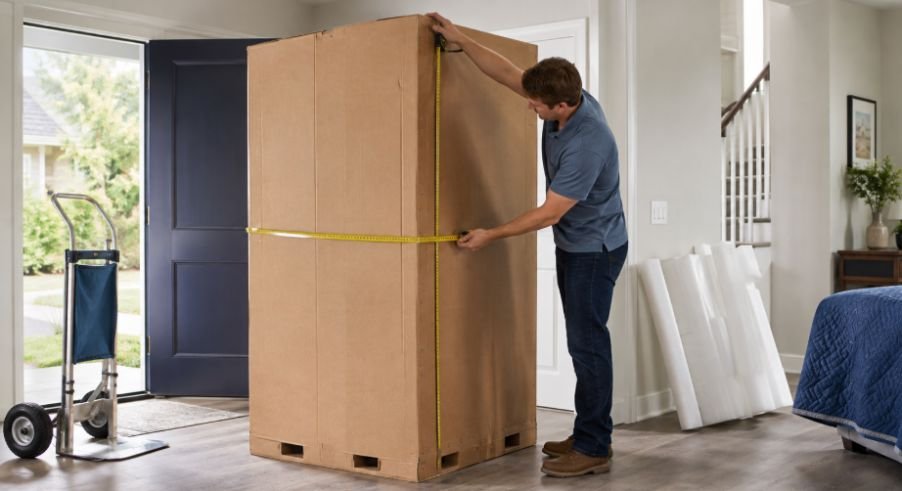
When I first measured a refrigerator carton, its size surprised me. So, how many cubic feet is a refrigerator box in practical terms? Most full-size refrigerator boxes occupy about 40 to 60 cubic feet of external space.
That figure describes the shipping carton, not the refrigerator’s advertised food-storage capacity. A refrigerator labeled “22 cubic feet” may arrive inside a carton measuring close to 50 cubic feet.
Quick Answer: Typical Refrigerator Box Volume
There is no universal refrigerator-box size. Appliance style, protective foam, handles, doors, and packaging design all affect the final dimensions.
The following estimates offer a useful planning range:
| Refrigerator type | Estimated box dimensions | Approximate box volume |
| Compact refrigerator | 26 × 27 × 40 inches | 16.3 cubic feet |
| Apartment-size refrigerator | 29 × 31 × 62 inches | 32.3 cubic feet |
| Standard top-freezer | 34 × 34 × 70 inches | 46.8 cubic feet |
| Side-by-side refrigerator | 37 × 34 × 72 inches | 52.4 cubic feet |
| Large French-door model | 38 × 38 × 72 inches | 60.2 cubic feet |
These are planning estimates rather than manufacturer specifications. Always check the product’s carton dimensions when arranging professional freight or storage.
Refrigerator Box Size Versus Storage Capacity
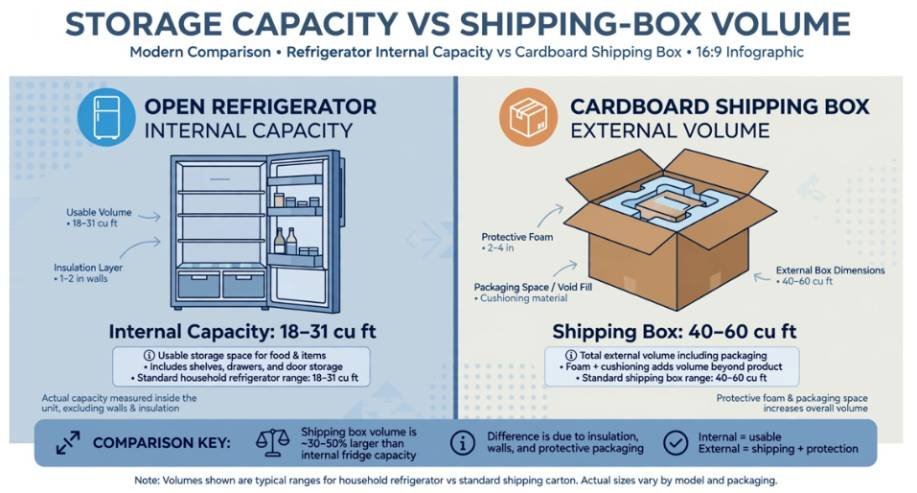
A common mistake is using the refrigerator’s advertised capacity as its shipping volume. The two measurements describe different spaces.
Internal capacity measures the usable compartments for fresh and frozen food. External box volume includes the appliance cabinet, insulation, mechanical components, doors, handles, foam, cardboard, and empty protective space.
According to Whirlpool’s refrigerator size guide, refrigerator capacities generally range from 11–13 cubic feet for small units to 22–31-plus cubic feet for large models. KitchenAid reports that many typical models offer about 20–25 cubic feet of internal capacity.
| Measurement | What it represents | Typical full-size range |
| Internal capacity | Usable food-storage space | 18–31 cubic feet |
| Appliance exterior | Complete physical refrigerator | About 32–55 cubic feet |
| Shipping-box volume | Appliance plus protective packaging | About 40–60 cubic feet |
Therefore, the answer to how many cubic feet is a refrigerator box cannot come from the capacity printed on the appliance label.
How to Calculate Refrigerator Box Cubic Feet
Measure the outside length, width, and height at their widest points. Include cardboard extensions, corner protectors, and the pallet when they form part of the shipment.
Use this formula:
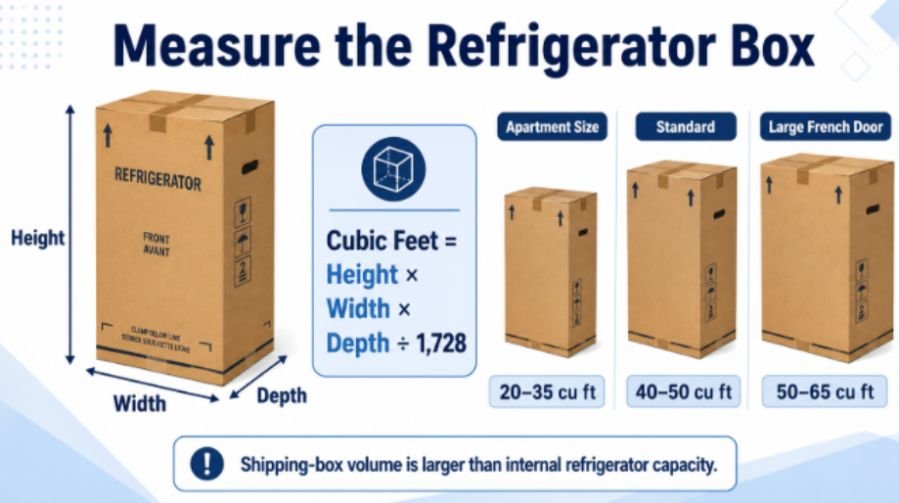
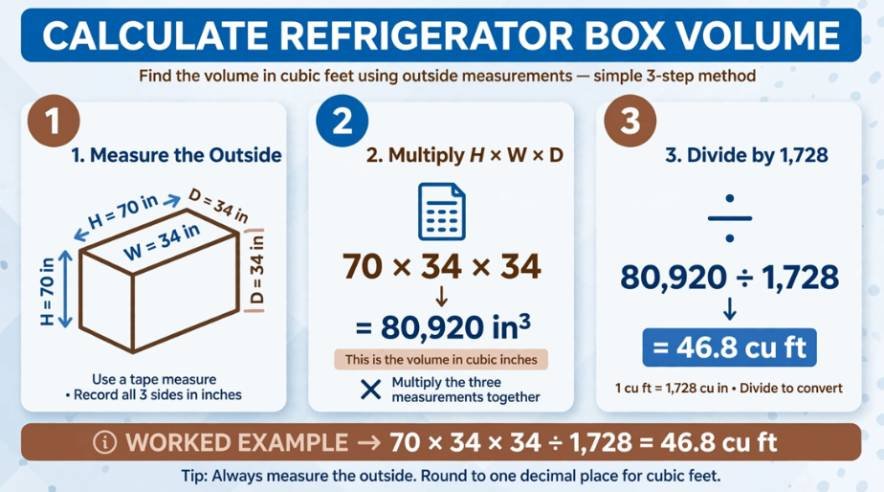
Cubic feet = Length × Width × Height ÷ 1,728
The number 1,728 represents the cubic inches in one cubic foot:
12 × 12 × 12 = 1,728
Round fractional dimensions up when estimating freight requirements. Both UPS and FedEx instruct shippers to use the package’s outer dimensions when calculating dimensional weight.
Worked Standard-Refrigerator Example
Suppose I measure a boxed top-freezer refrigerator at:
70 inches high × 34 inches wide × 34 inches deep
The calculation is:
70 × 34 × 34 = 80,920 cubic inches
80,920 ÷ 1,728 = 46.83 cubic feet
The refrigerator box occupies approximately 46.8 cubic feet. For moving-truck planning, I would round that result to 47 cubic feet.
Worked French-Door Refrigerator Example
Now consider a larger carton measuring:
72 inches high × 38 inches wide × 38 inches deep
The calculation becomes:
72 × 38 × 38 ÷ 1,728 = 60.17 cubic feet
This box needs about 60.2 cubic feet of cargo space.
My practical finding is that adding only two inches of packaging around each appliance dimension can increase external volume sharply. A 68 × 32 × 32-inch appliance occupies 40.3 cubic feet. A 70 × 34 × 34-inch box occupies 46.8 cubic feet—an increase of roughly 16%.
Refrigerator Shipping Box Dimensions by Style
Refrigerator style offers a reasonable starting point when carton measurements are unavailable. The Home Depot lists standard refrigerator exteriors at roughly 28¾ inches wide, 61¾–71¼ inches high, and 28¾–34⅝ inches deep. Packaging usually adds several inches.
| Refrigerator style | Common appliance characteristics | Likely carton volume |
| Compact | Short, narrow body | 10–20 cubic feet |
| Apartment-size | Narrow but nearly full height | 25–38 cubic feet |
| Top-freezer | Moderate width and depth | 40–50 cubic feet |
| Bottom-freezer | Taller body with deeper drawers | 42–52 cubic feet |
| Side-by-side | Wide, full-height doors | 48–58 cubic feet |
| French-door | Wide cabinet and large lower freezer | 50–65 cubic feet |
Model differences remain significant. KitchenAid lists standard refrigerator exterior measurements ranging from 24–40 inches wide, 61–72 inches high, and 28–35 inches deep.
Why the Box Is Larger Than the Refrigerator
The carton must protect a heavy appliance during warehouse handling and truck transport. Manufacturers leave space for molded foam, reinforced corners, cardboard bases, and accessory packages.
Doors and handles may also extend beyond the main cabinet. Some models arrive on a wooden or composite shipping base. If that base remains attached, include its full dimensions.
The empty carton can collapse after unpacking. However, its assembled volume determines how much room it uses before delivery.
Measuring for Moving, Storage, or Shipping
The purpose of the calculation changes how precise your result must be. If I only need to reserve moving-truck space, rounding up to the next whole cubic foot works well. Freight quotes demand exact outer measurements.
Large items can consume space faster than expected. The same calculation helps estimate the volume of a generator size and volume.
Moving-Truck Space
Do not treat a 50-cubic-foot carton as 50 cubic feet of perfectly usable truck capacity. Refrigerator boxes must usually remain upright. Their rigid shape can create unused gaps around furniture and other boxes.
I allow an extra 10% to 15% when planning mixed household loads. Therefore, a 50-cubic-foot refrigerator carton may effectively claim 55 to 58 cubic feet of practical cargo space.
Measure doors, stairways, elevators, and hallway turns too. A box can fit inside the truck yet fail to pass through the building entrance.
Freight and Dimensional Weight
Cubic volume and dimensional weight are related but different. Cubic feet describe space. Dimensional weight converts package size into a billable weight.
FedEx uses this U.S. dimensional-weight formula for applicable shipments:
Length × Width × Height ÷ 139
A 70 × 34 × 34-inch greenhouse section provides a defined amount of enclosed space. Greenhouse dimensions can help determine usable growing capacity, but benches, aisles, shelving, and plant spacing also affect how efficiently the space can be used. The same calculation helps estimate the volume of the usable growing space inside a greenhouse.
Common Refrigerator-Box Measurement Mistakes
When people ask how many cubic feet is a refrigerator box, they often use the refrigerator’s internal capacity or measure only its cabinet. Both methods underestimate shipping volume.
Other frequent errors include measuring after removing the foam, excluding the shipping base, or measuring depth without handles and protective guards. Rounding down can also change a carrier’s calculation.
Measure the fully packed carton at its longest, widest, and highest points. Use the manufacturer’s packaging sheet when available.
Frequently Asked Questions
1. How many cubic feet is a standard refrigerator box?
A standard full-size refrigerator carton commonly occupies about 40–50 cubic feet, although exact dimensions vary.
2. How many cubic feet is a French-door refrigerator box?
A boxed French-door refrigerator often requires approximately 50–65 cubic feet because these models are wider and deeper.
3. Can I calculate refrigerator-box volume from its capacity label?
No. The capacity label measures internal food storage, while the shipping carton measures the appliance and all protective packaging.
4. Does the refrigerator pallet count in the measurement?
Yes. Include the pallet or shipping base when it remains attached during storage, moving, or freight transport.
The Box Has Spoken: Measure Before You Move
I use 40–60 cubic feet as a quick estimate for a full-size refrigerator carton. I never rely on that range for a final freight booking, though.
To answer how many cubic feet is a refrigerator box accurately, measure its three outside dimensions and divide their product by 1,728. Then add modest loading clearance if you are planning a moving truck. One minute with a tape measure can prevent a costly space problem.

Ryan Mitchell
Ryan Mitchell holds a degree in Civil Engineering and spent over a decade working in construction project estimation, where accurate volume and material calculations were part of his daily work — from concrete pours to landscaping material orders. He founded this site to bring that same precision to everyday calculations, helping DIYers, contractors, and students get fast, accurate cubic footage results without the guesswork. Ryan reviews every calculator and formula on this site for accuracy and writes guides based on real-world measurement scenarios he's encountered on job sites.


