

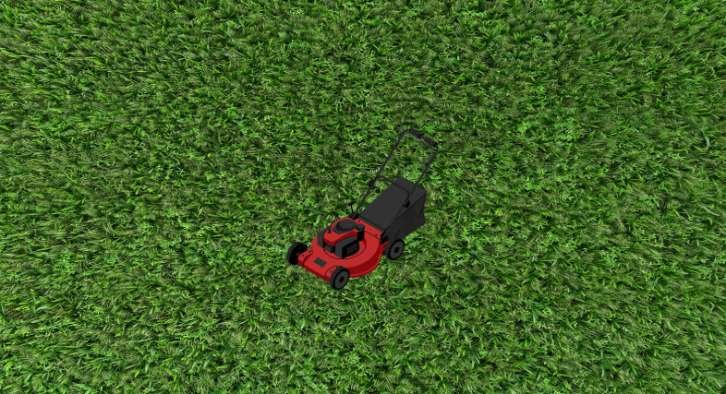
I used to think measuring a lawn mower was as simple as checking the width of its cutting deck. However, that measurement does not reveal how much storage or transportation space the entire machine needs. If you are asking, How Many Cubic Feet Is a Lawn Mower?, a folded push mower commonly occupies about 10 to 20 cubic feet, while a riding model may require 60 to 90 cubic feet. Larger zero-turn machines can exceed 100 cubic feet.
The exact answer depends on the mower’s length, total width, height, handle position and attachments. Calculating its rectangular storage envelope gives you a practical estimate for organizing a shed, garage, trailer or moving vehicle.
Average Lawn Mower Volume by Type
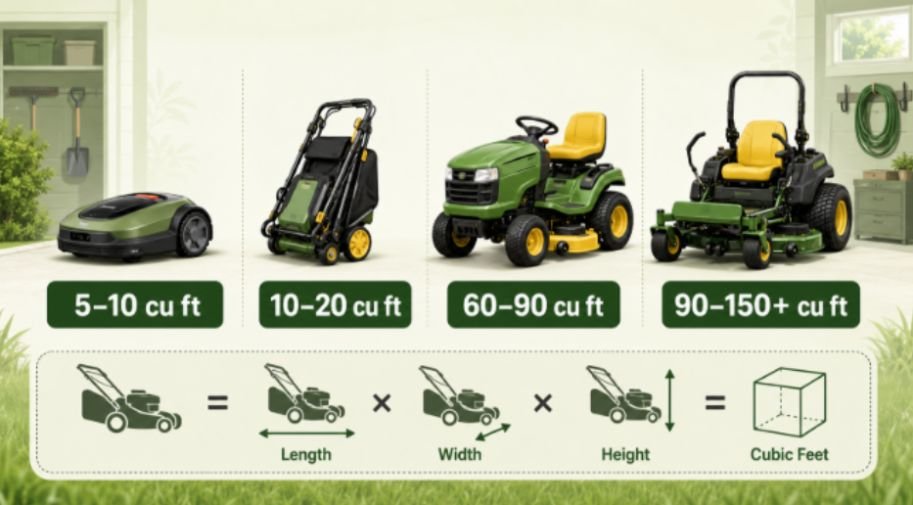
Mowers vary considerably in design, so one generic figure will not work for every machine. A small reel mower may occupy approximately 5 to 10 cubic feet when stored. Its narrow frame, simple construction and folding handle make it one of the easiest models to fit into a compact space.
A walk-behind electric or gas mower usually requires around 10 to 20 cubic feet with the handle folded. With the handle fully extended, its rectangular envelope can increase to approximately 30 to 45 cubic feet. The mower itself has not grown, but the extended handle creates a much larger storage boundary.
Self-propelled mowers generally fall within similar ranges, although their drive components, larger wheels and collection systems can add bulk. Robotic mowers are much smaller and may occupy only 1 to 4 cubic feet without their charging station.
Riding lawn mowers and lawn tractors typically need about 60 to 90 cubic feet. A large zero-turn mower may occupy 90 to 150 cubic feet or more, particularly when it has a wide cutting deck, rollover protection system, bagging attachment or raised seat.
How to Calculate Lawn Mower Cubic Feet
You can calculate the required volume using three measurements:
Cubic feet = length × width × height
When all measurements are taken in inches, multiply them and divide the result by 1,728. There are 1,728 cubic inches in one cubic foot.
For example, imagine that a folded push mower measures 36 inches long, 24 inches wide and 30 inches high:
36 × 24 × 30 = 25,920 cubic inches
25,920 ÷ 1,728 = 15 cubic feet
The mower therefore occupies a rectangular storage envelope of approximately 15 cubic feet. This does not mean the physical materials inside the mower total 15 cubic feet. It represents the smallest box-shaped area into which the machine could reasonably fit.
How to Measure a Mower Correctly
Measure the Total Length
Begin at the mower’s furthest front point and measure to its furthest rear point. Include the collection bag if you intend to leave it attached. For storage calculations, fold the handle into its normal storage position before measuring.
Find the Widest Point
Do not assume the advertised deck width equals the overall machine width. Wheels, discharge chutes and guards may extend beyond the cutting deck. Measure from the outermost point on one side to the outermost point on the other.
Check the Maximum Height
Measure from the floor to the mower’s highest permanent point. On a push mower, this may be the folded handle or engine cover. On a riding mower, it may be the steering wheel, seat back or rollover bar.
Include Fixed Attachments
Include anything that will remain attached during storage or transportation. A grass catcher, side-discharge chute, canopy or bagging system can noticeably increase the required space. Removable accessories should be measured separately if you plan to store them elsewhere.
Why Handle Position Changes the Result
Handle position is one of the biggest reasons online estimates differ. Makita lists one mower at approximately 23.25 inches long, 22.5 inches wide and 48 inches high in its stored configuration. Those dimensions equal about 14.5 cubic feet. Its operating length is substantially greater, demonstrating how folding the handle reduces the storage envelope.
Before folding any mower, check its manual. Some models are designed for vertical storage, while others must remain horizontal. A gas mower may leak oil or fuel when placed in an unauthorized position.
Cubic Volume Versus Floor Space
Cubic feet and floor space answer different questions. Cubic feet describe three-dimensional volume, while floor space indicates how much of the shed or garage floor the mower covers.
A mower measuring 3 feet long and 2 feet wide uses 6 square feet of floor area. If it stands 2.5 feet high, its rectangular volume is 15 cubic feet. Both figures are valuable: floor area helps you plan placement, while cubic volume is useful for moving, shipping and overall storage estimates.
Do not select a storage area based only on the mower’s calculated volume. Leave clearance around the machine so you can move it safely, reach the controls and avoid damaging nearby objects. Riding mowers need considerably more access space than push models. Storage providers consequently recommend larger units for riding machines, even though the mower itself occupies only part of that volume.
The same space-planning approach is useful when arranging other garden items, like the flower pots, where their combined size can affect available floor and storage space.
Planning Space in a Shed or Garage
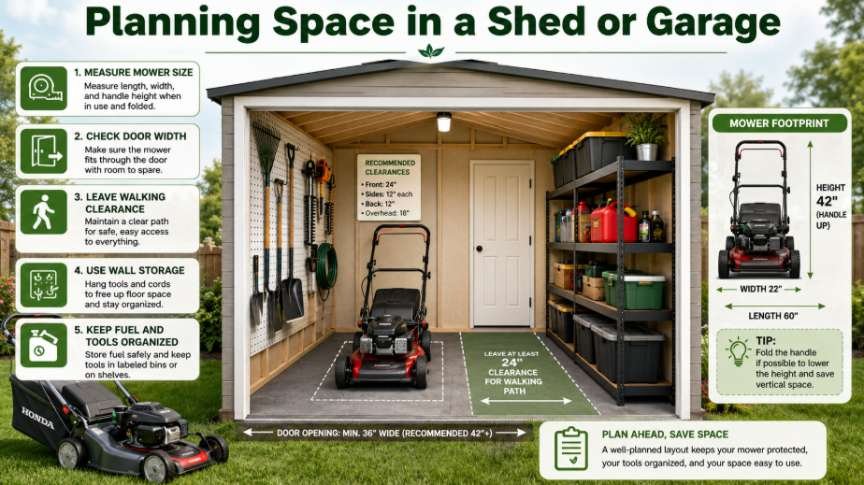
Measure the doorway before choosing a storage location. A mower may fit inside the room but still be too wide to pass through its entrance. Deck width also affects maneuverability, and common push and riding models cover a broad range of cutting widths.
Allow extra room for fuel containers, chargers, batteries, collection bags and maintenance tools. Keep the area dry and protected from weather. Clean away grass clippings before storage because trapped moisture and plant debris can encourage corrosion.
For transportation, measure the available cargo opening as well as the interior. Secure the mower so it cannot roll or shift, and follow the manufacturer’s instructions for fuel, battery and oil preparation.
If you are organizing multiple outdoor items, it can also help to estimate the space required for a compost tumbler before deciding how much room to reserve in your shed or garden storage area.
Frequently Asked Questions
1. How Many Cubic Feet Is a Lawn Mower when folded?
A typical folded push mower occupies approximately 10 to 20 cubic feet. Compact electric or reel models may require less, while heavy self-propelled machines with attached grass bags may require more.
2. How much space does a riding mower need?
The mower itself may occupy roughly 60 to 90 cubic feet, but its storage area should provide additional clearance for entry, turning, maintenance and attachments.
3. Does deck width determine total mower volume?
No. Deck width describes the cutting area, not the machine’s complete dimensions. Wheels, chutes, handles and collection systems can extend beyond the deck.
4. Should attachments be included in the calculation?
Include every attachment that will remain fitted during storage or transportation. Measure removable items separately when they will be stored in another location.
Final Thoughts
I have found that the most reliable approach is to ignore broad estimates until I have measured the actual machine. A folded walk-behind mower often falls near 10 to 20 cubic feet, whereas riding and zero-turn models demand much more room.
When I calculate How Many Cubic Feet Is a Lawn Mower?, I measure its longest, widest and highest points in the exact configuration in which it will be stored. That simple method produces a far more useful result than relying on deck width alone.

Ryan Mitchell
Ryan Mitchell holds a degree in Civil Engineering and spent over a decade working in construction project estimation, where accurate volume and material calculations were part of his daily work — from concrete pours to landscaping material orders. He founded this site to bring that same precision to everyday calculations, helping DIYers, contractors, and students get fast, accurate cubic footage results without the guesswork. Ryan reviews every calculator and formula on this site for accuracy and writes guides based on real-world measurement scenarios he's encountered on job sites.


