

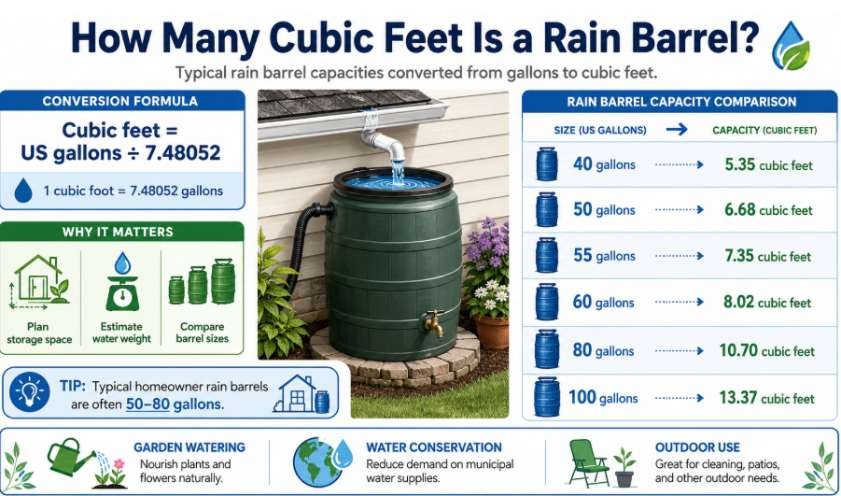
When I first looked at rain barrels, I found their gallon labels useful but incomplete. The label told me how much water the container could hold, yet it did not explain the physical space required for installation. After exploring How Many Cubic Feet Is a Rain Barrel?, I found that a typical 50- to 60-gallon model provides approximately 6.68 to 8.02 cubic feet of water capacity.
A standard 55-gallon rain barrel holds about 7.35 cubic feet. However, advertised capacity, usable water volume and exterior cubic footage are not always identical. Shape, overflow placement, wall thickness and decorative features can affect the final measurements.
Average Rain Barrel Capacity in Cubic Feet
Rain barrels are manufactured in several capacities to accommodate different gardens, roof sizes and available spaces. Compact models may hold around 30 gallons, while common household containers usually hold between 40 and 60 gallons. Larger freestanding models may provide 80, 90 or more gallons of storage.
Comparing rain barrel sizes with water tank capacity can also help homeowners understand how different storage containers meet their water collection needs.
A 30-gallon barrel contains approximately 4.01 cubic feet. A 40-gallon container holds about 5.35 cubic feet, while a 50-gallon model provides roughly 6.68 cubic feet. The popular 55-gallon size equals approximately 7.35 cubic feet, and a 60-gallon barrel holds about 8.02 cubic feet.
Larger 80- and 90-gallon containers provide approximately 10.69 and 12.03 cubic feet, respectively. These figures describe the amount of water each barrel can theoretically store rather than its complete exterior dimensions.
How to Convert Gallons to Cubic Feet
One cubic foot contains approximately 7.48052 gallons. The gallon measurements in this guide refer to the commonly used 3.785-litre gallon.
To convert a rain barrel’s capacity from gallons to cubic feet, use this formula:
Cubic feet = gallons ÷ 7.48052
For a 55-gallon rain barrel, the calculation is:
55 ÷ 7.48052 = 7.35 cubic feet
This simple formula can be used for any labelled rain barrel. If a container holds 65 gallons, dividing 65 by 7.48052 produces approximately 8.69 cubic feet. Conversely, multiply cubic feet by 7.48052 to convert the measurement back into gallons.
How to Calculate Volume From Barrel Dimensions
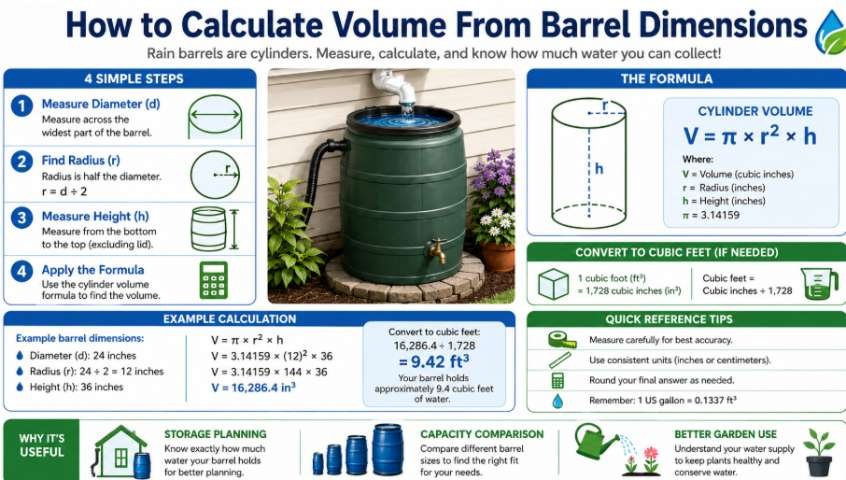
A missing or unreadable capacity label does not necessarily prevent an estimate. Interior measurements can be used with a cubic feet calculator for a rain barrel system to approximate the volume, provided the correct formula is selected for the barrel’s shape.
The same volume-measurement approach can be applied to other household containers, including estimating bathtub water capacity based on their internal dimensions.
Measuring a Cylindrical Rain Barrel
Most traditional barrels resemble cylinders. Measure the interior diameter, divide it by two to obtain the radius, and measure the usable interior height. Apply the following formula:
Volume = π × radius² × height
If the measurements are taken in feet, the result will be in cubic feet. When using inches, divide the calculated cubic inches by 1,728.
A barrel with a 12-inch interior radius and a usable water height of 30 inches has a theoretical capacity of approximately 7.85 cubic feet. Tapered sides, internal fittings and curved sections may reduce the actual capacity.
Measuring a Rectangular Rain Barrel
For a rectangular container, multiply its interior length by its width and usable height. Flat-back rain barrels may look rectangular from one side but remain rounded elsewhere. Treating such a container as a perfect box can overestimate its true capacity.
Manufacturer specifications are generally more reliable when the barrel has an urn shape, tapered walls, a built-in planter or an irregular decorative design.
Water Capacity Versus Exterior Cubic Footage
Water capacity measures the internal volume available for rainwater, while exterior cubic footage measures the overall installation, transport, or storage space occupied by the barrel. Understanding this difference also helps when determining how to size rainwater storage tanks for a particular collection area. These measurements answer different questions.
Multiplying the full exterior height, width and depth treats the barrel as a rectangular box. This calculation includes empty areas around curved walls, handles and tapered sections. Consequently, a barrel that holds 7.35 cubic feet of water may occupy a larger exterior envelope.
Additional room may be required for a stand, tap, watering can, downspout diverter and overflow hose. Maintenance access also matters because screens and fittings need occasional inspection and cleaning.
How Much Does a Full Rain Barrel Weigh?
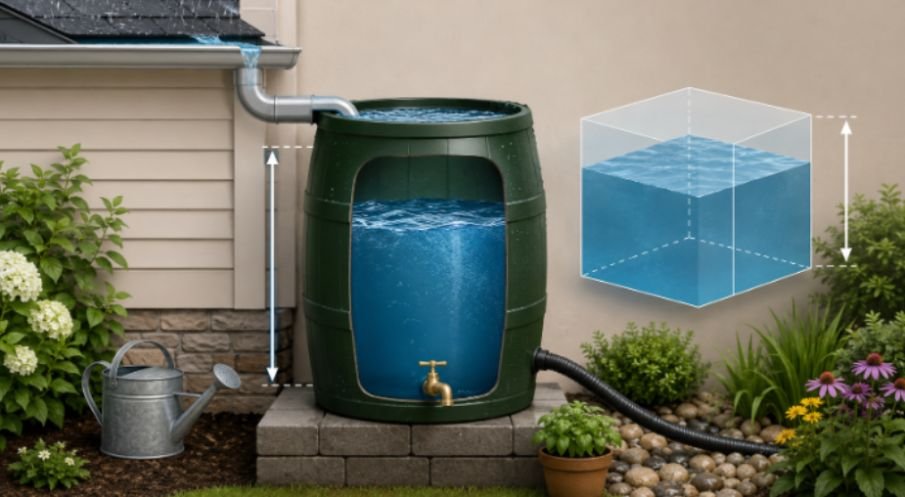
Water weighs approximately 8.34 pounds per gallon. A full 55-gallon barrel therefore contains about 459 pounds of water. After adding the container, fittings and supporting platform, the complete installation can approach or exceed 500 pounds.
A 40-gallon barrel contains approximately 334 pounds of water, while the water in an 80-gallon container weighs about 667 pounds. This substantial weight explains why every rain barrel needs a firm, stable and level foundation.
A purpose-built stand can raise the tap and improve gravity-fed water flow. However, the platform must be strong enough to support the barrel when completely full. Loose blocks, soft soil and unstable structures can shift under the load.
How Quickly Does a Rain Barrel Fill?
Even a relatively small roof can fill a barrel quickly. One inch of rainfall on one square foot of roof produces approximately 0.623 gallons of water before practical collection losses.
The basic calculation is:
Collected gallons = roof area × rainfall in inches × 0.623
One inch of rain falling on a 100-square-foot roof section can generate approximately 62.3 gallons. That is enough to fill a standard 55-gallon rain barrel during a single rainfall event.
Actual collection may be slightly lower because of gutter leaks, evaporation, wind, roof texture and the diversion of the initial runoff. Nevertheless, overflow management remains essential. Excess water should be directed away from walls, paths and foundations.
Several barrels can be linked when one container cannot provide sufficient storage. A connected system allows water to flow into an additional barrel after the first reaches its linking outlet.
Choosing the Appropriate Rain Barrel
The right capacity depends on the contributing roof area, typical rainfall, garden demand and available installation space. A small barrel may suit a shed or compact garden, while a larger landscape may benefit from multiple connected containers.
Capacity is only part of the decision. A practical model should include a secure lid, screened inlet, accessible tap and controlled overflow outlet. An opaque container helps limit sunlight exposure and algae growth. Screened openings also reduce debris and prevent insects from entering.
Collected roof runoff is generally suitable for lawns, ornamental plants and outdoor cleaning. Its suitability for edible crops can depend on roof materials, nearby pollutants and collection practices. Untreated barrel water should not automatically be considered safe to drink.
Frequently Asked Questions
1. How Many Cubic Feet Is a Rain Barrel?
A typical 50- to 60-gallon rain barrel holds approximately 6.68 to 8.02 cubic feet. A standard 55-gallon model provides about 7.35 cubic feet of rated water capacity.
2. How many gallons fit into one cubic foot?
One cubic foot holds approximately 7.48052 gallons. For quick calculations, this value can be rounded to 7.48 gallons.
3. Can half an inch of rain fill a barrel?
Half an inch of rain falling on 200 square feet of roof can produce approximately 62.3 gallons before collection losses. This is usually enough to fill a 50- or 55-gallon barrel.
4. Can rain barrels be connected?
Several rain barrels can be connected using linking hoses or a purpose-built connection kit. The final container still needs an overflow route that safely carries excess water away.
Final Takeaways
I would never select a rain barrel based exclusively on its gallon label. Converting capacity into cubic feet clarifies how much water it holds, while exterior dimensions reveal the installation space it requires.
For most gardens, a 50- to 60-gallon model provides approximately 6.68 to 8.02 cubic feet of capacity. By considering roof size, rainfall, foundation strength, overflow and intended water use, I can choose a barrel that delivers practical storage without causing avoidable drainage or maintenance problems.

Ryan Mitchell
Ryan Mitchell holds a degree in Civil Engineering and spent over a decade working in construction project estimation, where accurate volume and material calculations were part of his daily work — from concrete pours to landscaping material orders. He founded this site to bring that same precision to everyday calculations, helping DIYers, contractors, and students get fast, accurate cubic footage results without the guesswork. Ryan reviews every calculator and formula on this site for accuracy and writes guides based on real-world measurement scenarios he's encountered on job sites.


